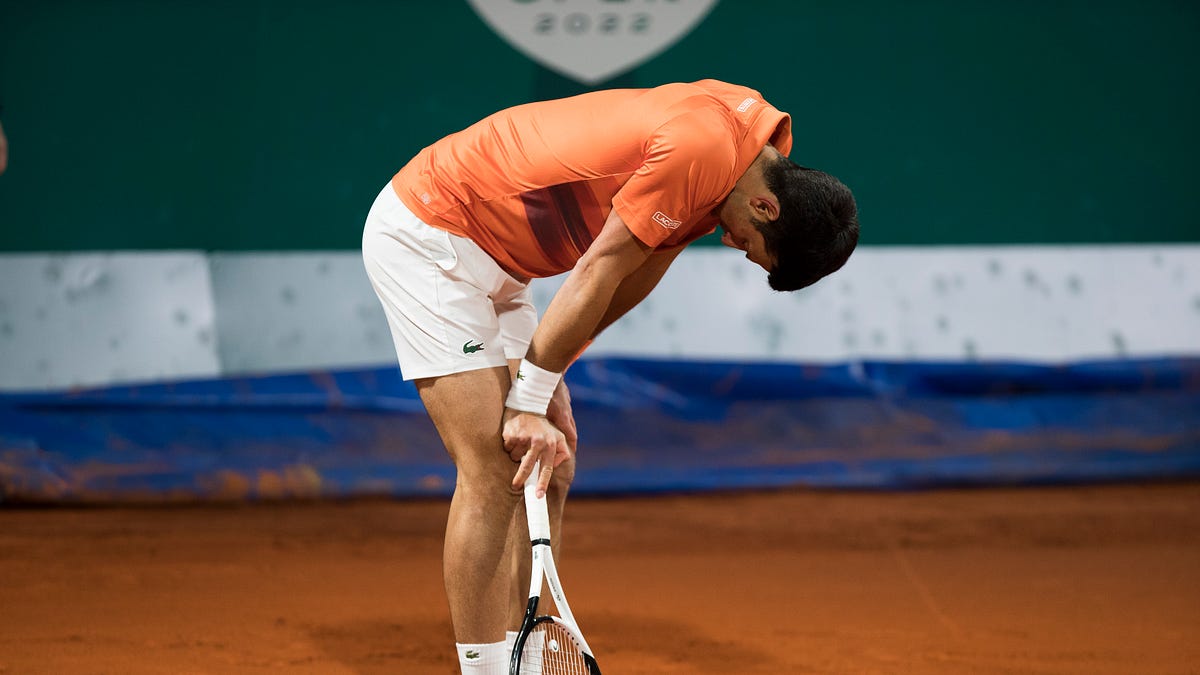
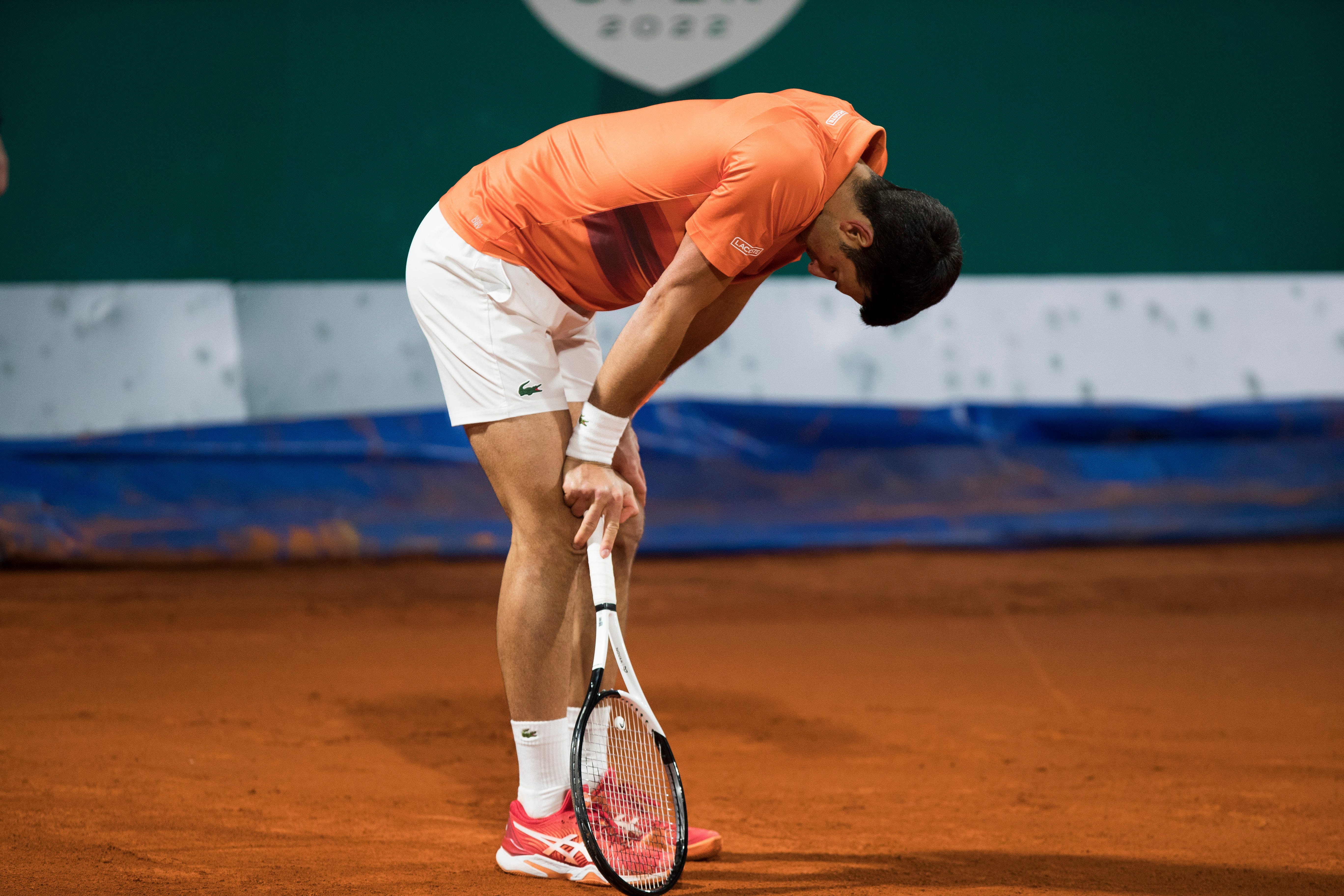
Rublev d Djokovic: 6-2, 6-7(4), 6-0

Before the Belgrade final started I was fully prepared to be writing about a Djokovic win in this analysis. Novak had seemingly found his form in multiple three setters against Djere, Kecmanovic and Khachanov pre-final. But multiple interesting things then happened today against Rublev.

Rublev adds himself to rarified air by beating Djokovic in a final:
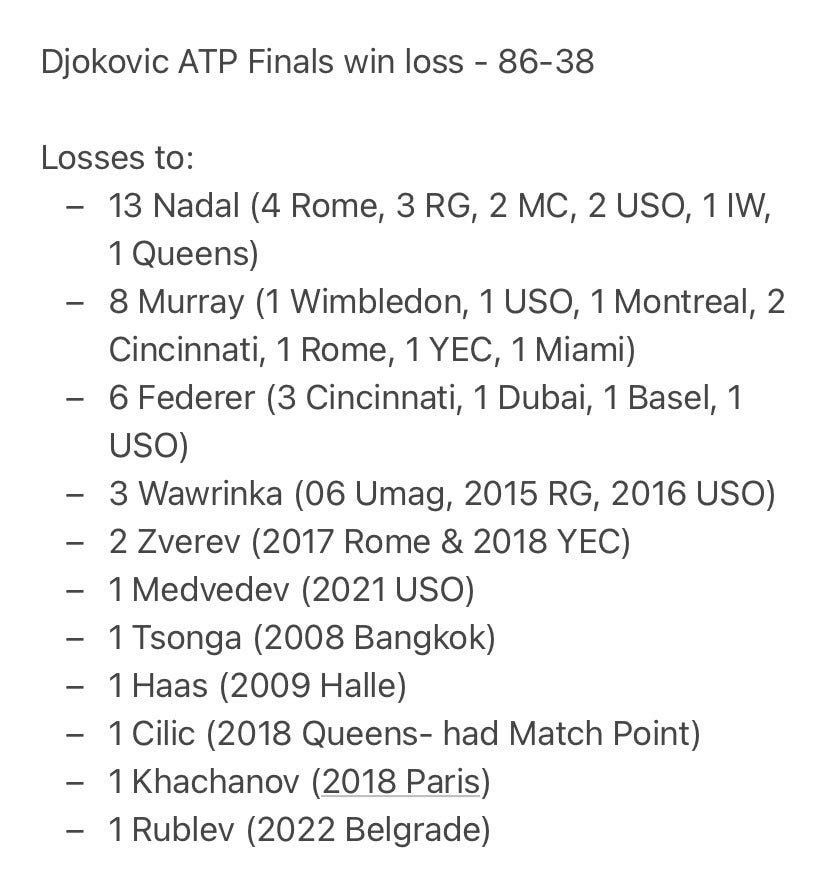
Credit @vanshv2k

Djokovic same struggle, different context

In some ways this match looked quite similar to Djokovic’s loss to Davidovich Fokina in Monte Carlo a few weeks ago. Novak was outplayed in set one with little serving advantage, gritted through a very tough set 2 with improved serving advantage, and then collapsed physically in a very one sided 3rd set. There are a few differences which I’ll come to at the end.

After his loss to Davidovich Fokina in Monte Carlo, I wrote this about Djokovic:

This is part of what has made Djokovic so difficult to beat in his 30’s more generally. An improved serve that means he often gets to breeze through his own service games and then make a nuisance of himself on return of serve. But if opponents (or Novak himself) can make Djokovic’s serving life less routine, as Fokina did this week, there are cracks that can appear on clay, especially on the back of time away from competition.

This has been a theme for Djokovic in early parts of his clay seasons for some time now post-prime. He initially struggles to find the kind of power he needs, especially off his forehand wing, and ends up playing gruelling exchanges which compound physically which then seeps into the rest of his usually excellent game.

This entire week in Belgrade followed a consistent pattern for Djokovic. The sets he lost he would really struggle to win straightforward 1st serve points.

In all the sets Djokovic played this week, including the final:

  • 1st serve points won in sets Djokovic lost: 56%

  • 1st Serve points won in sets Djokovic won: 76%

Djokovic’s career avg 1st serve pts won on clay is 71%.

Today against Rublev his 1st serve performance looked like this:

  • Set 1 (lost): 53% win

  • Set 2 (won): 73% win

  • Set 3 (lost): 36% win

I’m going to try and ‘Russian doll’ this analysis to open slightly deeper layers one at a time to unpack Djokovic’s 1st serve performance today against Rublev (and more generally).


Short vs long

Against Davidovich Fokina in Monte Carlo, Djokovic really had no reliable way to win points, either via early point aggression on the back of his serve, or in extended rallies. He lost both categories, overall and when it mattered. But Djokovic, for most of this week, had been making serious progress with his serve and serve+1 potency, hence the better 1st serve pts won numbers in those sets that he won.

Against Rublev, Djokovic had a solid 1st serve(ing) advantage in set 2, winning most of his shorter points on serve, but either had no advantage (set 1) in those shorter points or was at a disadvantage (set 3):
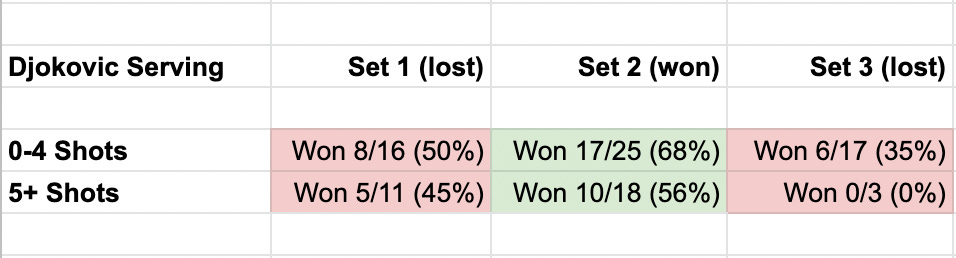
The only time Djokovic was winning the quick or short point battle on serve was set 2.

The more routine points and games Djokovic plays on serve, especially 1st serves which almost always make up the bulk of service points, the less he’s going to be pushed physically and the more the rest of his game, especially his return of serve, is allowed to shine.

Not only does greater 1st serve and serve+1 potency from Djokovic help save his energy, it also opens up more options for one of his favourite plays (especially on clay): the drop shot. Drop shots work, in part, because of the perceived threat of a more offensive shot, i.e the opponent moves back deep in the court anticipating a powerful groundstroke which frees up short court space for the player to drop shot into. The drop shot today was not successful for most of the match for Djokovic, in part because of the lack of perceived offensive threat in sets 1 and 3 (I’m making a separate piece on drop shots so don’t worry if this isn’t clear):
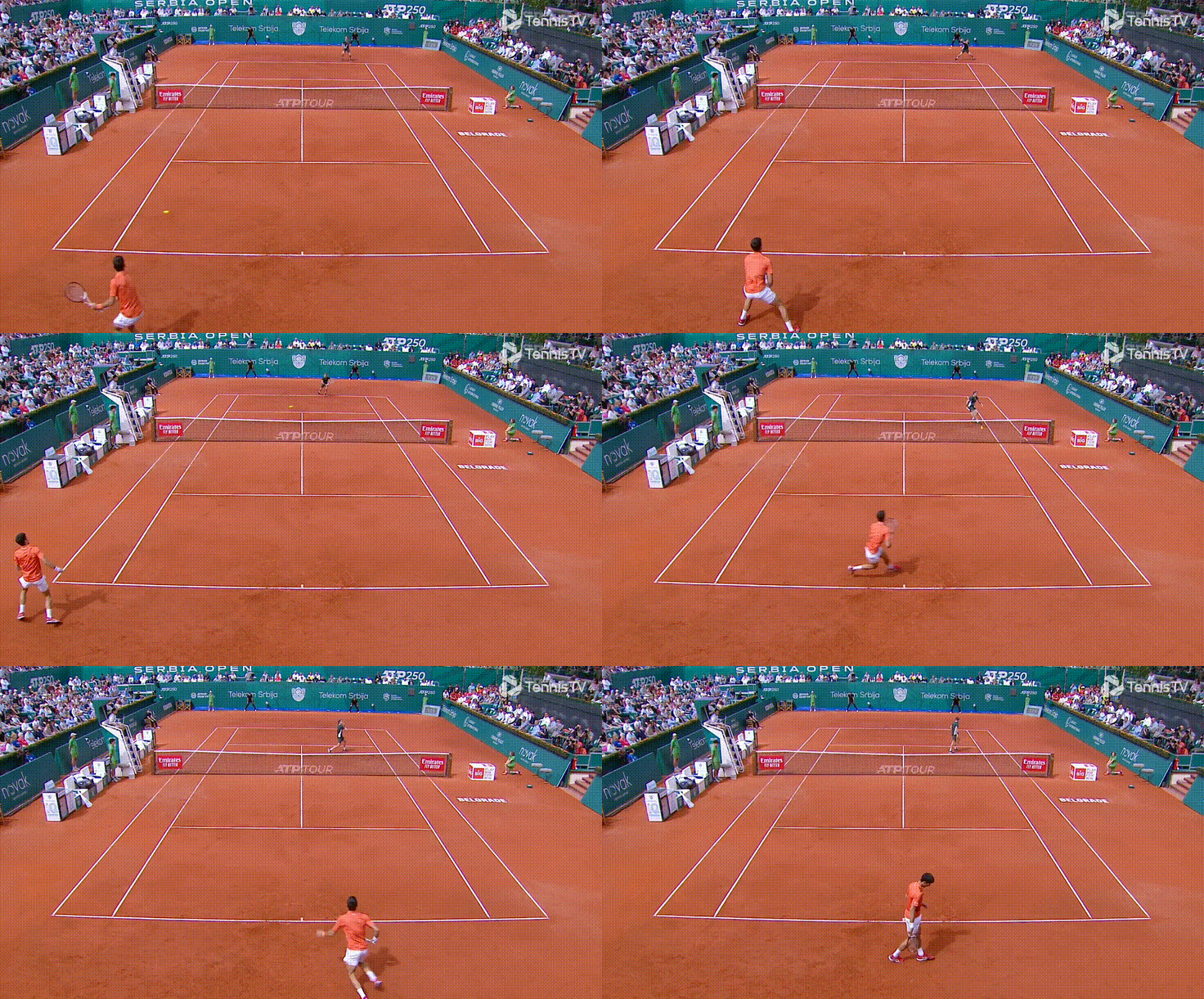
The first point of the match, with Djokovic serving, was a 20 shot rally. Djokovic had absolutely no serving advantage and bailed out with a drop shot despite Rublev being up on the baseline and getting to it in plenty of time. This happened more often than not today. The line separating a good drop shot from a bad drop shot often has plenty to do with the expected threat of the shot and the opponent’s positioning based on that expectation of offense.

Forehand potency

The next layer of the Russian doll reveals part of why Djokovic’s 1st serve performance and short point dominance fluctuated by set. And much of it comes down to his forehand, or ability to be offensive with his forehand, early in the point.

Regardless of Djokovic having arguably the best backhand of all time, he, just like 99% of top players, still has more offensive potential on his serve+1 off his forehand. And he wants to be hitting more of those follow up shots from his forehand side.
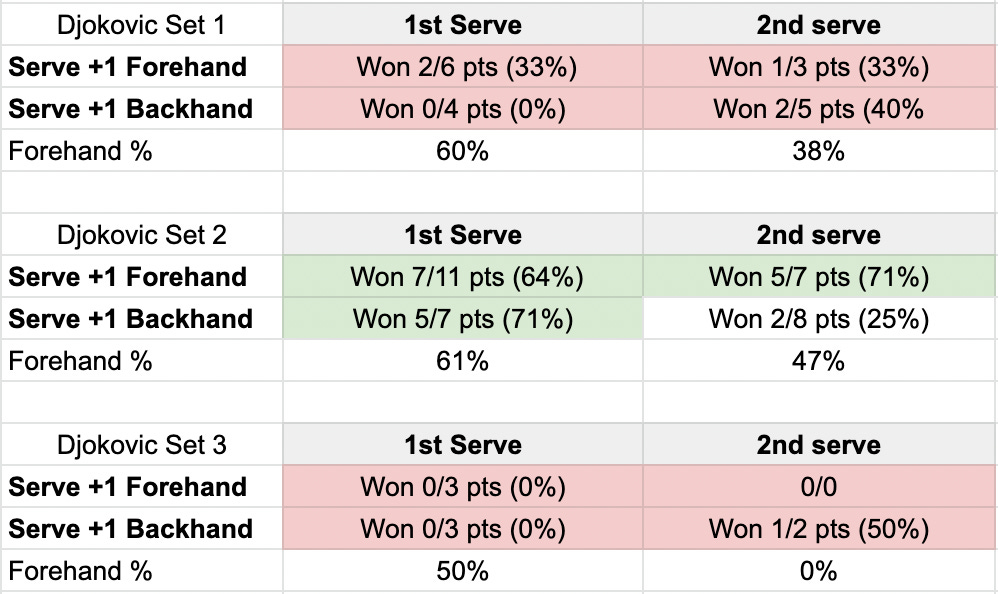
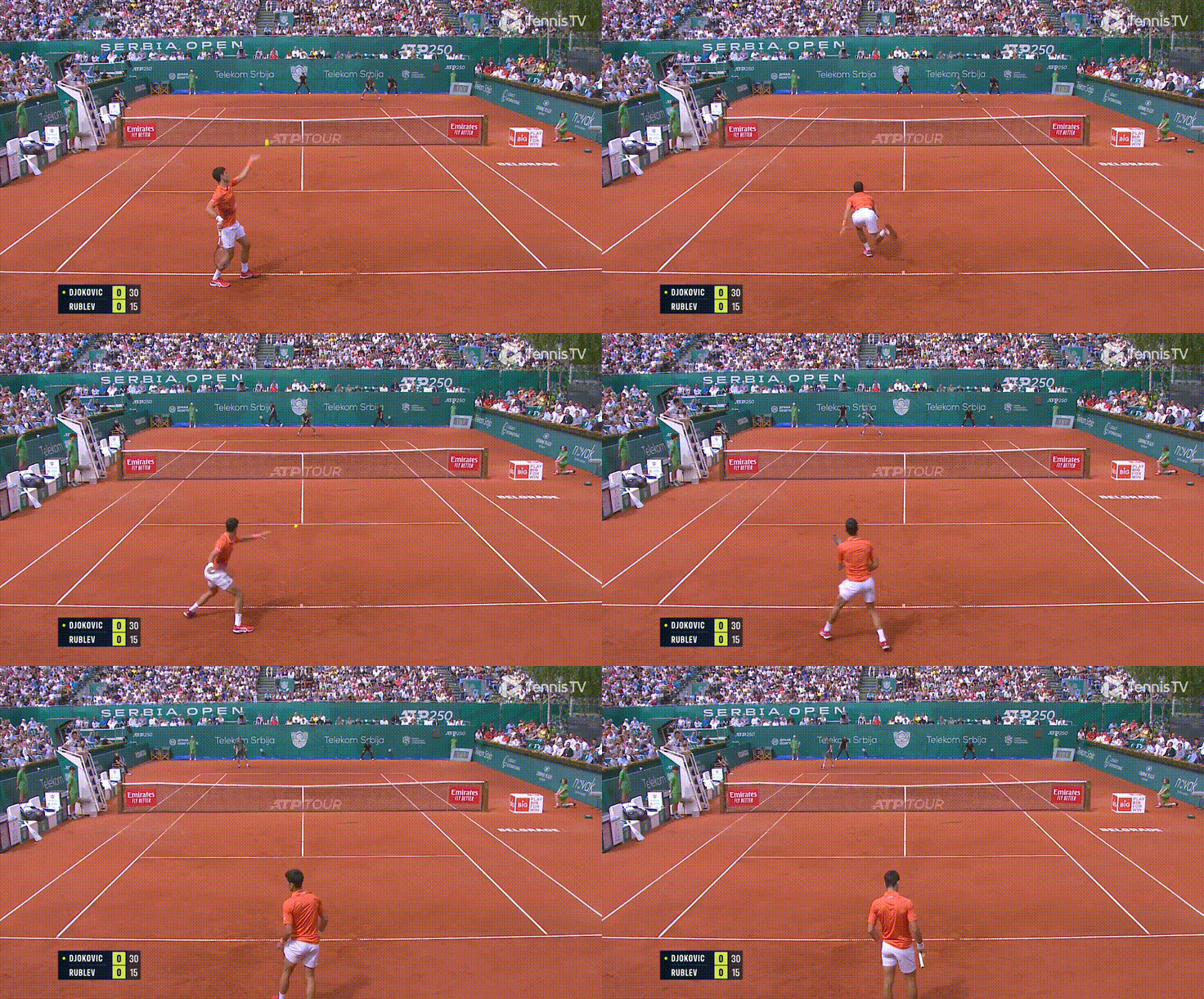
Djokovic’s better short point performance in set 2 compared to sets 1 & 3, had much to do with significantly better serve+1 forehand potency. Part of this was down to better spot serving, coaxing shorter, more attackable returns from Rublev, and part of it was just Djokovic being able to hit attacking forehands off whatever Rublev threw at him.
↑ The sets that Djokovic (in orange) has been losing on clay so far this year this have featured quite a lot of this. An ok 1st serve where he gets the mid court forehand to attack but then not doing enough on that +1. Here’s Rublev ripping his own forehand strength right onto the line on the back of a weaker than usual Djokovic forehand.

But the sets that Djokovic has won this week featured that forehand finding some serious form:
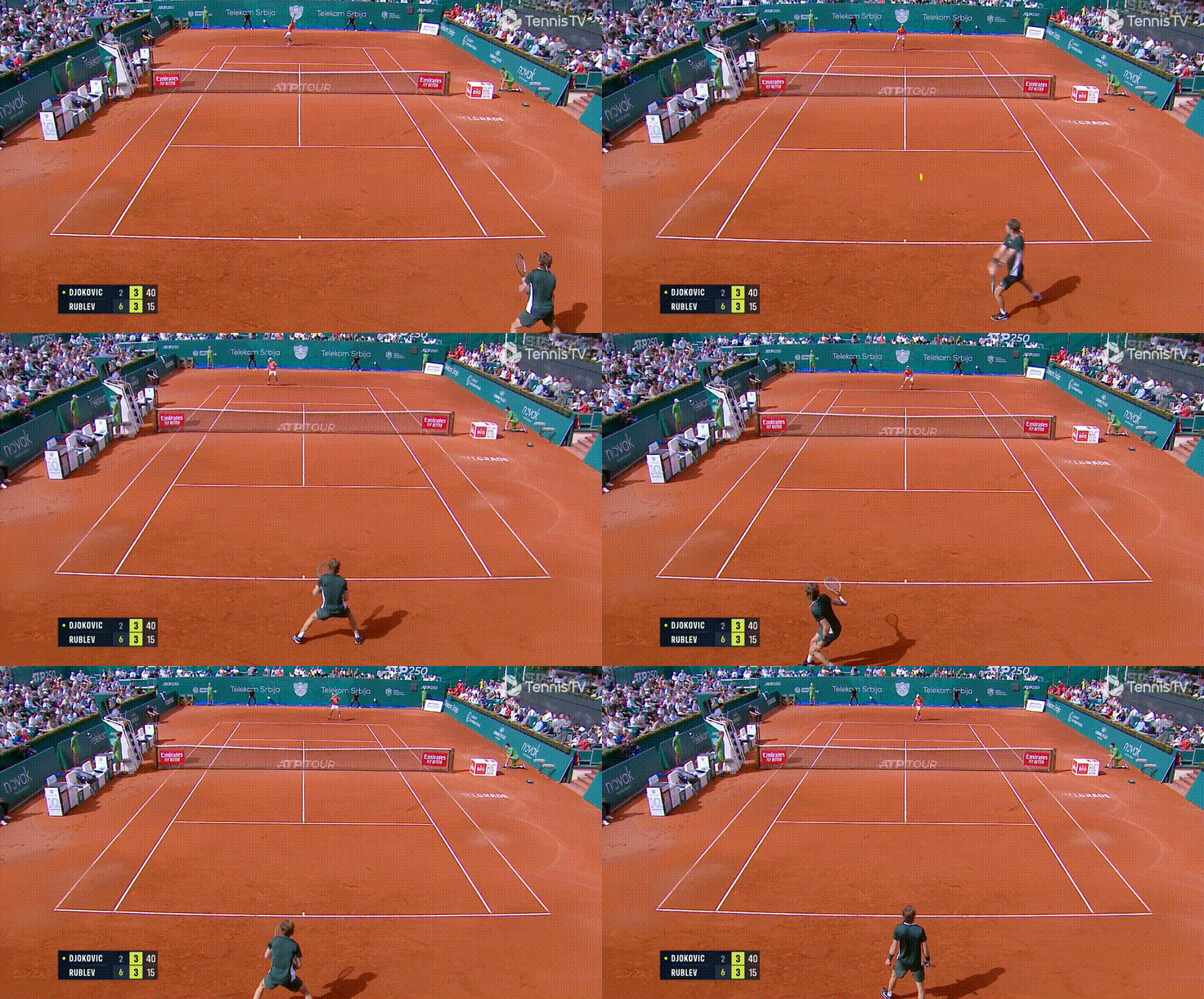
↑ Much better forehand serve+1’s from Djokovic (far end in orange) in set two. Novak experimented with some slower but kick-ier, and better placed, 1st serves high into the Rublev backhand in set 2 to try and set up the balls he wanted to attack. This time Djokovic finding great depth on his first forehand which then opens up space for his forehand winner. The more you see Djokovic dictating in short service points with his forehand, usually the better he’s playing.

Rublev’s returns

Of course part of why Djokovic struggled with his serve+1 was what his opponent was doing. Rublev returned superbly for most of the match, forcing Djokovic to play plenty of serve+1 backhands deep on the baseline, which then opened up neutral baseline rallies, or short balls, for Rublev to attack with his own forehand:
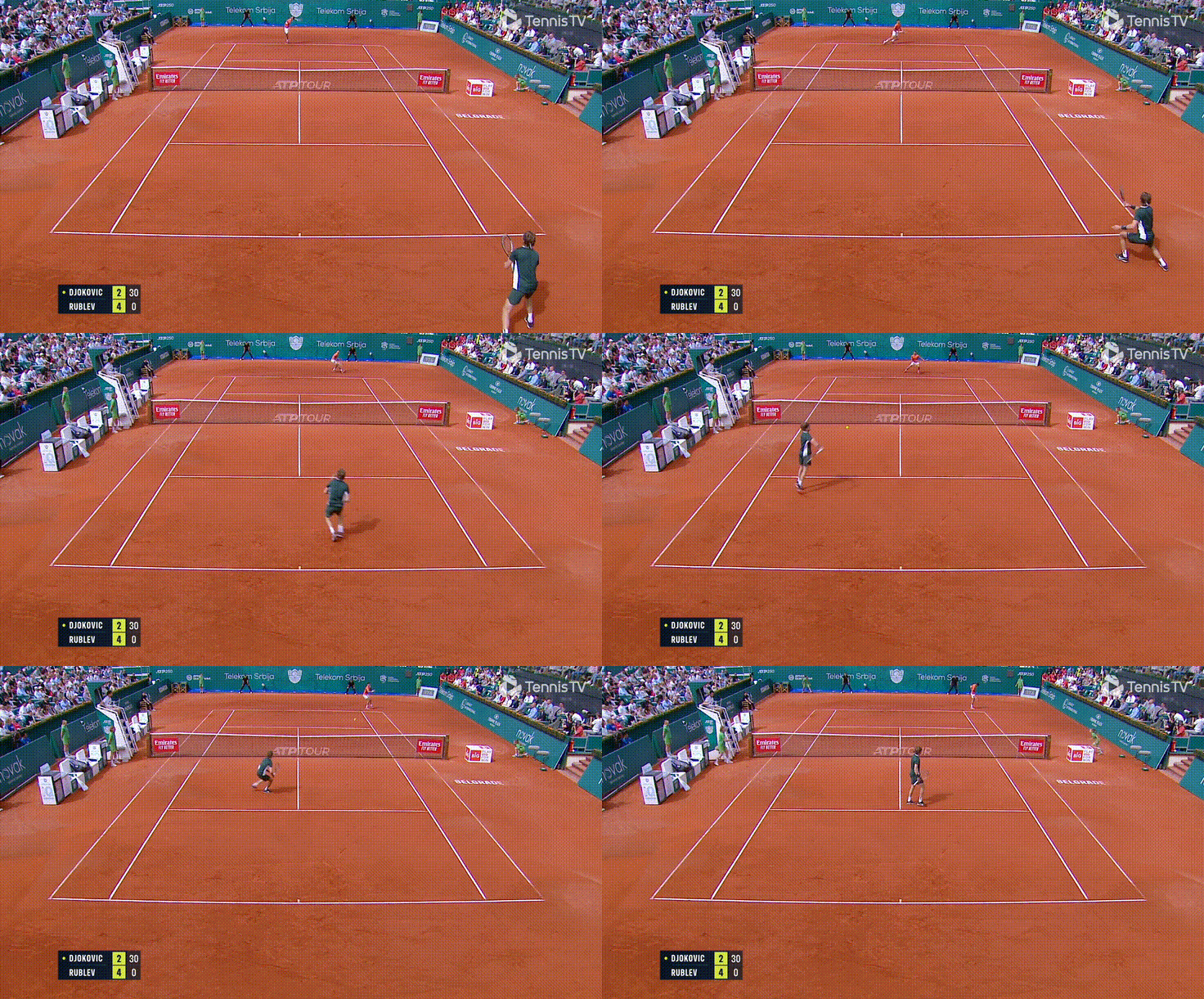
A mix of quite conservative Djokovic 1st serve placement and excellent Rublev returning was responsible for Djokovic struggling to hit his serve+1’s as well and as aggressively as he would have liked in sets 1 and 3. Rublev seemed to effortlessly set up opportunities to hit his own forehand in Novak’s service games.

On to Madrid

There were multiple other factors like there always are in long three set matches. Djokovic’s return was better in set 2 than it was in the other two sets, especially when feasting on an increasingly tired Rublev’s 2nd serves after some brutal rallies at the end of the 2nd set. And Rublev also played the pressure points wonderfully in set two, especially on his own 1st serve, despite losing that set, which extended that set to a place where Djokovic ended up exhausting himself. Unusually, despite Rublev losing that middle set, the exertion he forced out of Djokovic to win it was the decisive factor in Novak collapsing in the decider.

Djokovic’s return is sort of statically great, regardless of what surface he’s playing on, and he will get fitter and more match-tough with more matches this season. But It’s the 1st serve and the early point forehands that tend to fluctuate on clay when he’s building up to his top form. Those are the areas to watch as he completes his preparation for Roland Garros. The good news for Djokovic is that he was solving a lot of those problems, at least sporadically, in all his gruelling three setters this week. He doesn’t leave Belgrade in the same head space as he left Monaco. This time he has a body of work to build on having just reached a final.

Rublev was incredibly good all match long, in all areas. And he was the stronger physically of the two after the battle of the 2nd set. A hugely deserved title.

- MW
Twitter: @mattracquet

See you on Thursday.

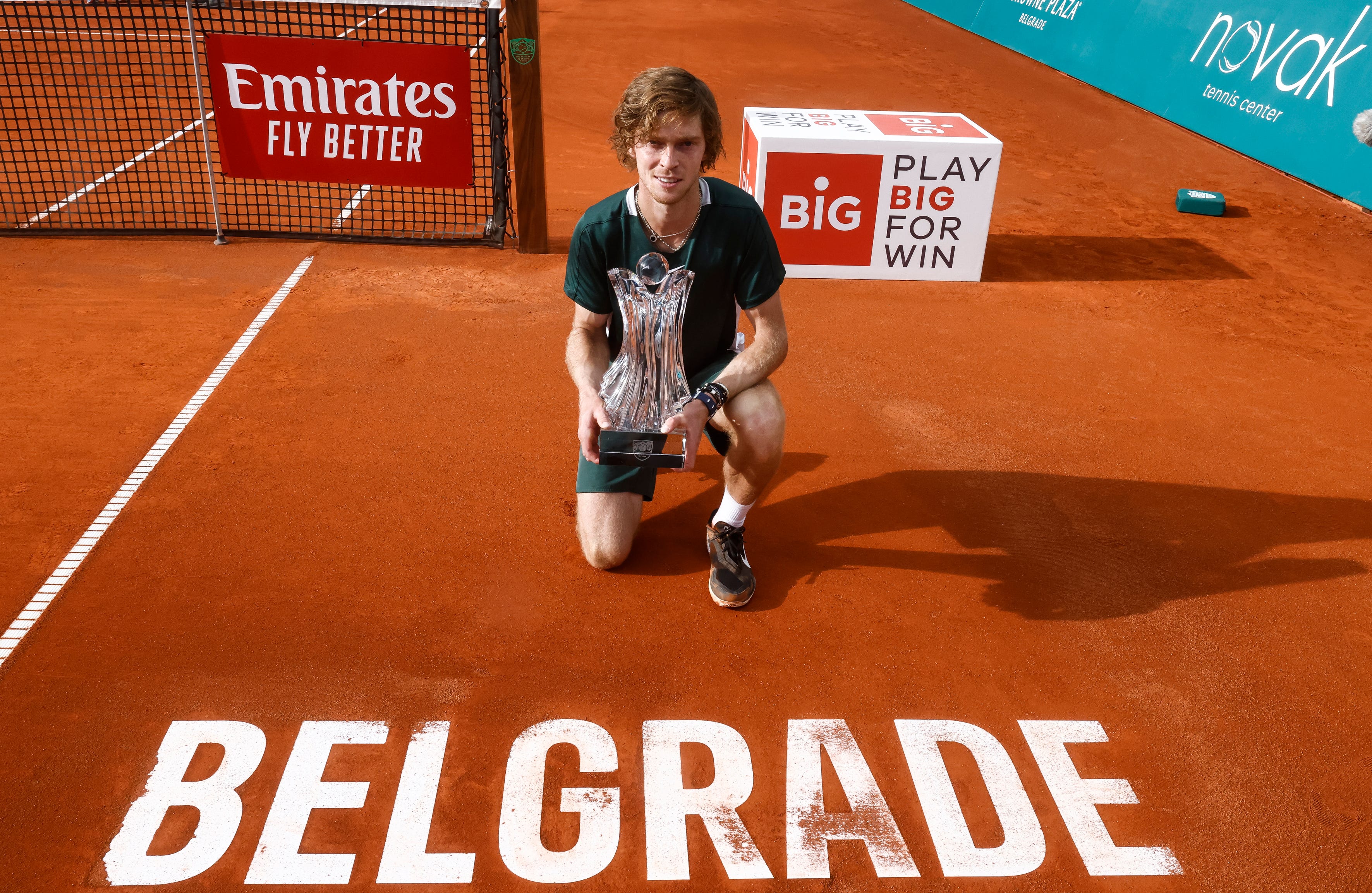
Top: Nikola Krstic/MB Media/Getty, Bottom: Srdjan Stevanovic/Getty

Most recent:

The Racquet
Wimbledon Bans Russians and Belarusians
Wimbledon has barred Russian and Belarusian players from Wimbledon due to Russia’s ongoing invasion of Ukraine. The LTA have done the same for their grass warm-up events in the UK (covering Queens, Eastbourne, Nottingham, Birmingham, Surbiton, and Ilkley). Considering those grass warm-up tournaments fall under the ATP or WTA, challenges to that decision …
Read more
The Racquet
Equal pay equal play?
L…
Read more
The Racquet
Iga x2
Świątek d Osaka: 6-4, 6-0 A complete rout. Świątek confirmed her position as the best player in the world and demonstrated the significant hard court improvements she’s made since these two players last met in 2019 (Osaka won that last and only meeting in straight sets…
Read more
The Racquet
Backhand Balance
Alcaraz d Tsitsipas: 7-5, 6-3 At the end of the first set, of what was a very high level Alcaraz vs Tsitsipas match last night, I tweeted this (don’t worry about the graphics, I’ll post better versions of them below…
Read more
The Racquet
Barty came, beat the game, and left
Ashleigh Barty, the world No.1, has retired from tennis. She is 25 years old and the holder of two out of the last three Slams, the 2022 Australian Open and 2021 Wimbledon (also winning Roland Garros in 2019). I’m so happy, I’m so ready, and I know at the moment, in my heart for me as a person, this is right…
Read more
The Racquet
Airbending In The Desert
As I write this Nadal is currently losing to Taylor Fritz in the Indian Wells final, although physical issues, Fritz (left ankle) and Nadal (left pec), are making that a pretty questionable match quality and strategy wise. So I thought I’d focus on the marquee match yesterday…
Read more
The Racquet
The 10% Chance
Yesterday Nadal came back from a double break deficit in the 3rd set against Sebastian Korda in Indian Wells. Korda served for the match twice and was broken twice by Nadal (who happens to be his idol), before Rafa won the deciding tiebreak. Nadal offered up some interesting insights in his post match presser…
Read more
The Racquet
The Big 3 Moat
I usually don’t write about the ‘Big 3’ of Federer, Nadal and Djokovic in any general sense with one recent exception. For the most part, The Racquet is about topical things happening in tennis like matchplay & play-style analysis, or bigger picture developments in the sport. At this point enough attention is already paid to those three players, often a…
Read more
The Racquet
Tennis and the veneer of etiquette
Tennis didn’t properly discipline Karolína Plíšková when she hit and broke an umpire’s chair with her racquet. Tennis didn’t properly discipline Kyrgios when he spat at an umpire and verbally abused him. Tennis didn’t properly discipline Daniil Medvedev when he…
Read more
The Racquet
Too Damn Good
Auger-Aliassime d Tsitsipas: 6-4, 6-2 An extremely easy bit of analysis. Auger-Aliassime (FAA) played flawless tennis and enjoyed a significant serve-return edge against Tsitsipas all match long. The Canadian didn’t dip once. A stunning performance worthy of his first ATP Tour title…
Read more
The Racquet
Defusing the Big Serving Counterpuncher Bomb
I’ve written a lot (probably too much) about the ‘Big Serving Counterpuncher’ playstyle that has emerged at the top of men’s tennis. Medvedev and Zverev, via huge serves and unusually good return and movement performances for their height, can both embody it, and have terrorised plenty of opponents over the last few years with it. But something interest…
Read more
The Racquet
Towering Peaks
It looks like Juan Martín del Potro will soon be leaving the sport. Outside of some Hail Mary medical interventions, Delpo says he’ll likely be bidding farewell to tennis after his matches on clay in Buenos Aires and Rio over the next two weeks. Both events will hopefully offer raucous receptions on the surface he grew up on. I hope he’s wrong about his…
Read more
The Racquet
Tennis AI
I’m going to break one of my own rules today. I’m going to write about Federer, Nadal and Djokovic in a way that makes sweeping generalisations about their playstyles. This is often my pet peeve in tennis coverage: commentators or pundits falling back on the outdated, decade-old stereotypes of Federer as effortlessly balletic, Nadal as the indomitable g…
Read more
The Racquet
The Future Of Tennis - Part 2
NB: This essay focuses on the digital and technological future of tennis more so than things like in-person tournament growth, format changes and participation. More on those soon. Part one is here, it helps but you don’t need to have read it for part two to make sense…
Read more