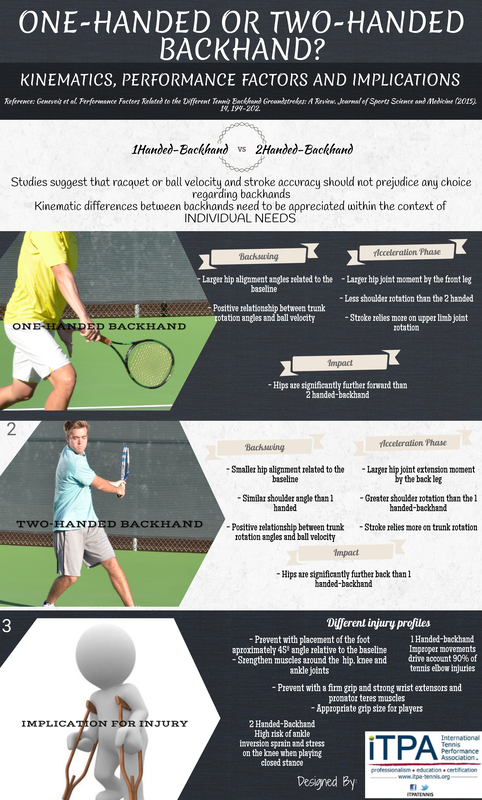
Backhand groundstrokes are gaining importance in modern tennis. 20 or 30 years ago, many players had weaker backhands than forehands. In the modern game it is very difficult - some may argue impossible - to play at the highest levels without a strong backhand. While studies and investigations have focused more on the serve and the forehand, the backhand is becoming one of the big changes in tennis over the past few decades. The one-handed backhand was almost the only option before the 1980’s, but nowadays some of the best players in junior, collegiate and professional tennis can master the two-handed backhand without losing tactical versatility. Many coaches only teach the two handed backhand as they feel it provides an advantage over a one handed backhand. This implies the need for coaches to understand the differences and performance factors of these two actions.
To prove the importance of the backhand, studies have compared factors such as ball velocity or accuracy compared to forehand results. Part of the literature doesn’t find any differences while other papers do find higher accuracy or speed with the forehand. Investigations must go further and try to study different levels and situations.
Focusing on the two variations of the backhand, literature is even more inconclusive showing few differences between one and other options. This suggests coaches shouldn’t prejudice any choice regarding which stroke to use based on speed or accuracy. Kinematic differences between each backhand needs to be appreciated and put together in the context of each individual player and their needs.
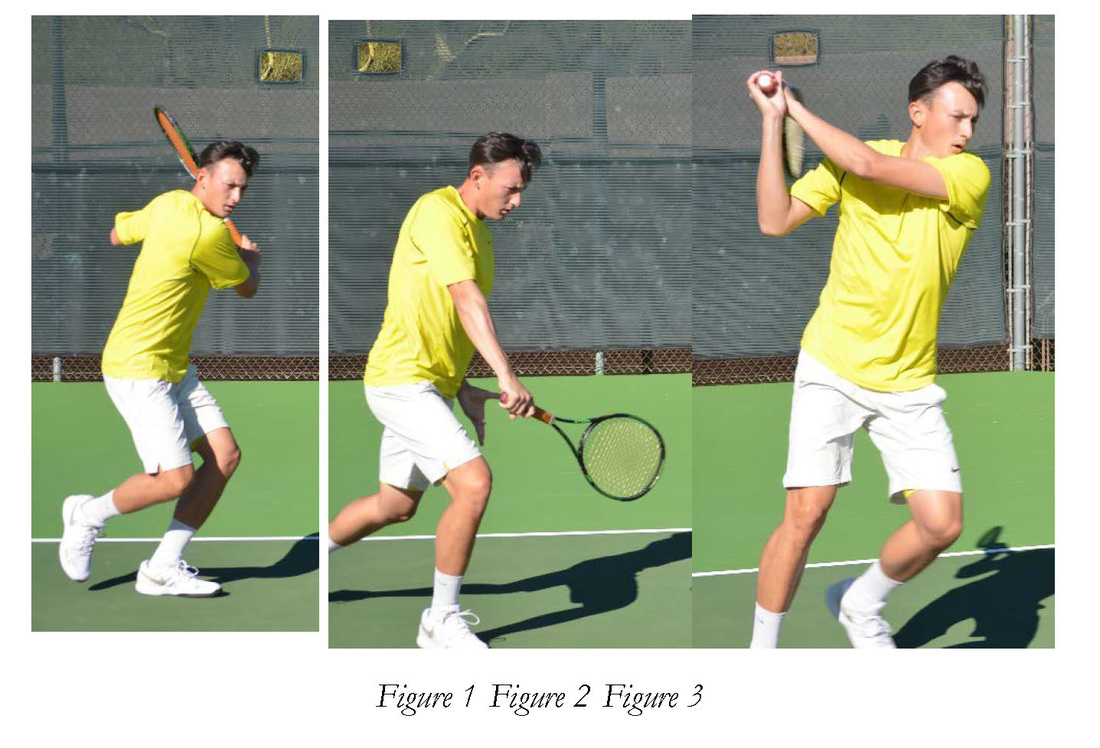
If we divide the backhand stroke into its three common phases (Ryu et al. 1988) we find:
Preparation phase: displacement of the racket backward until the initial movement of reversing the direction forward. (Figure 1).
Acceleration phase: from the start of the racket forward displacement until the ball contact. (Figure 2).
Follow through phase: from the contact point with the ball until the end of the racket forward movement. (Figure 3).
Following this classification, every phase has its differences between the one-handed backhand and the two-handed backhand.
Concepts offered above can be used as a guide to help with correct technique – whether the athlete uses a one or two handed backhand. Bad execution of strokes is a major reason for many injuries. Different kinematic patterns we’ve seen offer different injury profiles which we will go over next.
As the one handed backhand relies more on upper-body rotation instead of trunk, injuries are many times seen in elbow and wrist related problems. A correct transfer of the momentum from proximal to distal segments (from trunk to hand) is essential in preventing these problems, as well as a specific strengthening program for wrist extensors and pronator teres. Adequate grip size selection based on age and hand size can also help.
Regarding the two-handed backhand, the direction of the foot relative to the net when playing a closed stance can influence the risk of ankle inversion sprain and heightens the stress on the knee. The authors of this one review recommend placement of the foot approximately 45º angle relative to the baseline to facilitate body rotation and decrease stress on the hip, knee and ankle joints. Strengthening programs specifically for these areas could also help and prevent injuries.
In conclusion, backhand selection shouldn’t be conditioned by differences in velocity, speed or ball accuracy, but based on kinematic factors, coordinative abilities and general skills of the player. Knowledge of correct execution and specific movement patterns and strokes help to limit injuries and will allow for more effective prevention programs and preparation workouts.
References:
Genevois, C. Reid, M. Rogowski, I. Crespo, M. Performance Factors Related to the Different Tennis Backhand Groundstrokes: A Review. Journal of Sports Science and Medicine. (2015). 14, 194-202.