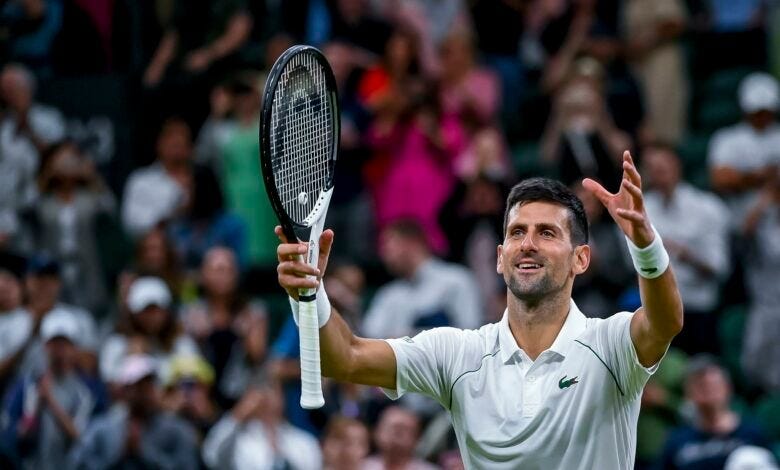
Novak Djokovic is into the 11th Wimbledon semifinal of his career.
Sure, it wasn't a certainty - going down two sets to love against Jannik Sinner wasn't the best way to kick off his quarterfinal and left many of his fans squirming.
But for those watching from an unbiased perch, there felt little for the Serb to be worried about from that position. Many thought back to his matches against Musetti and Tsitsipas at last year's French Open and had a good idea of what to expect. Djokovic would go for a toilet break, would return to the court in "lockdown mode" and would gift the Italian nothing.
I'd like to focus on one aspect of Djokovic's so-called "lockdown mode" for this article - his immense serving. Call it a sort of coach's corner piece as we look to learn from acthe legend's serving performance.
Djokovic's Serving Performance
Djokovic was able to grit out return game after return game following the first two sets against Sinner, of that there is no doubt and it did make a difference to the outcome of the match. But it wouldn't have meant diddly if he'd continued to hold serve 70% of the time.
Well for the last three sets, Djokovic held his serve 100% of the time. One stat improvement sticks out above all the rest - Djokovic's ability to win first-serve points.
Let's break it down.
Comparisons Between Sets
In the first two sets, Djokovic was able to land his first-serve 58% of the time and won 69% of these points. That's 24 points won on first-serve of 60 total service points (40%).
In the final three sets, Djokovic landed his first-serve 70% of the time and won 92% of these points. That's 46 points won on first-serve of 71 total service points (65%).
More first-serves landed, a higher-percentage of first-serve points won.
Lethal.
Was it all because of the first-serve in isolation though?
Here are the amount of points where Novak's first-serve was good enough to affect the outcome of the point i.e. an ace, an unreturned serve, a serve that sets up an effective +1 or +2 or even a serve that sets up an easy ball that Novak misses (the latter happened twice throughout the match).
In the first two sets, Djokovic hit a good enough first-serve to end the point 19 times of 60 total service points (32%).
In the final three sets, Djokovic hit a good enough first-serve to end the point 39 times of 71 total service points (55%).
An insane leap that was basically winning Djokovic every other point. What happened?
Service direction didn't really change throughout the match. Djokovic went wide a little less often in the ad-court but it wasn't a significant change.
No tactical change per se no - watching the match, there obviously something different as chalk began to dust up from the court far more frequently.
Djokovic just began to hit his spots a lot more reliably. That's it. He just served better.
... No, I needed more (there is a lesson here, bear with me).
How To Hit Your Spots On Serve
Breaking down Djokovic's serve further, there are some interesting takeaways on some of his serves.
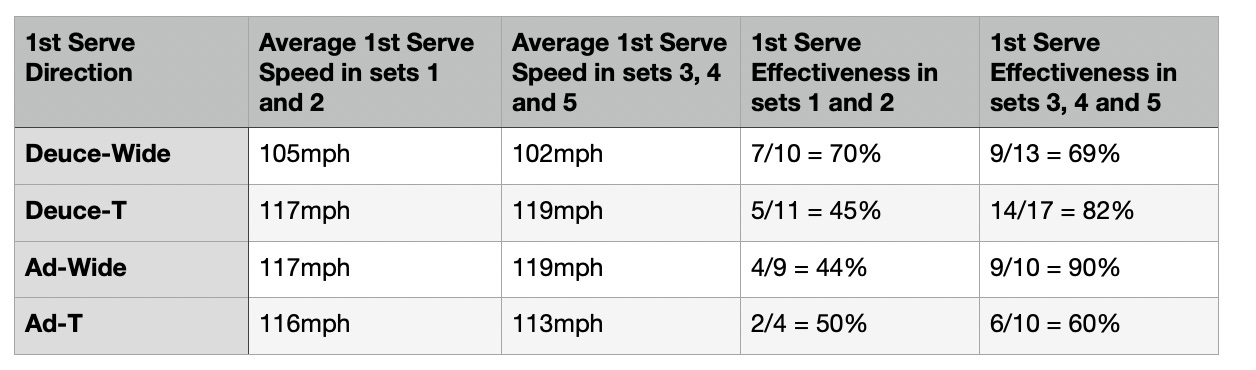
Numbers = thinking so here's the low-down.
The deuce-wide serve often has plenty of slice on it. To hit your spots on the wide-serve, you may need to hit further up the box. We can assume the speed didn't really change on this serve as there was one flat serve that skews the service speed in the first two sets plus the effectiveness of the serve didn't really change - Novak was hitting his spots on the wide-serve to the same level throughout the entirety of the match.
The ad-T serve is a little bit of an outlier but we'll discount it based on their only being four first-serves in this direction in the first two sets (small sample size).
As for the other two first-serves, the ad-wide and the deuce-T... there is a big enough sample size on these serves to say confidently that Djokovic improved his performance on these two serves markedly.
Djokovic's Teachings
When Djokovic stepped up to hit these serves, placement had to be in the back of his mind. These are generally flat, pacey serves that if sent slightly to the left can be redirected with interest, particularly against a player like Sinner.
Unlike the wide-sliding serve, it's not necessary to ease up on the serve to hit further up the box. As a right-hander, the serve is unlikely to swing away from the opponent so prioritising pace over angle for the ad-wide serve is still very important.
It seems like a small boost but in hitting his spots on the deuce-T and ad-wide serves more often, Djokovic actually increased his service speed from 117mph to 119mph. These numbers don't even tell the whole story...
Djokovic topped 120mph on the deuce-T serve nine times in the final three sets compared to just twice in the first two sets.
A similar story for the ad-wide serve with a 115mph outlier dragging Djokovic's average service speed down.
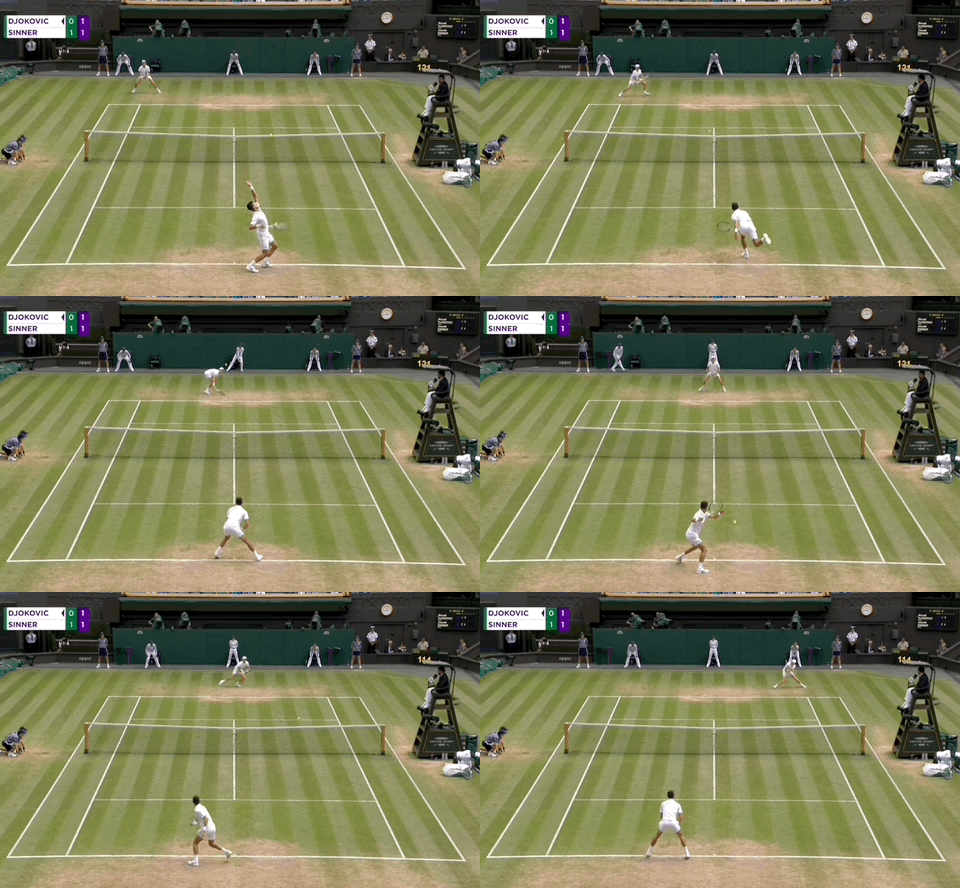
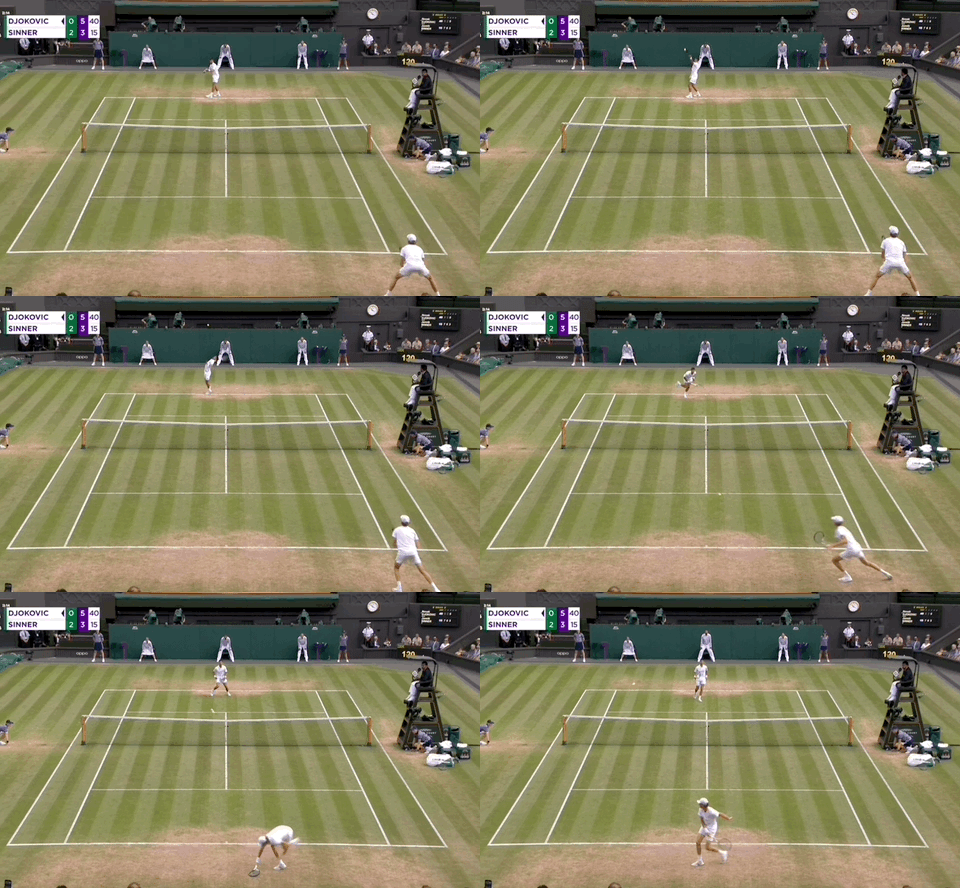
That's the lesson. If you're looking for accuracy on a flat serve, don't slow down the racket. The faster you swing, the more control you impart on the ball. It really is true what they say - stay loose and swing freely and your control of the ball will likely increase.
If you've got your back against the wall in the future - maybe you're down two sets to love against a Diego Schwartzman type at your local tennis club - and you know you need to find some well-placed flat serves, don't feel like you need to sacrifice pace for placement.
Swing faster to hit your spots.