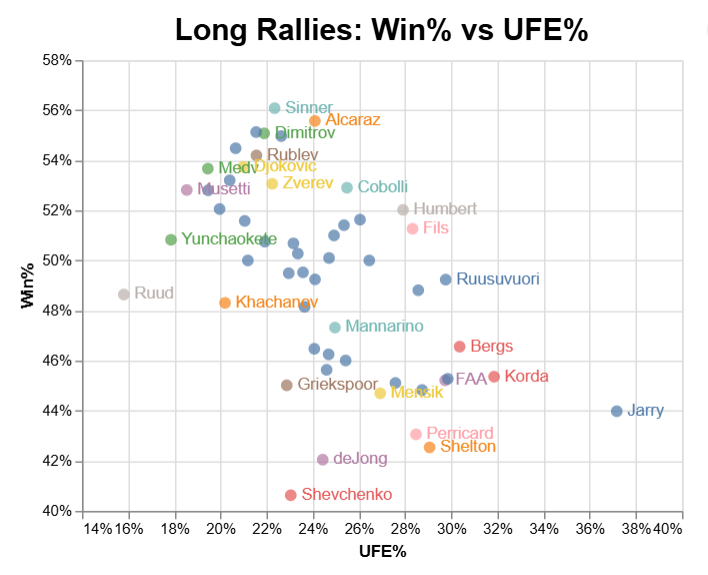
Carlos Alcaraz making it look easy Tennis people increasingly talk about “shot tolerance.” What does it mean? There’s no standard definition. A Google summary settles on this: “a player’s ability to get to and return a given ball as desired.” Other definitions focus more on avoiding unforced errors: How long can a player stay in a rally without making a mistake? I think of it like defense, in a very broad sense. Usually when we talk about defensive skills, it’s a lunging Andy Murray, recovering balls that nearly end the point, like big serves or would-be winners. In pro tennis, though, nearly every shot has an offensive component. That is to say, almost every shot tests the defensive skill–or resourcefulness, or shot tolerance–of the other player. A heavy Jannik Sinner forehand right at the feet, a Novak Djokovic backhand angled wide: Can you handle that and keep the point alive? Another way to conceptualize shot tolerance is to imagine a win probability stat that updates with each shot. When Sinner hits that heavy forehand, his chances of winning the point against an average opponent increase to, say, 70%. A player with high shot tolerance will somehow save more than 30% of those points. A player with low shot tolerance will fail to get as many back (or hit weaker replies), and he’ll win fewer than 30% of those points. We don’t have that all-knowing win probability stat, so we can’t measure shot tolerance so directly. Because the concept is fuzzy, I don’t imagine we’ll land on a fully satisfying way to quantify shot tolerance. But it’s worth the attempt, and it will help us explain how Rotterdam champ Carlos Alcaraz works his magic. Long rallies Start with the basics. Players with high shot tolerance should win more long rallies, right? I drew the line at six shots, including rallies where the sixth stroke was an unforced error. I don’t want to muck things up by mixing surfaces, so we’re sticking with hard courts today. Based on Match Charting Project data, here are the men who have won the most of these “long” rallies on hard courts since the beginning of 2024: Player 6+ W% Jannik Sinner 56.1% Carlos Alcaraz 55.6% Alex de Minaur 55.1% Grigor Dimitrov 55.1% Joao Fonseca 55.0% Learner Tien 54.5% Andrey Rublev 54.2% Novak Djokovic 53.7% Daniil Medvedev 53.7% Alejandro Tabilo 53.2% The top of the list is as expected: Sinner and Alcaraz can outlast most opponents and have the ability to end the point. Fonseca and Tien probably won’t sustain these numbers, since they haven’t played the same level of competition as the others. Tabilo’s position is dicey, too, as we don’t have as many charted matches of his. Alexander Zverev is next on the list, if you’d like to promote him in Tabilo’s place. Complicating matters is how these points end . The goal isn’t to sustain the longest rally possible. At some point shot tolerance gives way to power and calculated risk-taking. Some players are particularly strong on the pure shot-tolerance side of things, avoiding unforced errors in these long rallies: Player 6+ Rally UFE% Casper Ruud 15.8% Bu Yunchaokete 17.9% Lorenzo Musetti 18.5% Daniil Medvedev 19.5% Alex Michelsen 19.5% Frances Tiafoe 20.0% Karen Khachanov 20.2% Alejandro Tabilo 20.4% Learner Tien 20.7% Novak Djokovic 21.0% There’s some overlap between the two lists, but not much. Sinner’s error rate is better than average, at 22.3%, while Alcaraz’s is worse, at 24.1%. In the Rotterdam first round against Botic van de Zandschulp, Alcaraz committed unforced errors on 40% of points that reached the sixth shot. He still somehow won half of the long points. There’s a relationship between win rate and error rate on long points–there pretty much has to be, since errors are points lost. But error rate explains less than 30% of the variation in long-rally winning percentage. Alcaraz, for one, breaks the mold by committing a lot of errors yet winning the majority of the points: Alcaraz’s errors don’t usually expose a weakness of shot tolerance. They reflect a gamble. (Sinner is similar, though his groundstrokes are so imposing that he can do more damage with less risk.) We can’t just count errors and create a shot-tolerance metric, but we also don’t have the ability to ask players what they were thinking when they attacked every shot. Isolating shot tolerance requires a different approach. Accepting errors Let’s shift from points to shots. Again for hard-court matches since the start of last season, I tallied each player’s baseline strokes starting from the fourth shot of each rally. Shot tolerance is useful for serve returns and plus-ones, but those shots are so often out of a player’s control. And since most points are short, returns and plus-ones end up dominating the data. To get a sample of shots th