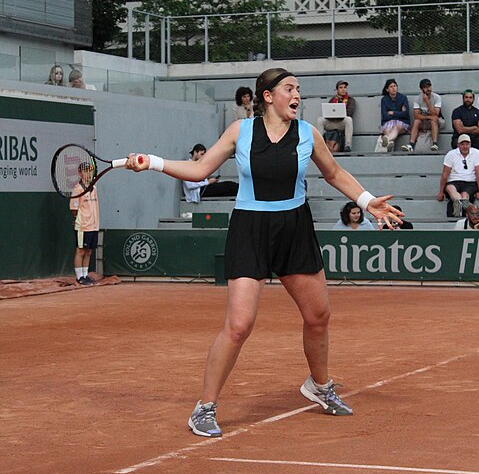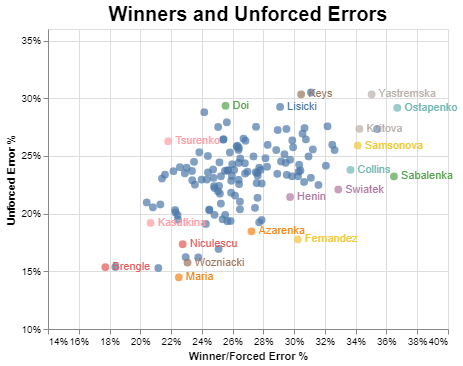
Also today: Deciding tiebreaks, a MCP milestone, and assorted links. Jelena Ostapenko in 2023. Credit: Hameltion If you’ve ever spent five minutes watching Jelena Ostapenko play tennis, you know she’s as aggressive as it gets. She swings for the fences and sometimes knocks them over. Get her on a hot streak, and opponents can only hope its ends before the handshake. When she’s off her game, spectators in the first few rows duck for cover. What you might not realize is just how aggressive she is. A few years ago I tuned Lowell West’s Aggression Score metric so that the numbers fell in a range between 0 and 100. In theory, 0 is maximally passive; 100 is go-for-broke, all the time. Ostapenko’s career Aggression Score in rallies is 175. This sort of extreme style lends itself to all sorts of narratives. She can beat anybody, any time, as she showed when she won the 2017 French Open as an unseeded player, and again last year when she upset Iga Swiatek at the US Open–her fourth win in as many matches against the Pole. That makes her a perennial dark horse pick at majors. Even though she hasn’t reached a semi-final since 2018, neither Iga nor Coco Gauff–who exited the Australian Open after an Ostapenko barrage last year–would like her find her in their section. (Sorry Iga: Guess who you might face in the quarters !) Hyper-aggressive players also appear to be works in progress. Especially early in Ostapenko’s career, commentators would talk about her stratospheric potential if she could only improve her footwork, or play a bit more “within herself.” That is, not quite so many winners, not quite so soon, more point construction, fewer unforced errors. But players rarely change much, and as they age, they are more likely to become more aggressive, not less. The Latvian is now 26 years old, beginning her ninth year on tour. What you see is what you get. What you get, it turns out, is a lot of close matches. Ostapenko played 30 three-setters last year, including four in a row to reach the Birmingham final and another four straight to start the US Open. Alona’s apotheosis came at Indian Wells, when she faced fellow super-aggressor Petra Kvitova in the third round. Both women tallied exactly 75 points; Kvitova won, 0-6, 6-0, 6-4. Tennis ball fuzz could be seen floating over the desert for days afterward. That particular scoreline was an oddity, but the margin of victory was not. Ostapenko’s tight matches are not a result of streakiness, flightiness, or anything of the sort. They are an unavoidable function of her game style. It’s almost impossible to hit lots of winners without also committing piles of unforced errors. (We’ll come back to that.) When you do both in such numbers, you personally account for a substantial majority of point outcomes. The winners and errors (very approximately) balance each other out, and unless your opponent does something remarkable–or remarkably bad–with the limited influence you leave her, you end up winning about half the points played. No one takes the racket out of an opponent’s hand like Ostapenko does. Once the return is in play, the Latvian ends nearly two-thirds of points herself, with a winner or unforced error, or by forcing an error. No one else comes close. Drawing on Match Charting Project data, I’ve listed the active players who end the most rallies: Player RallyEnd% Jelena Ostapenko 65.9% Petra Kvitova 61.6% Madison Keys 60.8% Liudmila Samsonova 60.0% Camila Giorgi 59.7% Aryna Sabalenka 59.7% Veronika Kudermetova 57.5% Danielle Collins 57.5% Ekaterina Alexandrova 57.2% Ons Jabeur 56.8% Peyton Stearns 56.5% Caroline Garcia 56.2% Naomi Osaka 56.2% Varvara Gracheva 55.0% Iga Swiatek 55.0% Here’s another way to look at Alona’s extreme position on this list. The only other woman to grade out so far from 50% is Madison Brengle, who ends fewer than 34% of rallies. Ostapenko’s power turns the rest of the tour into Brengle. Give and take Ending even 57% of points on your own racket requires a lot of big swings. When you aim for a line, you might feel confidence about your chances, but you are taking a risk. A few players, like Swiatek, can generate winners without paying the unforced-error penalty, but that takes an unusual combination of patience and power that most players do not possess. The 66% of points that Ostapenko ends on her own racket divides into roughly 37% winners (and forced errors) and 29% unforced errors. That’s worse than Aryna Sabalenka, who hits nearly as many winners with only a 23% error rate, but compared to the tour as a whole, the ratio is a solid one. For every unforced error she commits, she ends 1.25 points in her favor. Average among players represented in the Match Charting Project is 1.16, and the true mean is probably lower than that, since the MCP is more heavily weighted toward the best players. The ratio var