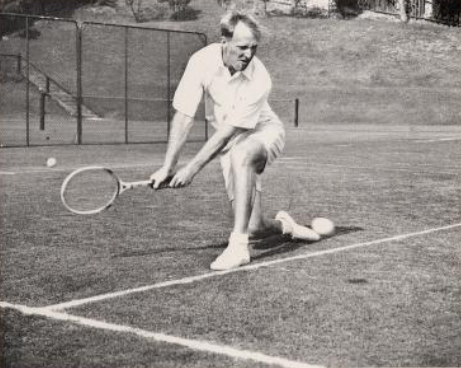
John Bromwich at the 1951 New South Wales Championships. Credit: Mitchell Library, State Library of New South Wales In 2022, I’m counting down the 128 best players of the last century. With luck, we’ll get to #1 in December. Enjoy! * * * John Bromwich [AUS] Born: 14 November 1918 Died: 21 October 1999 Career: 1935-54 Played: Ambidextrous (right-handed serve, left-handed forehand, two-handed backhand) Peak rank: 3 (1938) Major singles titles: 2 Total singles titles: 56 * * * No one has ever played tennis the way that John Bromwich played tennis. How many people have ever so clearly stood apart? There are only so many ways to serve, or hit groundstrokes, or manage the tactics of a match. And when a player with unusual technique starts to enjoy some success, others quickly follow. Not with Bromwich. He was impossible to imitate. Anyway, no coach would have allowed it. Bromwich (pronounced “brummage”) picked up an adult-size racket when he was too small to lift it with one hand. Like Chris Evert a few decades later, he compensated by using both hands. At the beginning, it wasn’t just a two-handed backhand: He hit with two hands on both sides, and he hit double-handed serves and overheads. As the Australian got bigger and stronger, the second hand came off the racket. But the unorthodox style remained. While he was a natural lefty, his improvised two-handed serve had been a righty delivery. He continued to serve and hit overheads from that side. His service was never intimidating, and it would be misleading to call his overhead a “smash”–it was accurate but not hard-hit. You would think that for a southpaw, hitting a right-handed serve and a two-handed backhand would be sufficiently unique. Not so. Bromwich was a true artist with a tennis racket. Roy Emerson, a big fan, said, “[H]e could make the ball talk.” His equipment was optimized for his precision game, and it was nearly as unorthodox as his strokes. He played with a very light racket, less than 12 ounces, compared to the usual 14 ounces for a wooden racket. Some of the weight was saved by a grip almost as slim as that of a golf club. For added control, Bromwich used strings so loose that friends called his rackets “onion bags.” Bromwich’s double-hander was unorthodox even compared to other two-handers. He got down so low to hit the shot that after a match, his right knee was often green, smudged from the turf. Taken together, the unusual package of technique and equipment was deadly from the baseline. Jack Kramer, the great practitioner of high-percentage tennis, considered that serve-and-volley was almost always the smart move–unless one of a select handful of players were standing across the net. Bromwich was one of them. He rarely approached the net in a singles match–and there was another paradox. He was one of the great doubles players of all time. With Adrian Quist , he held the Australian national title from 1938 to 1950, and he won Wimbledon doubles twice, with two different partners. Kramer chose Bromwich and Don Budge as his doubles team for a hypothetical all-time, all-Universe Davis Cup competition. “Anytime you had Bromwich in your forecourt, you should win.” * * * The subtle, sophisticated Bromwich style sounds like the sort of game that would suit a veteran. He did indeed play well into his thirties, scoring shock upsets over the likes of Tony Trabert and Lew Hoad in 1954 after his first retirement failed to stick. But John was a star from a young age. He was part of a doubles team that stretched Fred Perry and his British Davis Cup partner to five sets when he was only 16. At 18, he reached the finals in both singles and doubles at the Australian Championships. Aussie fans must have wondered what was happening with their sport. The man who beat Bromwich for the 1937 title was Viv McGrath, another early exponent of the two-handed backhand. A few months later, Bromwich made his first trip abroad. He took a set from Budge in a Davis Cup Interzonal match, even as the Aussies were swept by their American hosts. The team from Down Under was odd enough to earn a mention in Time magazine: When Australia’s Vivian McGrath appeared on the international tennis scene four years ago, experts could not have been more astonished had he been a kangaroo. For all backhand shots McGrath held his racket with both hands. … As a freak tennis player, Australia’s John Bromwich makes McGrath’s methods look banal. … Like 21-year-old McGrath, Bromwich is not only a freak but a prodigy. The Australians would reach the Challenge Round in 1938. The 19-year-old Bromwich once again took a set from Budge, who was then in the middle of winning the Grand Slam. Bromwich and Quist had just lost the US national doubles title, but they bounced back to win their Davis Cup rubber against the same team–Budge and Gene Mako–thanks to what the New York Times c
