By Jonny Fraser (iTPA MTPS, MSc, CSCS), Owner of Science in Tennis
Medicine balls are often used in tennis helping develop, endurance, strength and power. They provide a good tool to add external resistance, develop torso strength and stability whilst allowing training of tennis specific movements through the kinetic chain. Understanding what the intention of using medicine ball training is important.
The first method involves using medicine balls to add external load. An example may include when players are performing squats or lunge patterns. The weight and position of the medicine ball can be changed accordingly to progress or regress. Particularly at a junior level the introduction of medicine balls plays an important progression from body weight movements. Furthermore, for travelling players medicine balls may be an important piece of ‘on the road’ equipment to add external load when training. Small hotel gyms often also have medicine balls.
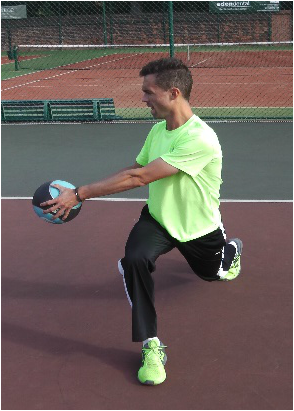
Figure 1: Lunge with Rotation
Medicine ball can be used to develop a stable, strong torso or core stability. From a fundamental movement perspective the trunk muscles can brace or rotate, whilst also being able to flex and extend. Often it is these rotational movements we train using medicine balls (Figure 1) alongside working the kinetic chain. Energy is transferred from ground force reactions, through the lower body to the trunk region, scapular, elbow and then wrist.
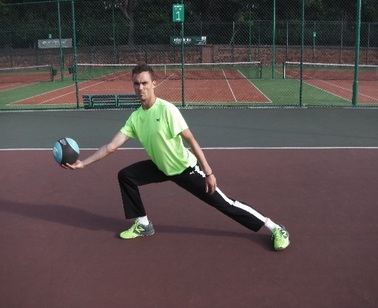
Figure 2: Isometric Lunge Hold
Rotation (angular momentum) and diagonal patterns of movements are foundations of tennis movements. Tennis requires large amounts of rotation from the trunk, shoulders, and contralateral movements across slings of the body - hence training these two methods seems important. Movements such as lunges with rotations (Figure 1) or diagonal pattern movements such as wood chops or cross body
Using medicine ball training in tennis requires awareness of how to train the torso and the whole body. Fletcher (2014) considers four areas in which you need to train the torso. These include ‘random perturbations’, ‘rotation and rotational control’, ‘diagonal patterns’ and ‘force through the kinetic chain’. Random perturbations predominantly involve the ability to brace and be stable when external forces are placed the body. An example when using a medicine ball may be an isometric hold in a lunge position (Figure 2). Perturbations are then added by the ball being pushed in various directions and the athlete stabilising his or her body.
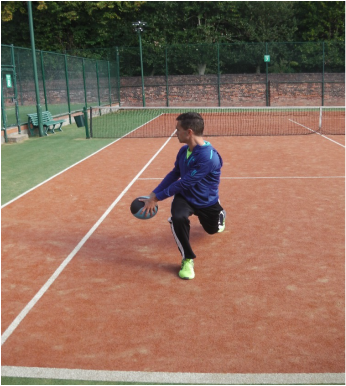
Figure 3: Cross Body Lunge
Rotation (angular momentum) and diagonal patterns of movements are foundations of tennis movements. Tennis requires large amounts of rotation from the trunk, shoulders, and contralateral movements across slings of the body - hence training these two methods seems important. Movements such as lunges with rotations (Figure 1) or diagonal pattern movements such as wood chops or cross body lunges provide examples (Figure 3). They both help develop stability, motor control and synchronisation of the body. This will benefit tennis performance and help reduce the likelihood of injury through efficient movement patterning.
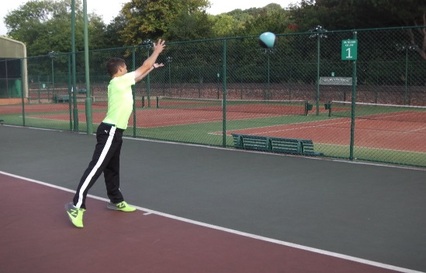
Figure 4: Sideways Throw
The last type of training is kinetic chain training. Training methods provide an excellent stimulus for developing muscle synchronisation, motor control and utilising ground force reactions. This will all have benefits to performance and reducing injury risk. Example exercises maybe a soccer overhead throw or a sideways throw (Figure 4). However for a true performance transfer effect we need to show an understanding of the biomechanics of tennis. This may include factors such as the stance, the type of shot (e.g. single or double handed backhand), weight shift, follow through and separation angles of the body.
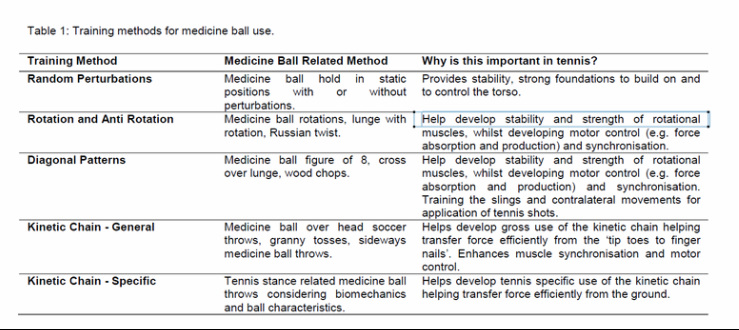
When using a medicine ball for example to train a step in stance shifting the weight from the back to the front foot should occur (Bahamonde and Knudson, 2003). Another example is the open stance forehand where emphasis should be made to the player about the separation angle between the hip and shoulder. That is the shoulder rotates further round than the hip (by average by 13°) to allow the player to ‘wind up’ and maximise elasticity of the body and angular momentum (Bahamonde and Knudson 2003). Furthermore the separation angle between the hips and shoulders is greater in the single handed backhand than in the double handed backhand (Genevois et al., 2015). Therefore understanding the needs of your athlete, the intention of your training and specificity of the sport when using medicine ball should reflect the training methods used (Table 1).
Table 1: Training methods for medicine ball use.
References
Bahamonde, R. and Kundson, D. (2003). Kinetics of the upper extremity in the open and square tennis forehand. Journal of science and medicine in sport, 6(1), 88-101.
Fletcher, I. (2014). Myths and reality: training the torso. Professional strength and conditioning, 33, 25-29.
Genevois, C., Reaid, M., Rogowski, I. and Crespo, M. (2015). Performance factors related to different tennis backhand groundstrokes: a review. Journal of sport science and medicine, 14 (1), 194-202.