Purpose
The purpose of this booklet is to provide the tennis industry with consistent language around the major tennis movements. As the leading tennis-specific fitness and sport science association, the International Tennis Performance Association (iTPA) determined that some major challenges exist throughout the global tennis industry in how tennis movement is communicated, and therefore how it is taught. Up until this point a lack of consistency has existed to describe the most common movements seen on the tennis court.
Standardization
The objective of this booklet is to standardize terminology around these movements to allow for better communication between tennis coaches within tennis centres and academies as well as communication among other individuals that test, train and rehab tennis athletes. Developing a simple common language is paramount for easier communication among all individuals involved in the development of tennis players at all ages, stages of development and levels of play.
How this was compiled
The information in this booklet was compiled via review of thousands of tennis points and movement as well as interviews with over two dozen of the top tennis coaches in addition to some of the top tennis movement experts. The goal was to use language that is commonly utilised, but also that simply highlights the movements and directions involved in the most common tennis situations.
Contributors
Martin Blackman, Jay Berger, Craig Boynton, Gabriel Echeverria, Robby Ginepri, Jose Higueras, Stephen Huss, Jamea Jackson, Kent Kinnear, Mark Kovacs, Ola Malmqvist, Diego Moyano, Yutaka Nakamura, Satoshi Ochi, Kathy Rinaldi.
The 37 movements
- Lateral Movements (9)
- Forward Movements (5)
- Backward Movements (4)
- Recovery Movements (4)
- Return of Serve (5)
- Serve (3)
- Overhead (3)
- Volleys (4)
Lateral Movements
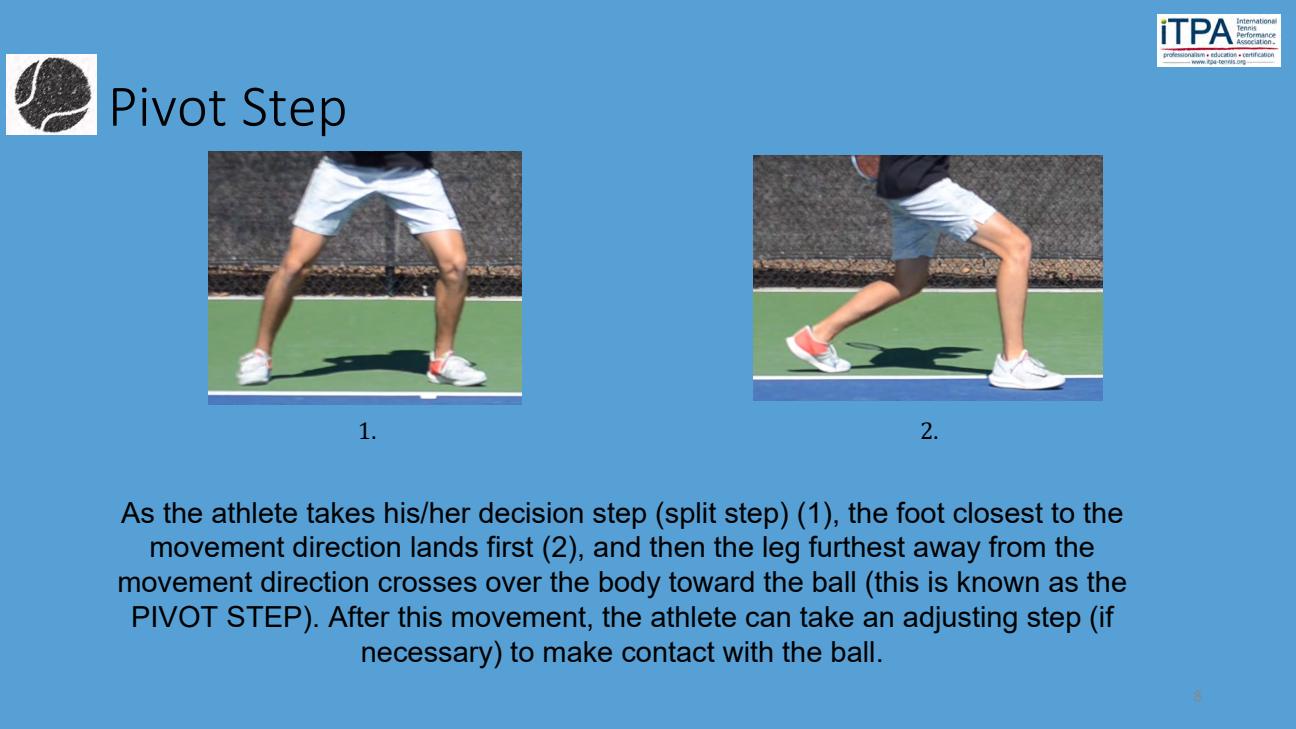
Pivot Step
As the athlete takes his/her decision step (split step) (1), the foot closest to the movement direction lands first (2), and then the leg furthest away from the movement direction crosses over the body toward the ball (this is known as the PIVOT STEP). After this movement, the athlete can take an adjusting step (if necessary) to make contact with the ball.
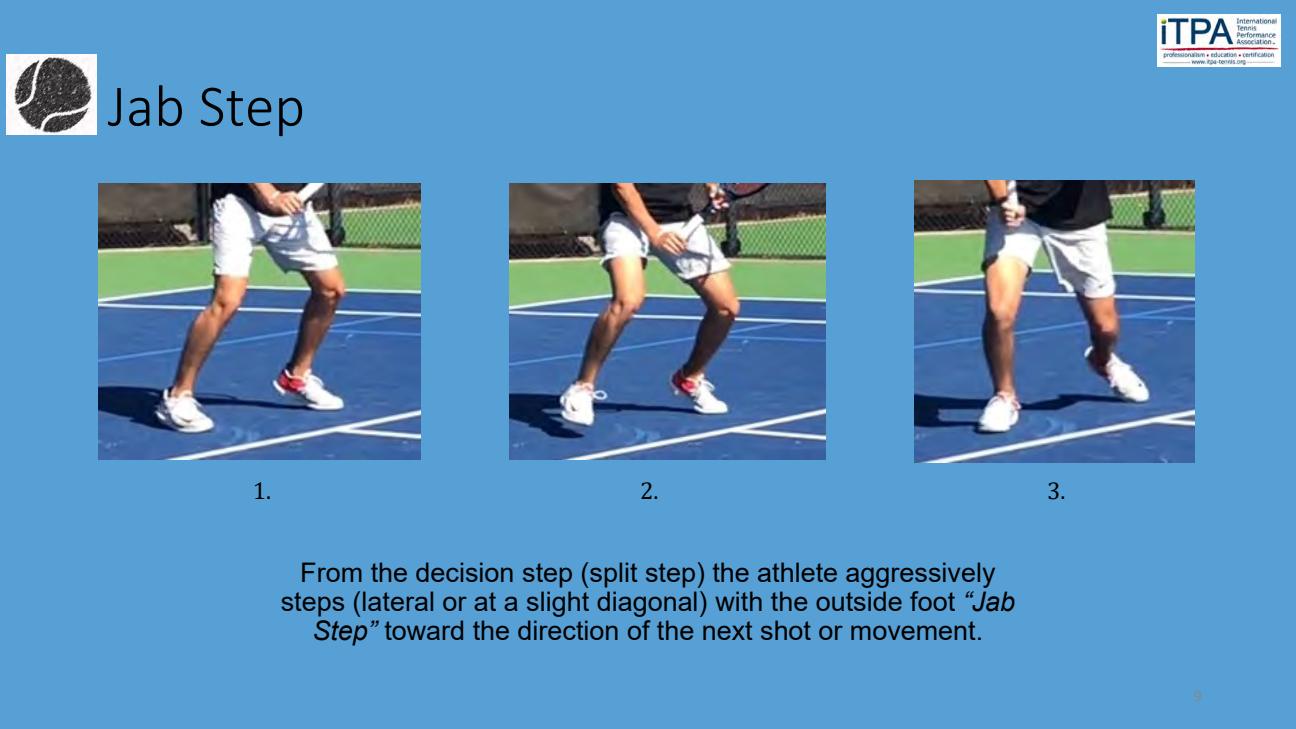
Jab Step
From the decision step (split step) the athlete aggressively steps (lateral or at a slight diagonal) with the outside foot “Jab Step” toward the direction of the next shot or movement.
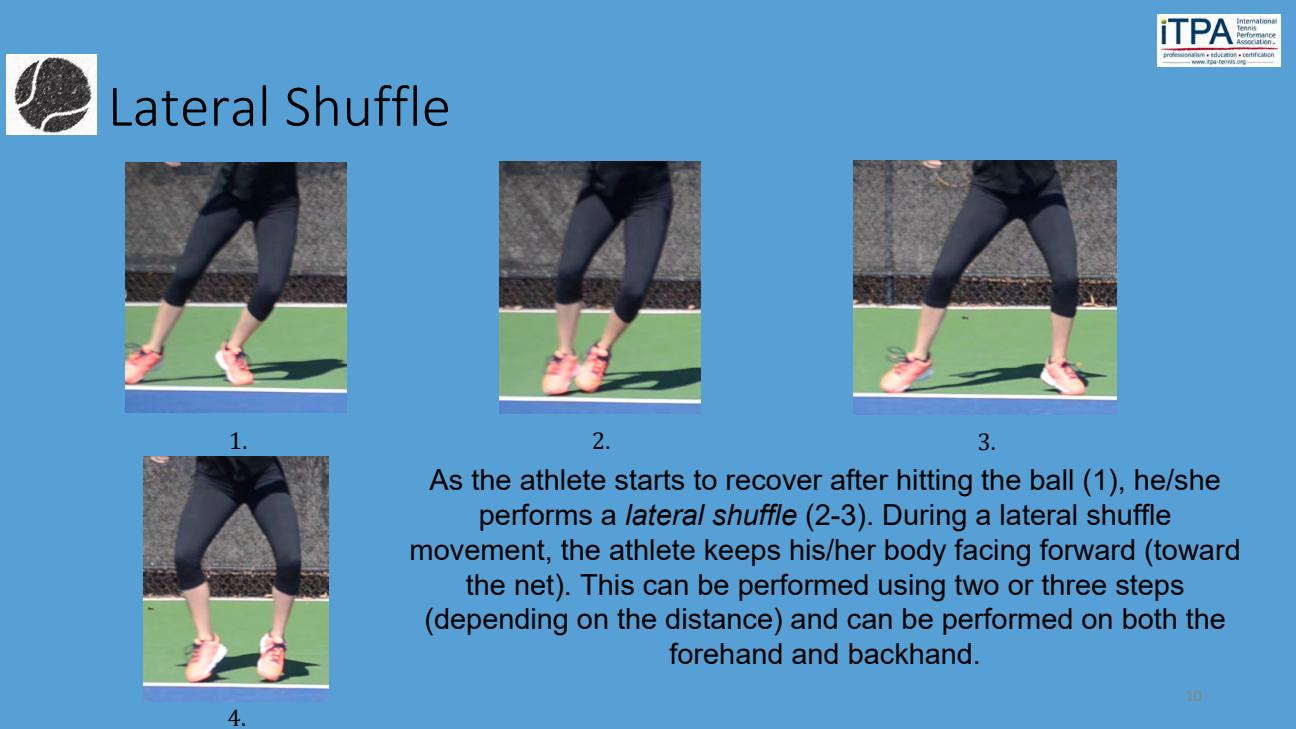
Lateral Shuffle
As the athlete starts to recover after hitting the ball (1), he/she performs a lateral shuffle (2-3). During a lateral shuffle movement, the athlete keeps his/her body facing forward (toward the net). This can be performed using two or three steps (depending on the distance) and can be performed on both the forehand and backhand.
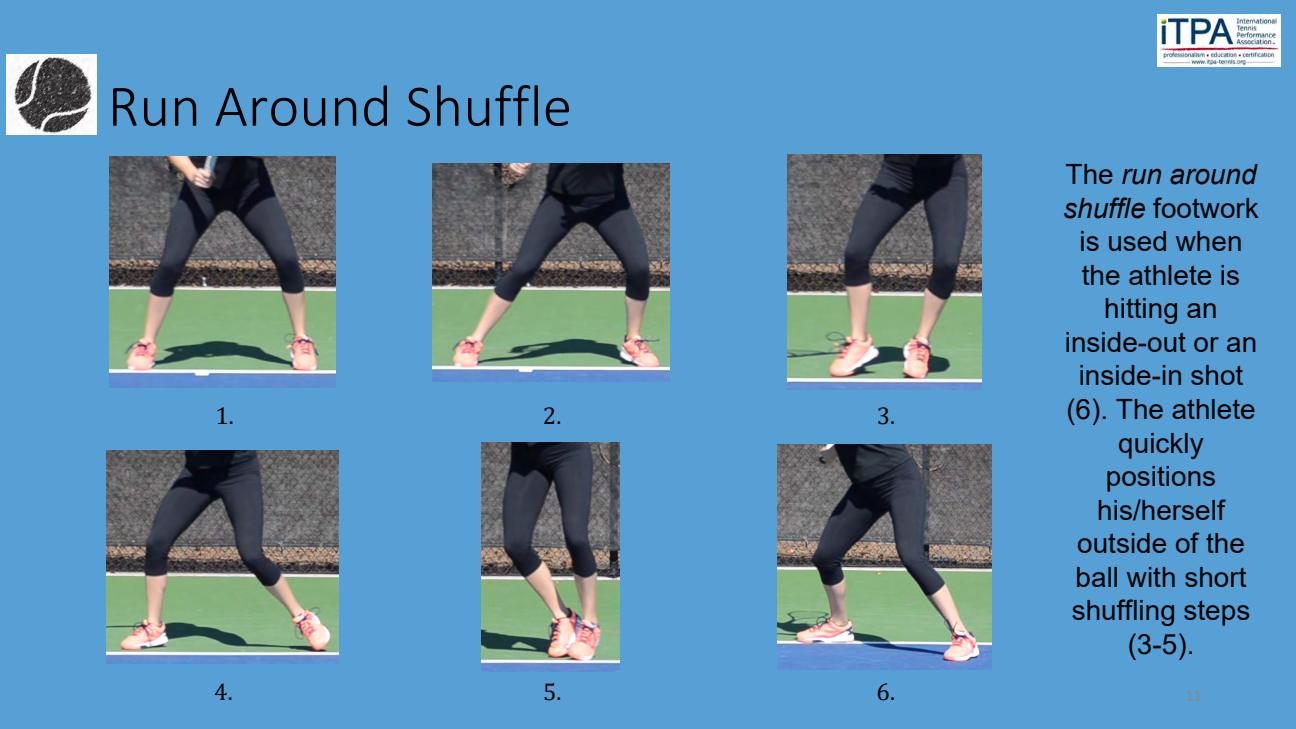
Run Around Shuffle
The run around shuffle footwork is used when the athlete is hitting an inside-out or an inside-in shot (6). The athlete quickly positions his/herself outside of the ball with short shuffling steps (3-5).
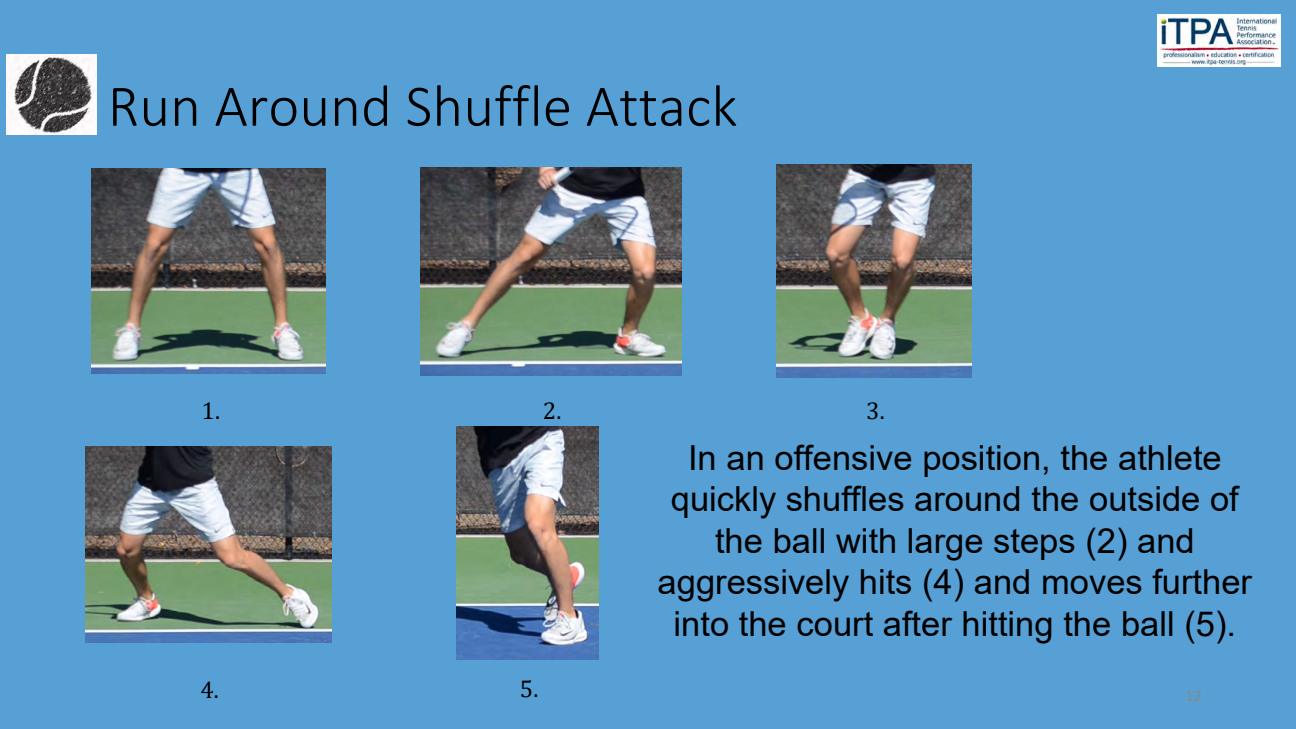
Run Around Shuffle Attack
In an offensive position, the athlete quickly shuffles around the outside of the ball with large steps (2) and aggressively hits (4) and moves further into the court after hitting the ball (5).
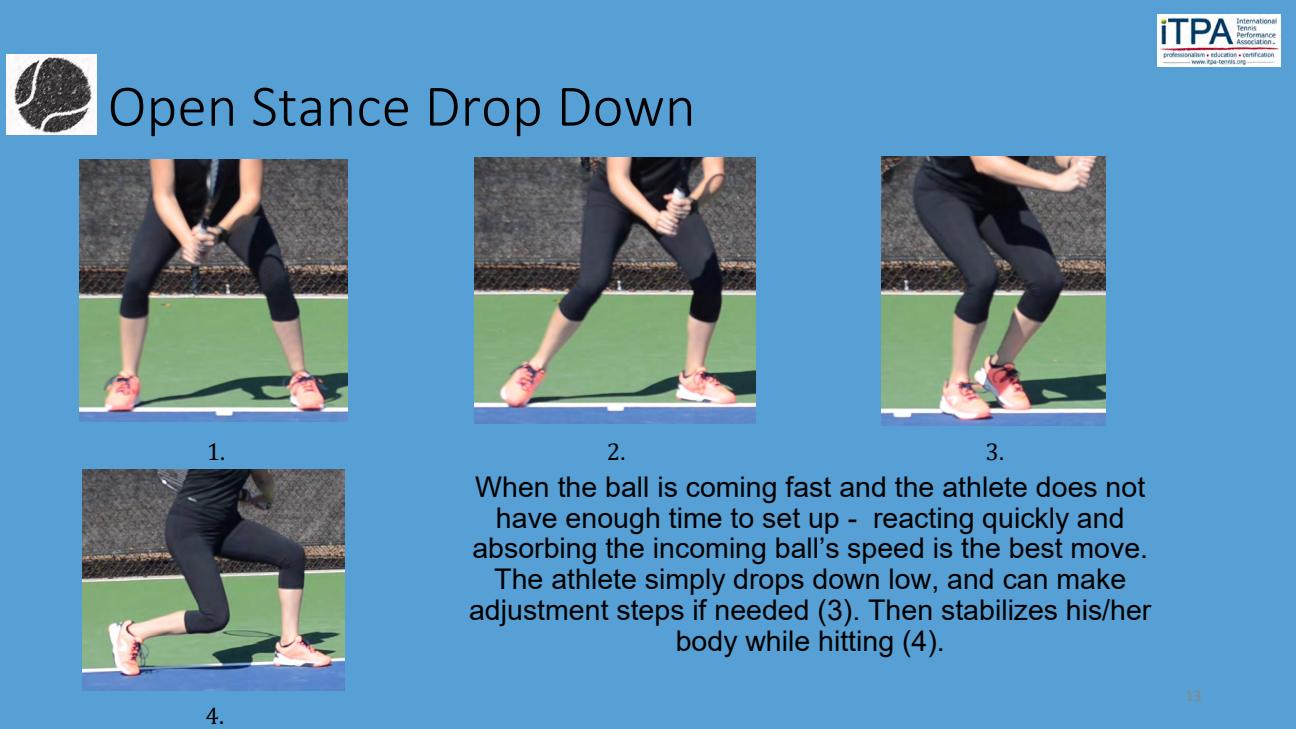
Open Stance Drop Down
When the ball is coming fast and the athlete does not have enough time to set up - reacting quickly and absorbing the incoming ball’s speed is the best move. The athlete simply drops down low, and can make adjustment steps if needed (3). Then stabilizes his/her body while hitting (4).
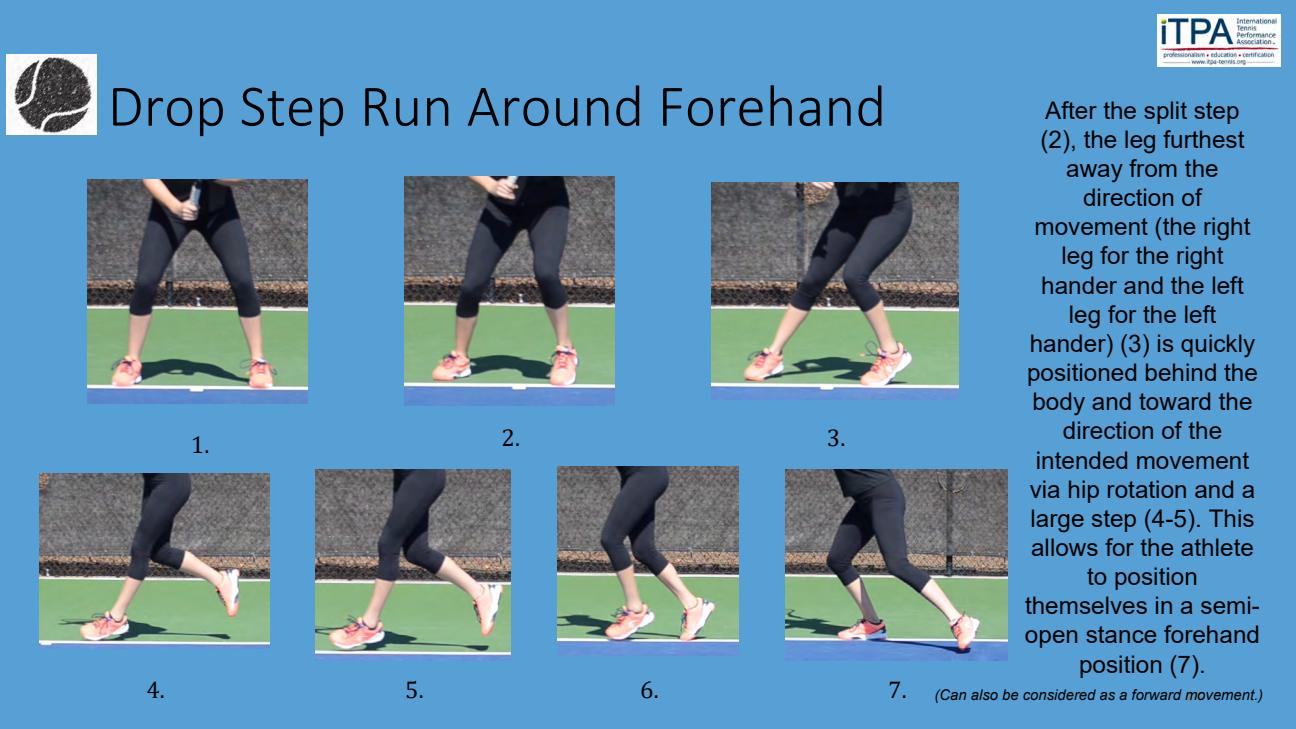
Drop Step Run Around Forehand
After the split step (2), the leg furthest away from the direction of movement (the right leg for the right hander and the left leg for the left hander) (3) is quickly positioned behind the body and toward the direction of the intended movement via hip rotation and a large step (4-5). This allows for the athlete to position themselves in a semi-open stance forehand position (7). (Can also be considered as a forward movement.)
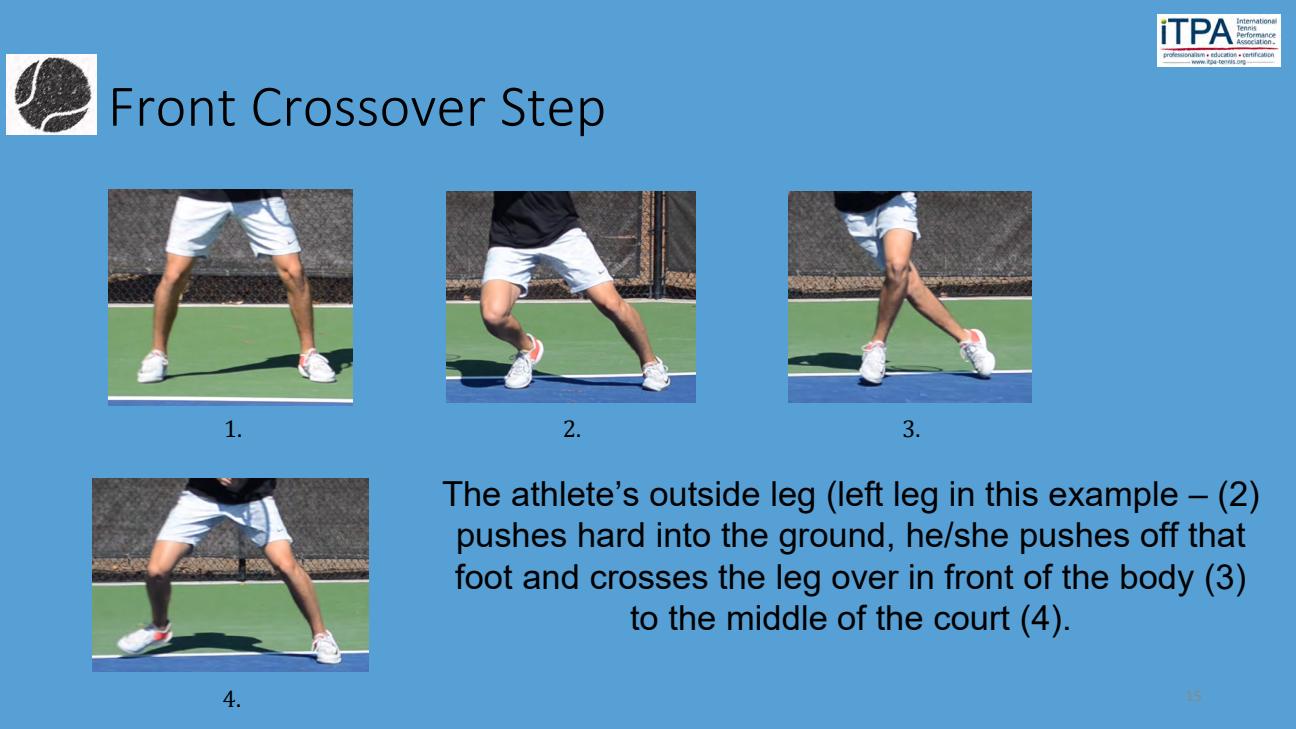
Front Crossover Step
The athlete’s outside leg (left leg in this example – (2)) pushes hard into the ground, he/she pushes off that foot and crosses the leg over in front of the body (3) to the middle of the court (4).
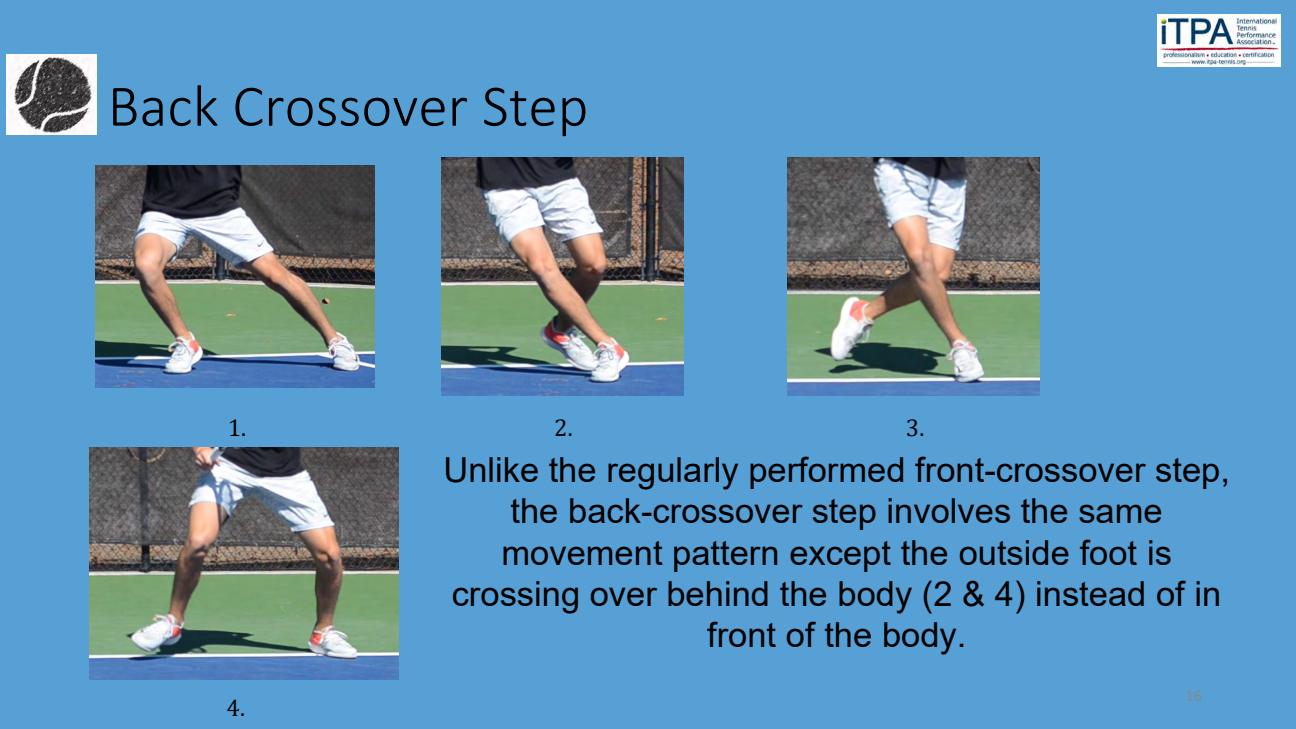
Back Crossover Step
Unlike the regularly performed front-crossover step, the back-crossover step involves the same movement pattern except the outside foot is crossing over behind the body (2 & 4) instead of in front of the body.
Forward Movements
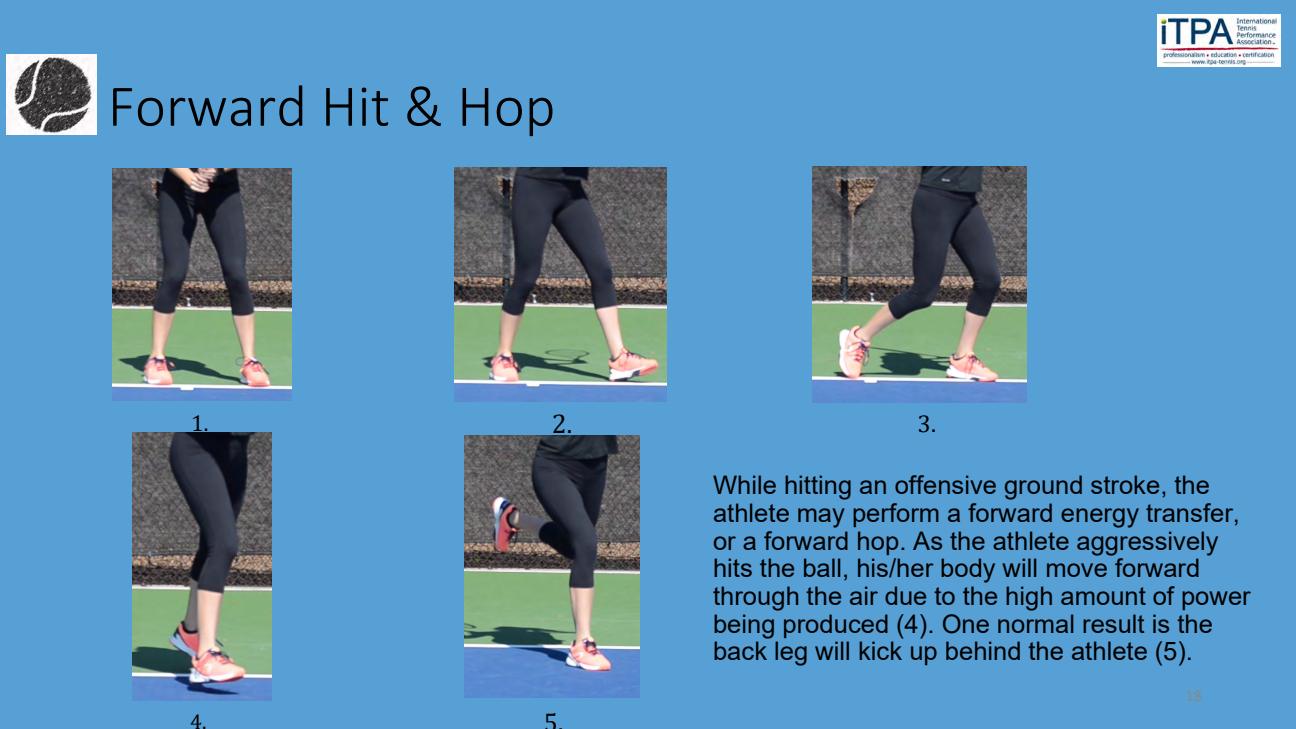
Forward Hit & Hop
While hitting an offensive ground stroke, the athlete may perform a forward energy transfer, or a forward hop. As the athlete aggressively hits the ball, his/her body will move forward through the air due to the high amount of power being produced (4). One normal result is the back leg will kick up behind the athlete (5).
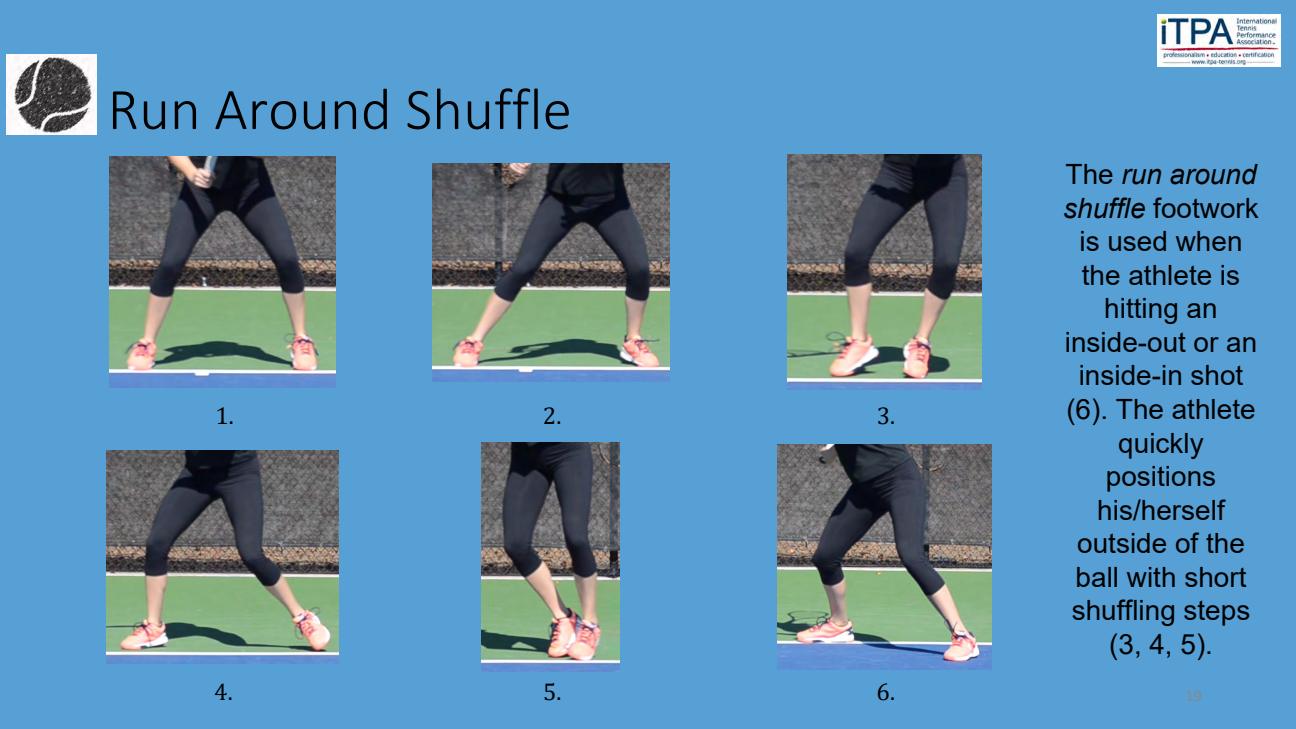
Run Around Shuffle
The run around shuffle footwork is used when the athlete is hitting an inside-out or an inside-in shot (6). The athlete quickly positions his/herself outside of the ball with short shuffling steps (3, 4, 5).
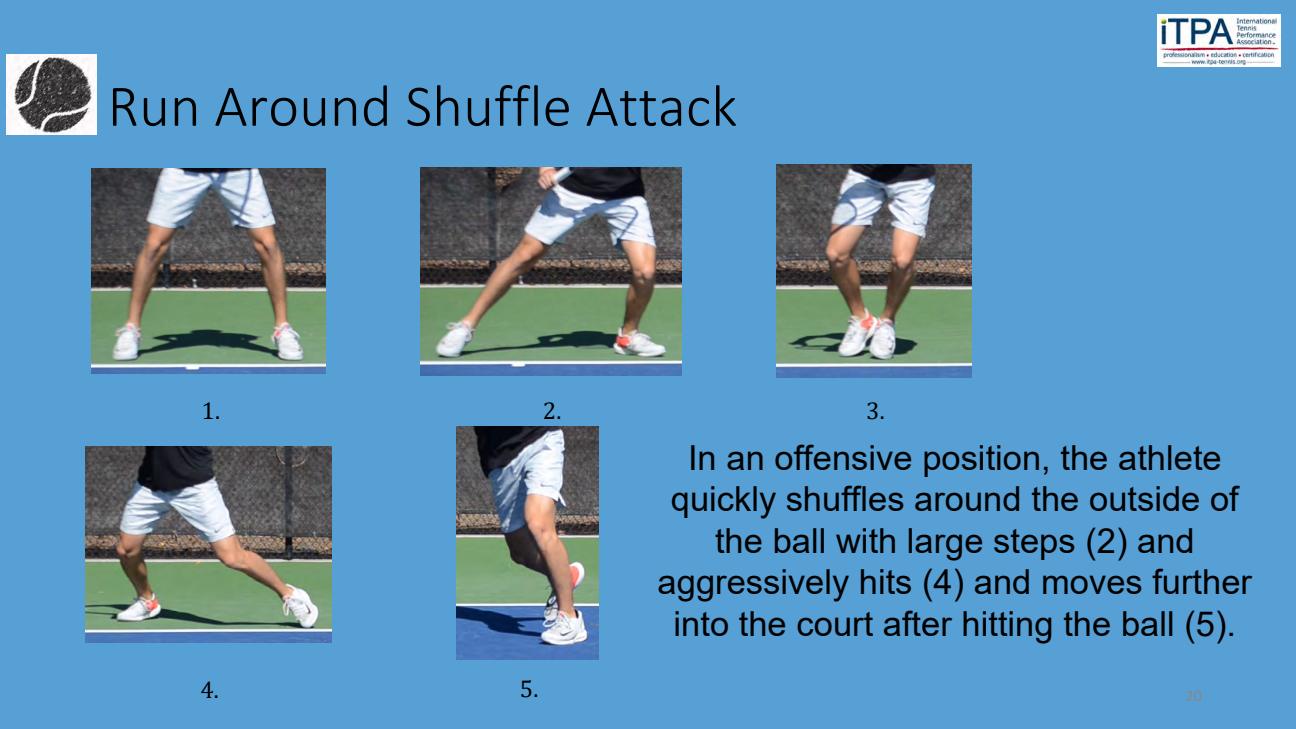
Run Around Shuffle Attack
In an offensive position, the athlete quickly shuffles around the outside of the ball with large steps (2) and aggressively hits (4) and moves further into the court after hitting the ball (5).
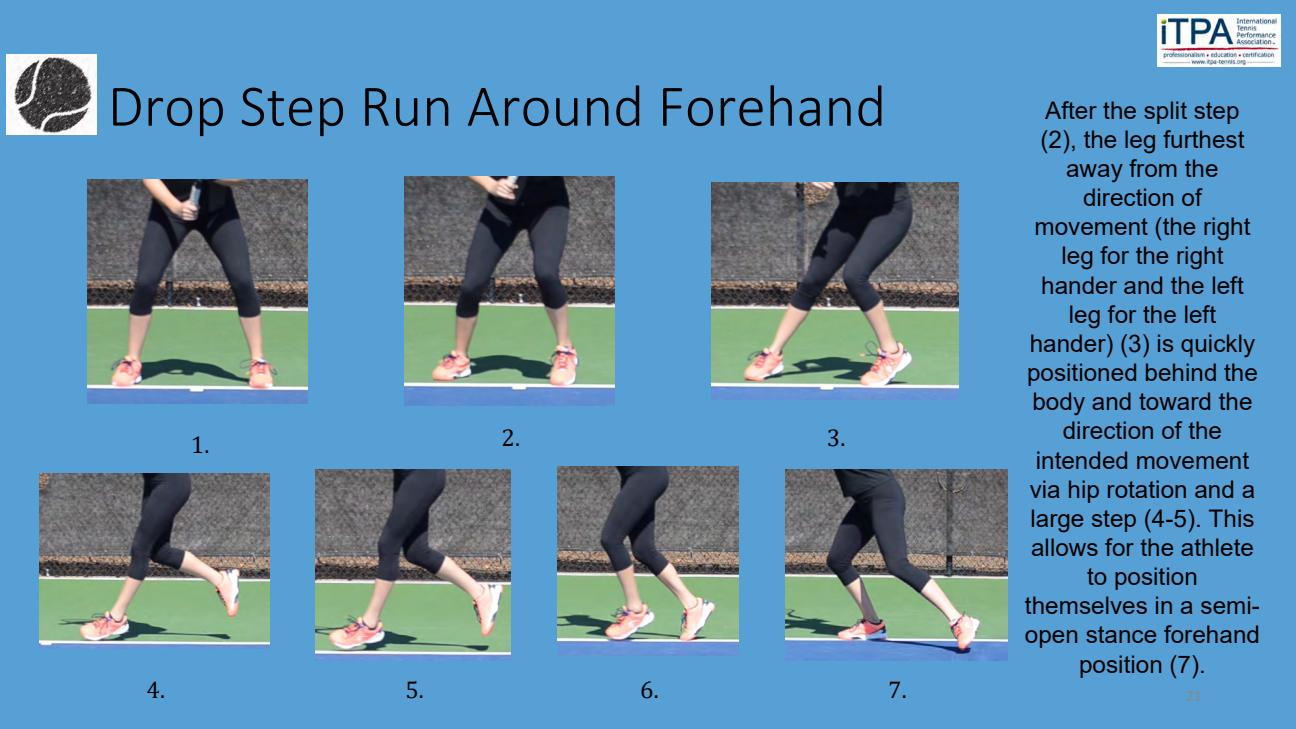
Drop Step Run Around Forehand
After the split step (2), the leg furthest away from the direction of movement (the right leg for the right hander and the left leg for the left hander) (3) is quickly positioned behind the body and toward the direction of the intended movement via hip rotation and a large step (4-5). This allows for the athlete to position themselves in a semi-open stance forehand position (7).
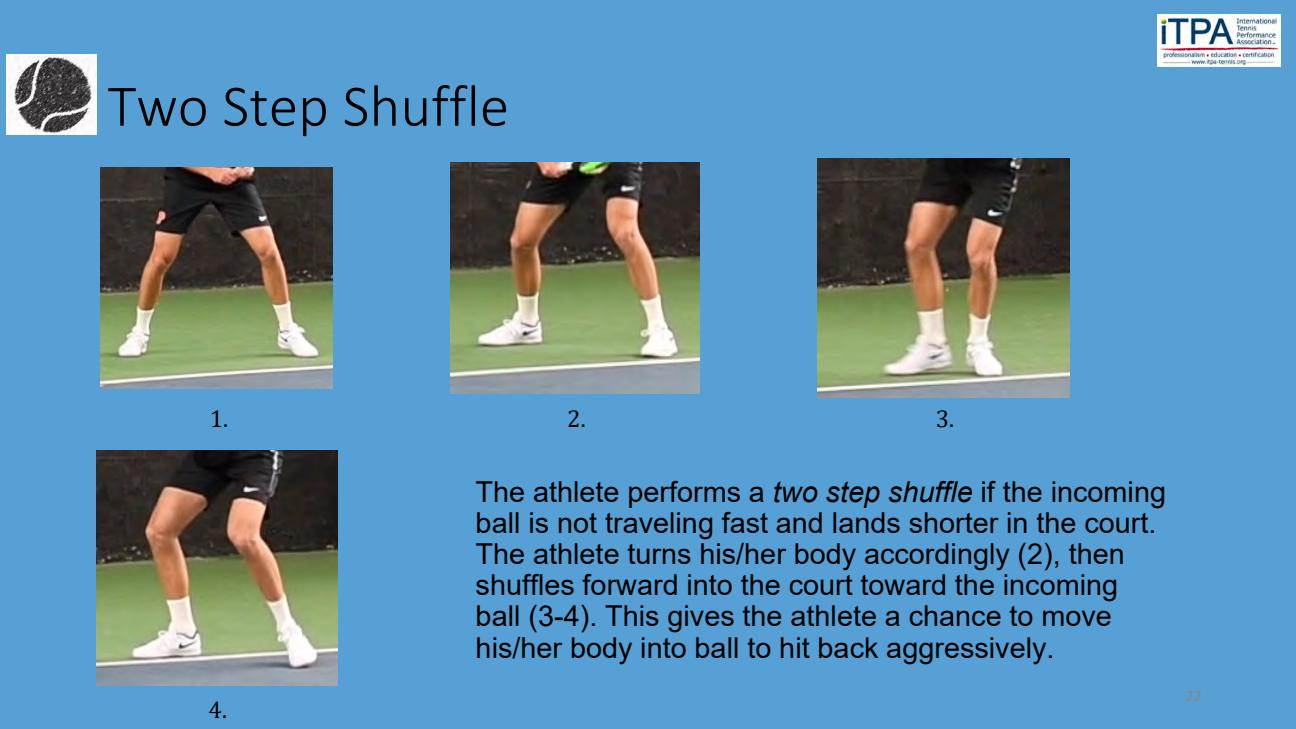
Two Step Shuffle
The athlete performs a two step shuffle if the incoming ball is not traveling fast and lands shorter in the court. The athlete turns his/her body accordingly (2), then shuffles forward into the court toward the incoming ball (3-4). This gives the athlete a chance to move his/her body into ball to hit back aggressively.
Backward Movements
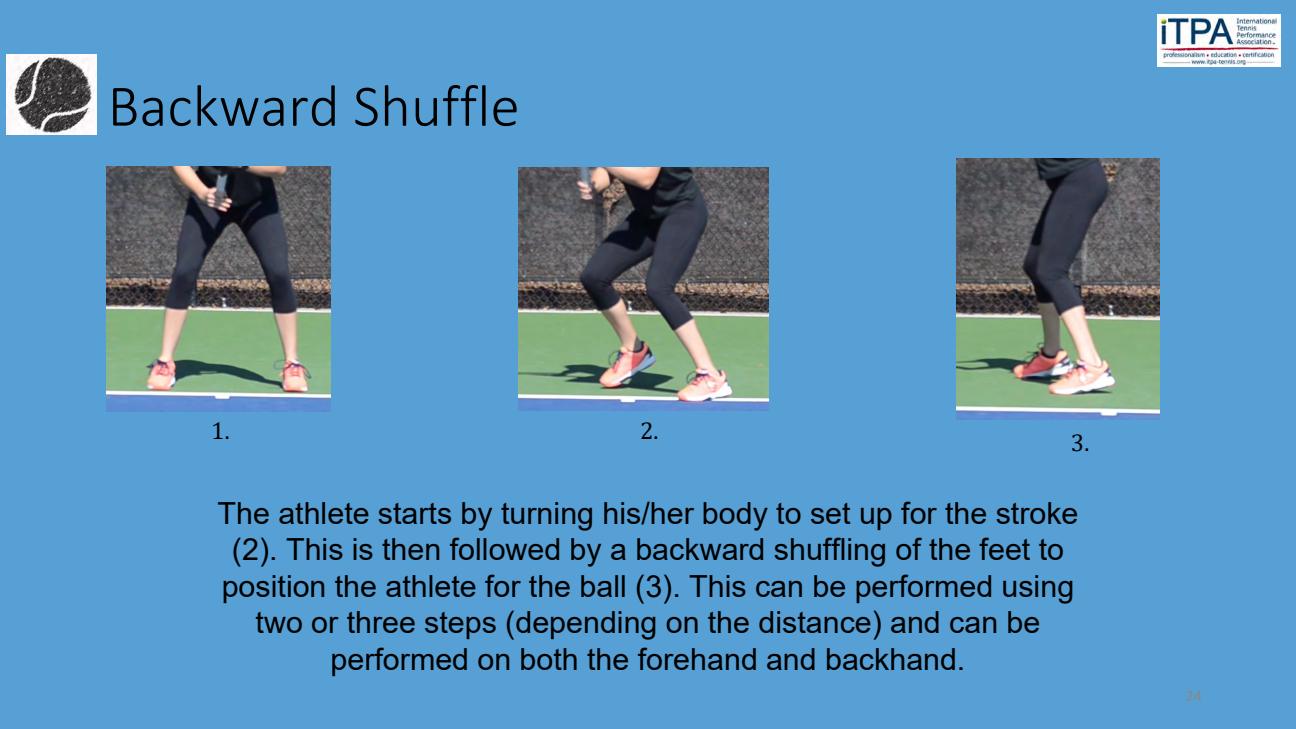
Backward Shuffle
The athlete starts by turning his/her body to set up for the stroke (2). This is then followed by a backward shuffling of the feet to position the athlete for the ball (3). This can be performed using two or three steps (depending on the distance) and can be performed on both the forehand and backhand.
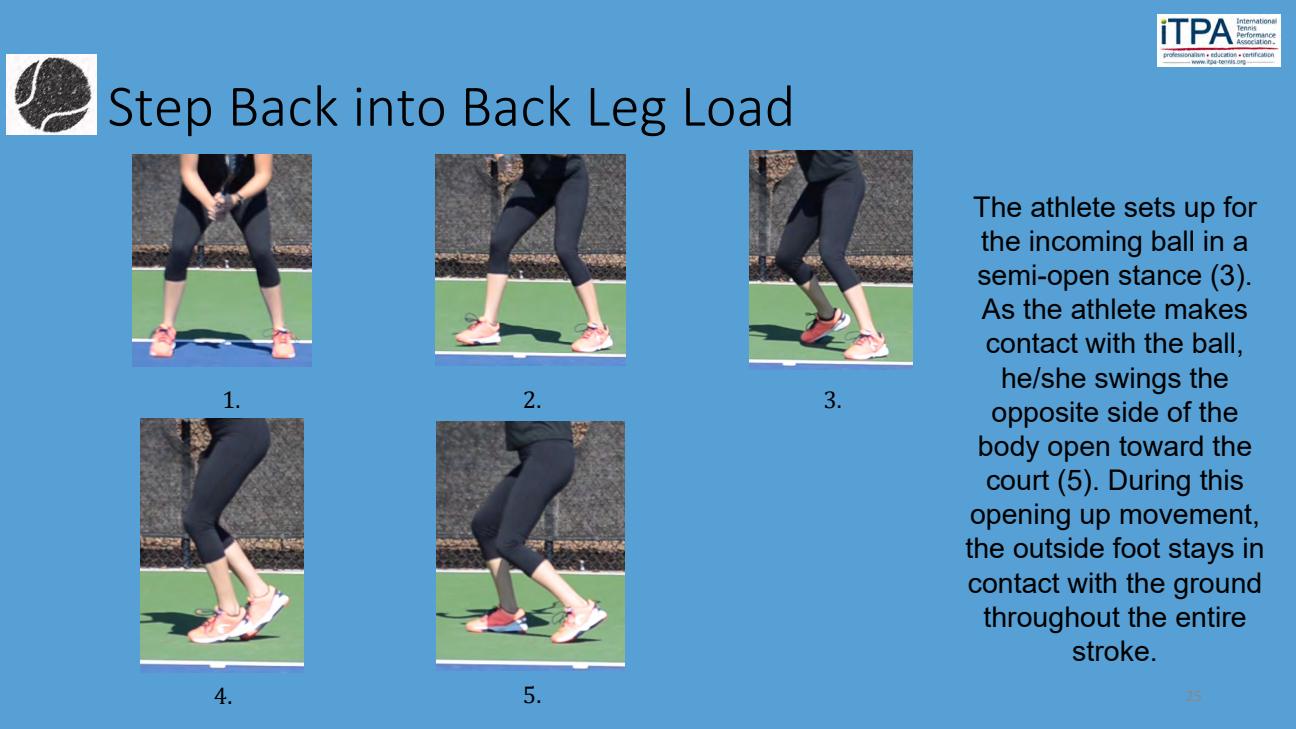
Step Back into Back Leg Load
The athlete sets up for the incoming ball in a semi-open stance (3). As the athlete makes contact with the ball, he/she swings the opposite side of the body open toward the court (5). During this opening up movement, the outside foot stays in contact with the ground throughout the entire stroke.
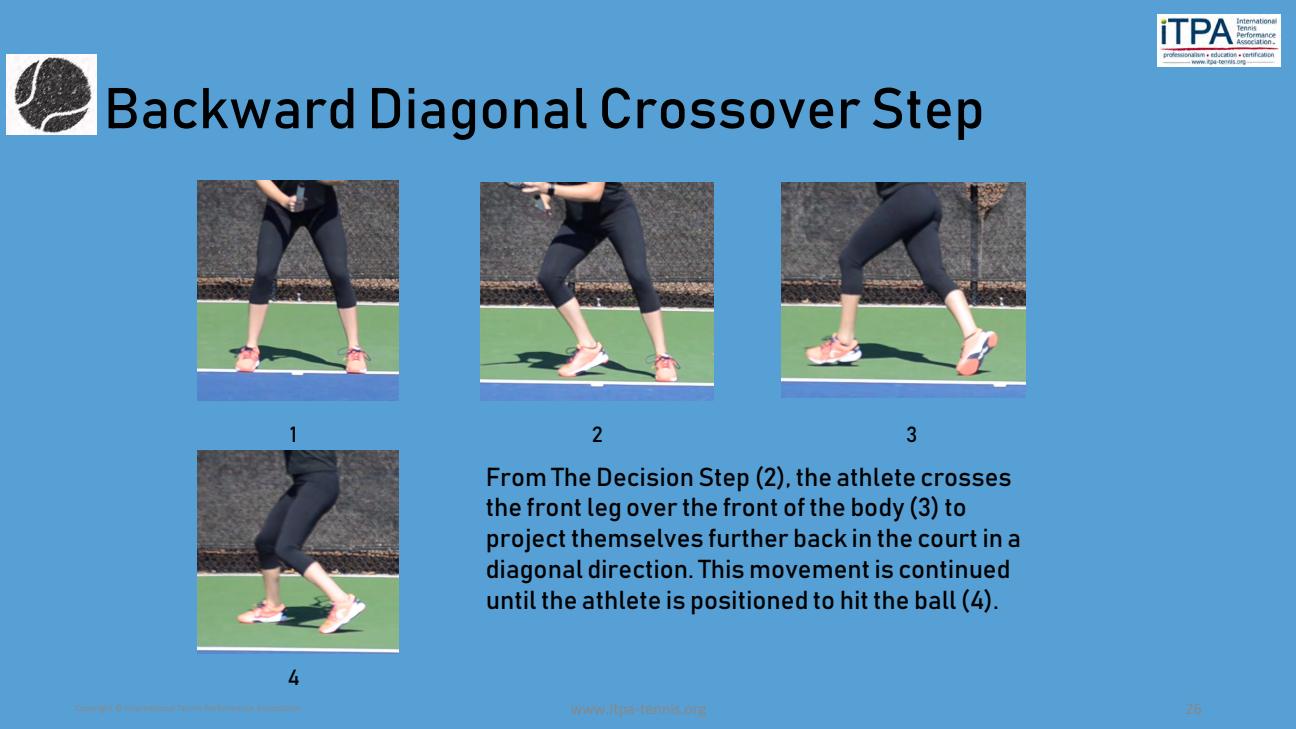
Backward Diagonal Crossover Step
From The Decision Step (2), the athlete crosses the front leg over the front of the body (3) to project themselves further back in the court in a diagonal direction. This movement is continued until the athlete is positioned to hit the ball (4).
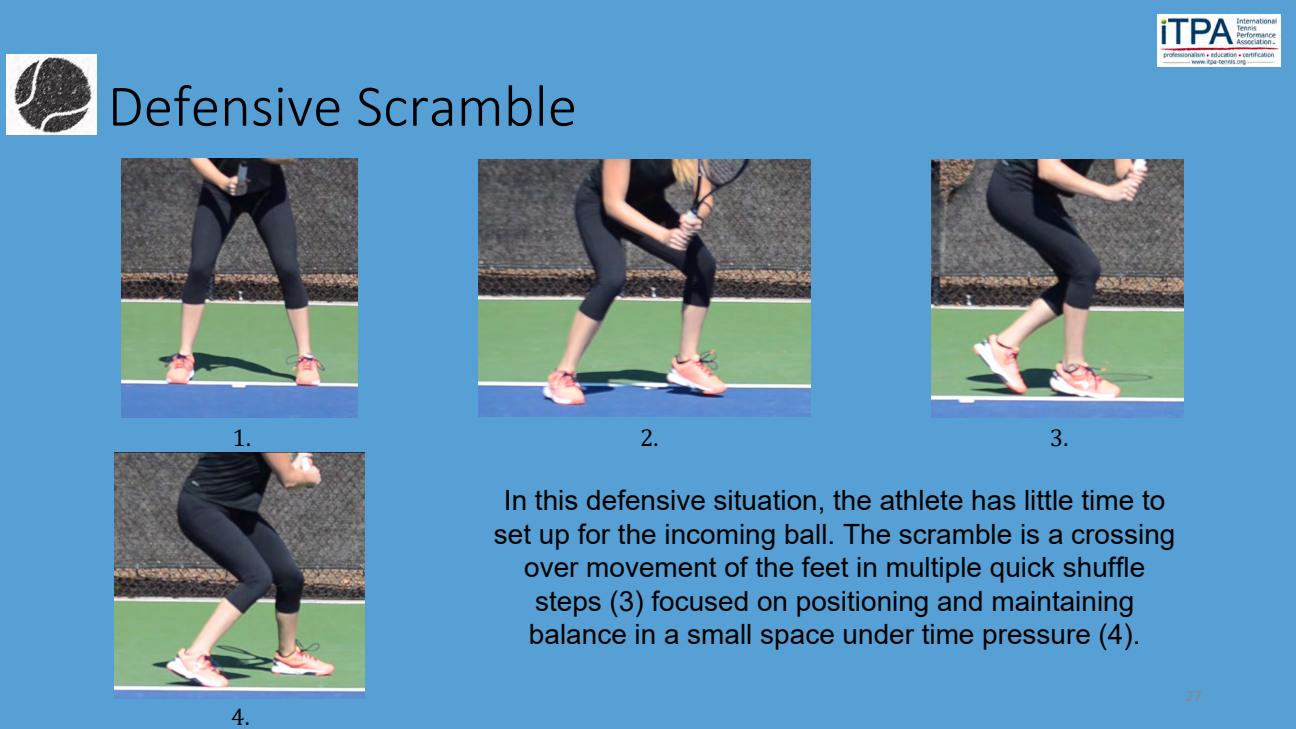
Defensive Scramble
In this defensive situation, the athlete has little time to set up for the incoming ball. The scramble is a crossing over movement of the feet in multiple quick shuffle steps (3) focused on positioning and maintaining balance in a small space under time pressure (4).
Recovery Movements
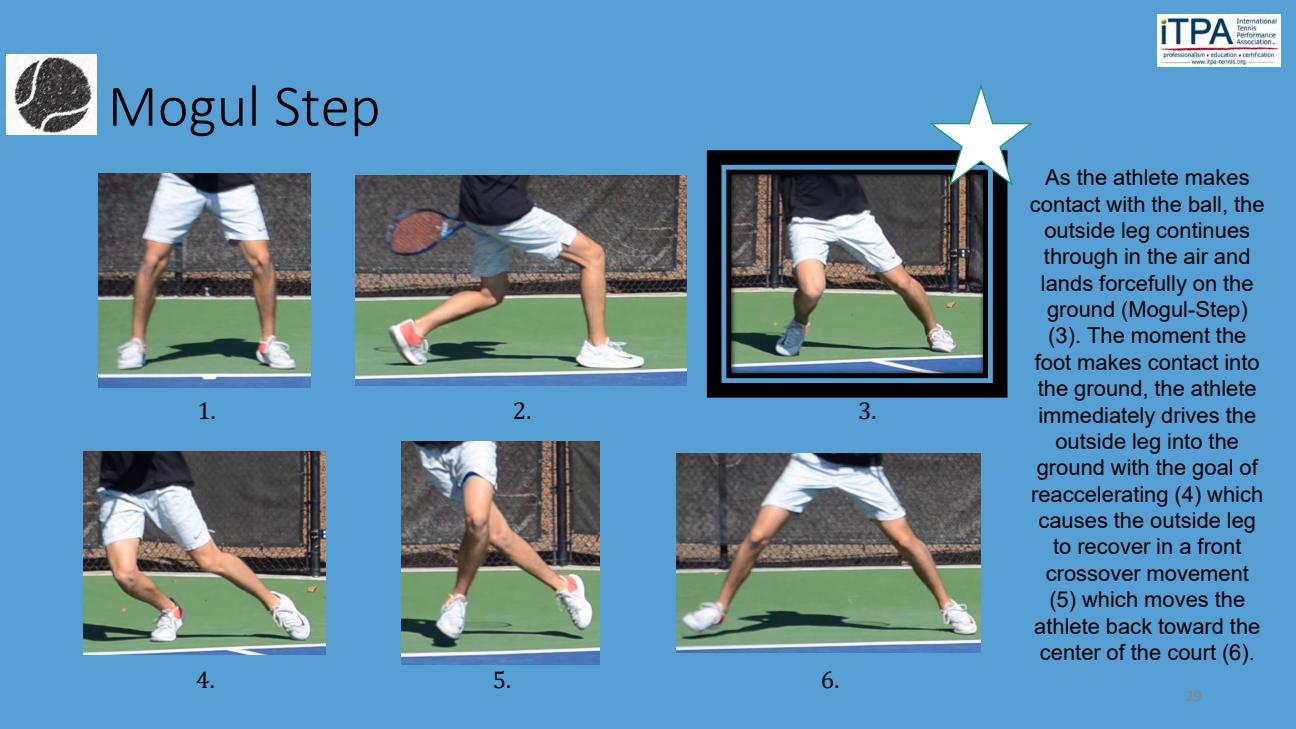
Mogul Step
As the athlete makes contact with the ball, the outside leg continues through in the air and lands forcefully on the ground (Mogul-Step) (3). The moment the foot makes contact into the ground, the athlete immediately drives the outside leg into the ground with the goal of reaccelerating (4) which causes the outside leg to recover in a front crossover movement (5) which moves the athlete back toward the center of the court (6).
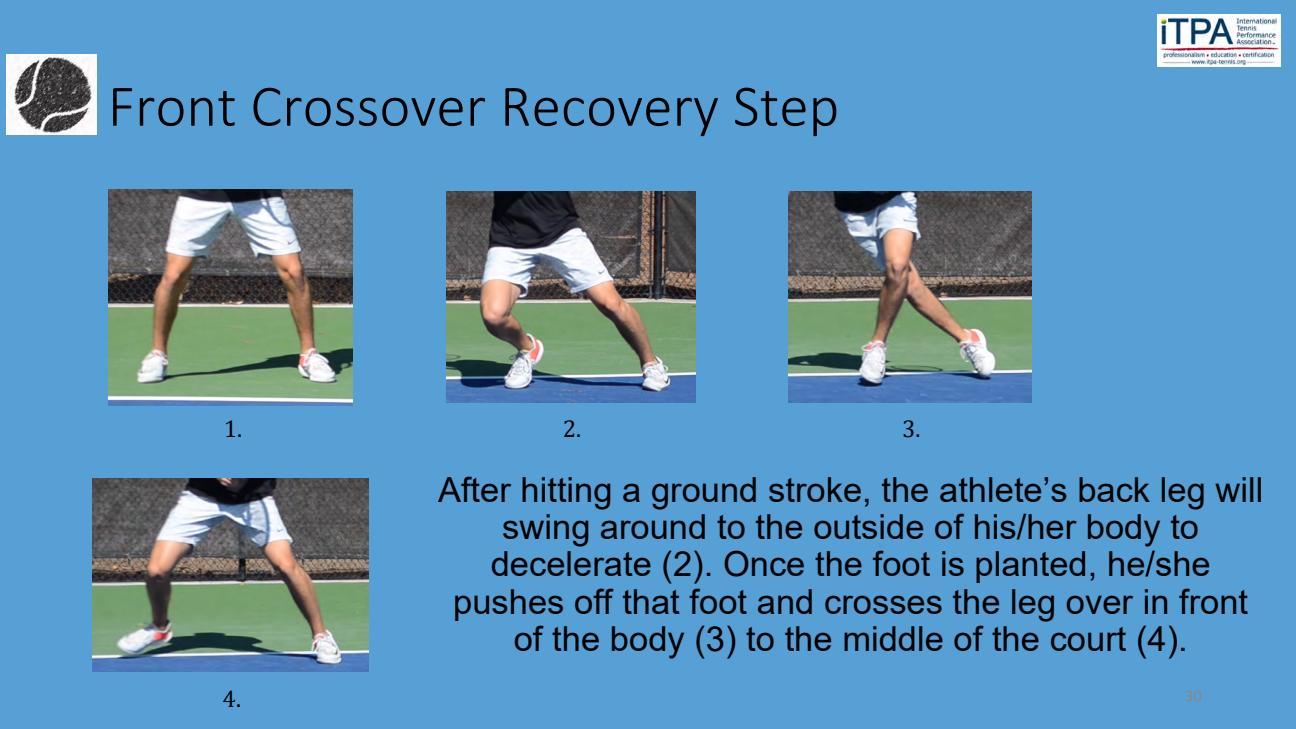
Front Crossover Recovery Step
After hitting a ground stroke, the athlete’s back leg will swing around to the outside of his/her body to decelerate (2). Once the foot is planted, he/she pushes off that foot and crosses the leg over in front of the body (3) to the middle of the court (4).
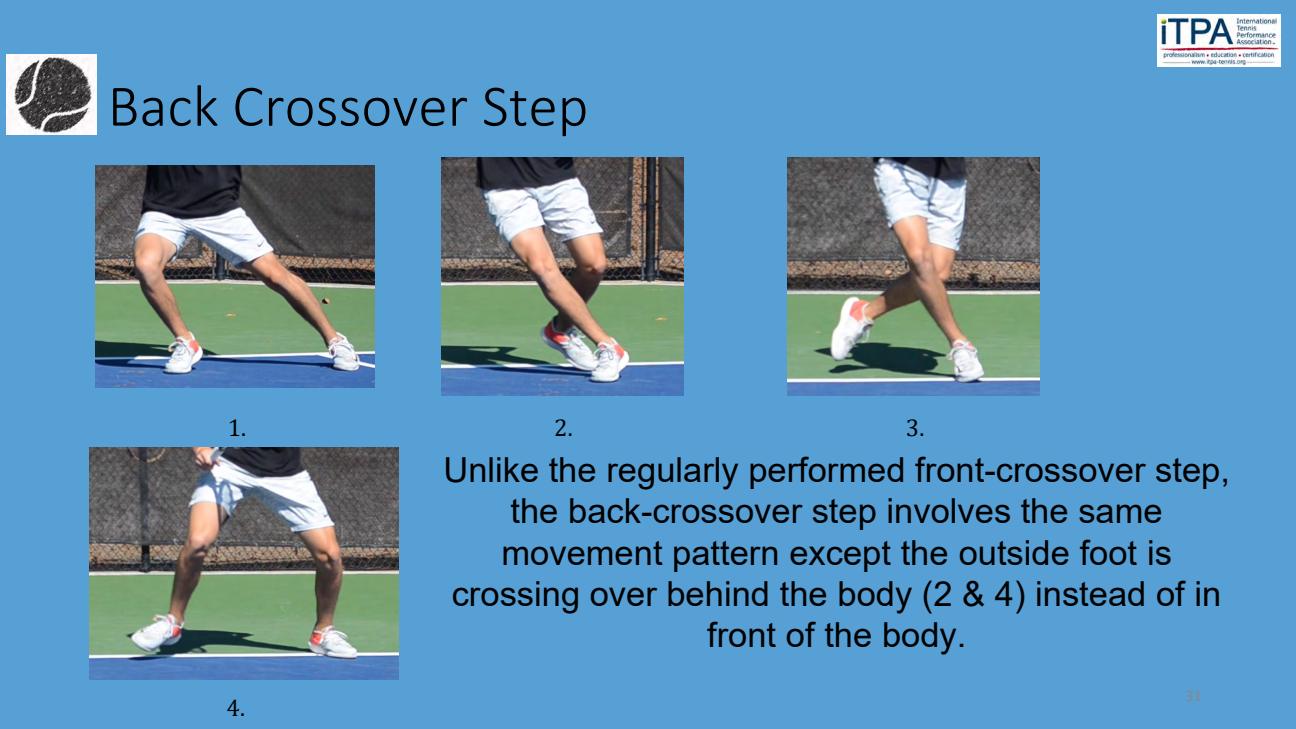
Back Crossover Recovery Step
Unlike the regularly performed front-crossover step, the back-crossover step involves the same movement pattern except the outside foot is crossing over behind the body (2 & 4) instead of in front of the body.
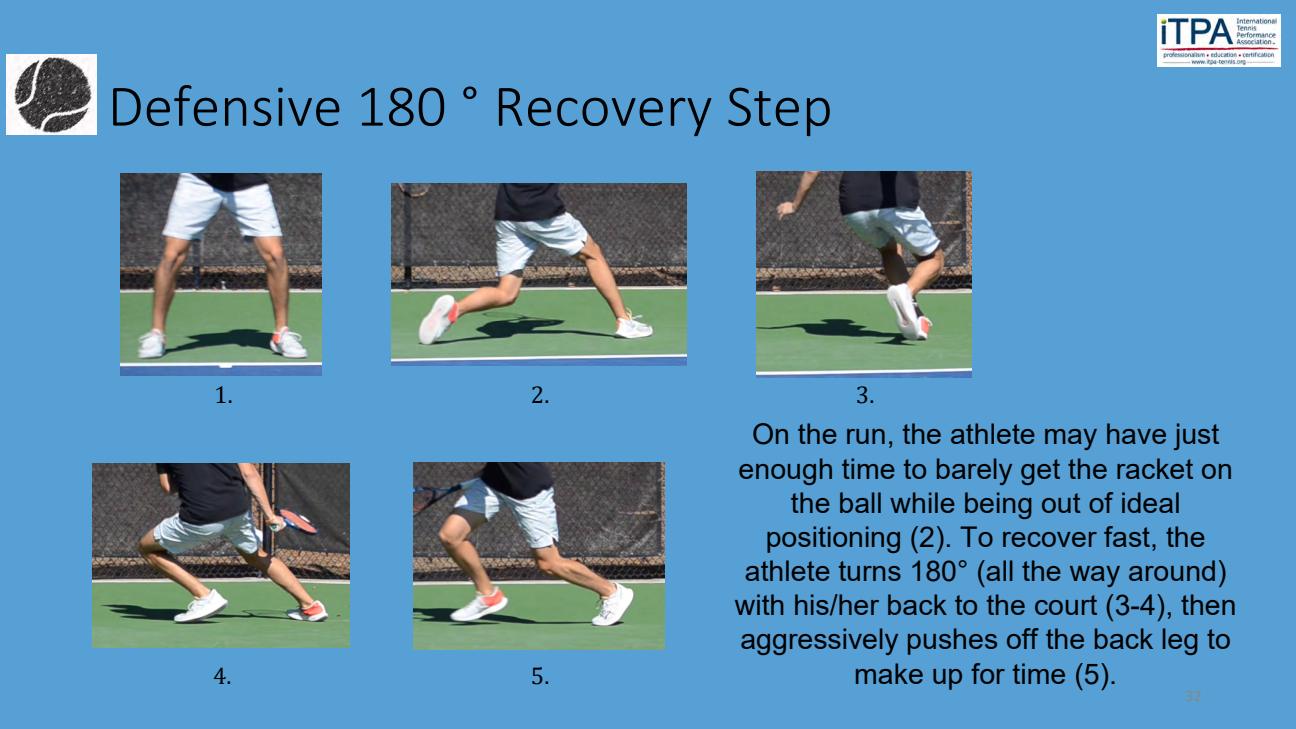
Defensive 180° Recovery Step
On the run, the athlete may have just enough time to barely get the racket on the ball while being out of ideal positioning (2). To recover fast, the athlete turns 180° (all the way around) with his/her back to the court (3-4), then aggressively pushes off the back leg to make up for time (5).
Return of Serve
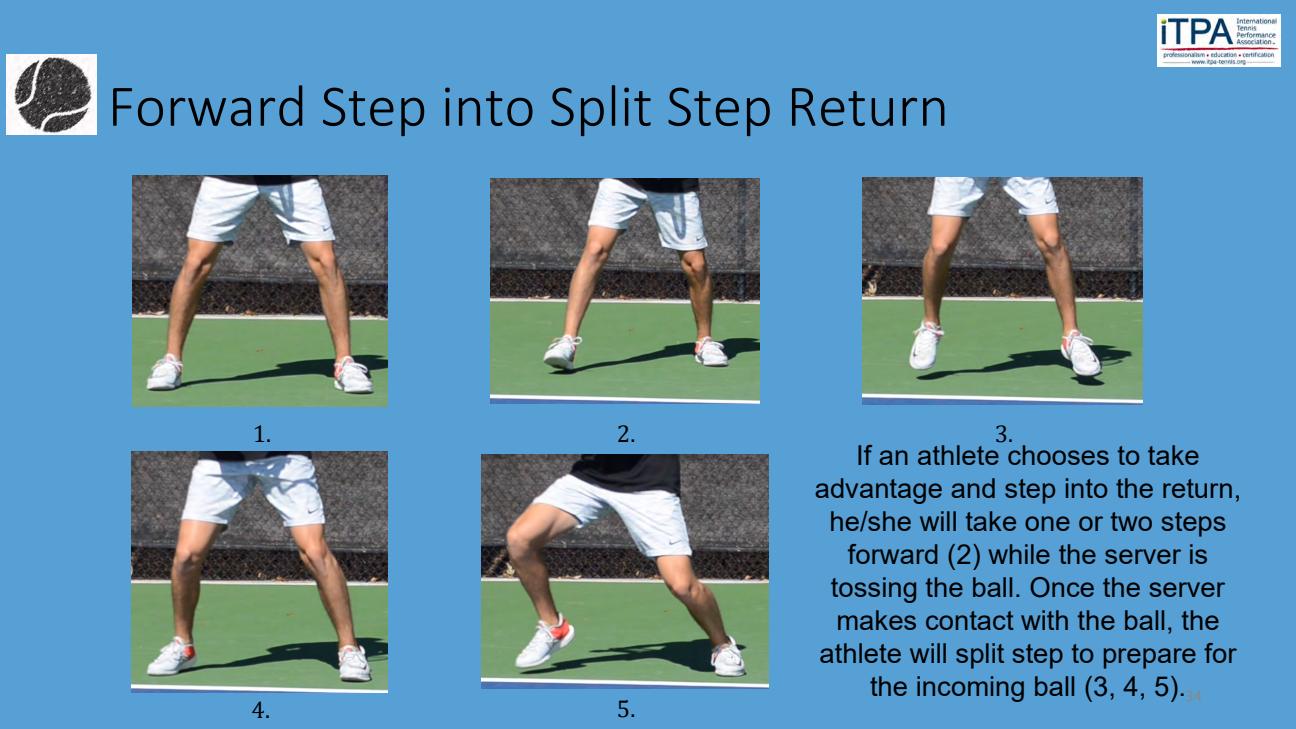
Forward Step into Split Step Return
If an athlete chooses to take advantage and step into the return, he/she will take one or two steps forward (2) while the server is tossing the ball. Once the server makes contact with the ball, the athlete will split step to prepare for the incoming ball (3, 4, 5).
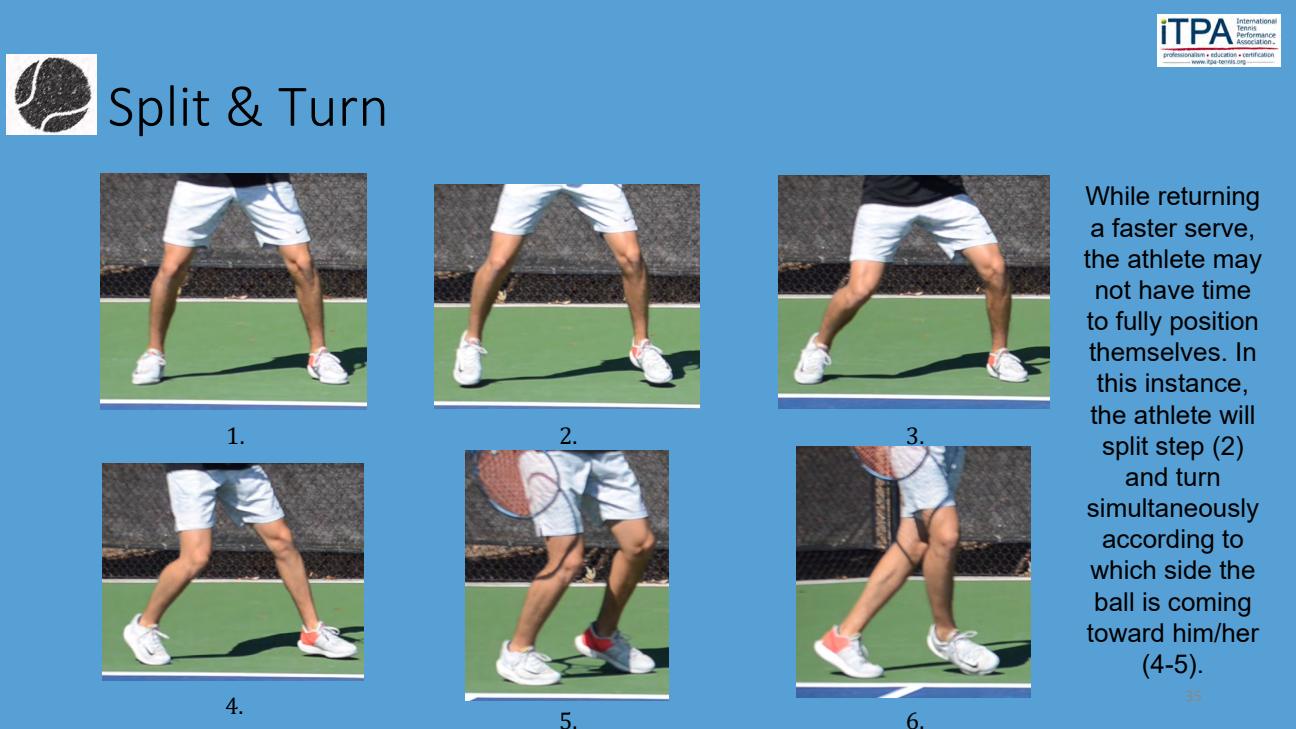
Split & Turn
While returning a faster serve, the athlete may not have time to fully position themselves. In this instance, the athlete will split step (2) and turn simultaneously according to which side the ball is coming toward him/her (4-5).
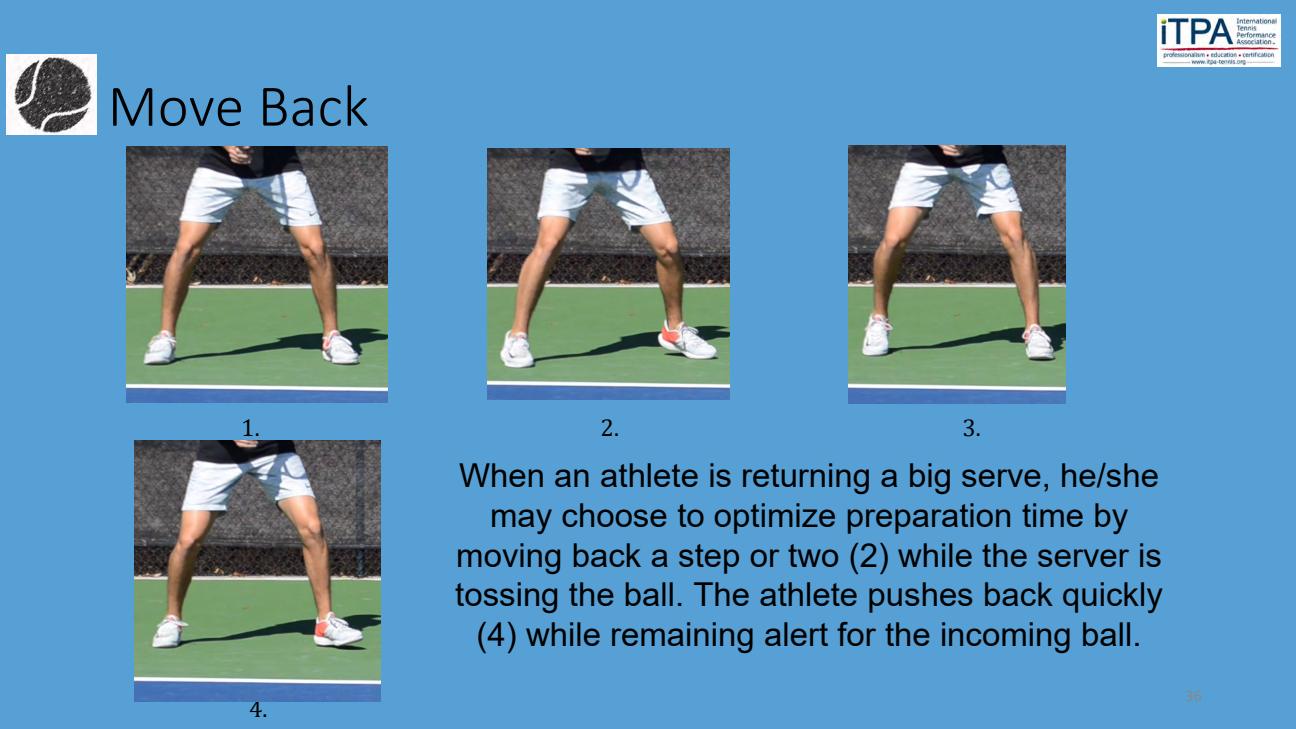
Move Back
When an athlete is returning a big serve, he/she may choose to optimize preparation time by moving back a step or two (2) while the server is tossing the ball. The athlete pushes back quickly (4) while remaining alert for the incoming ball.
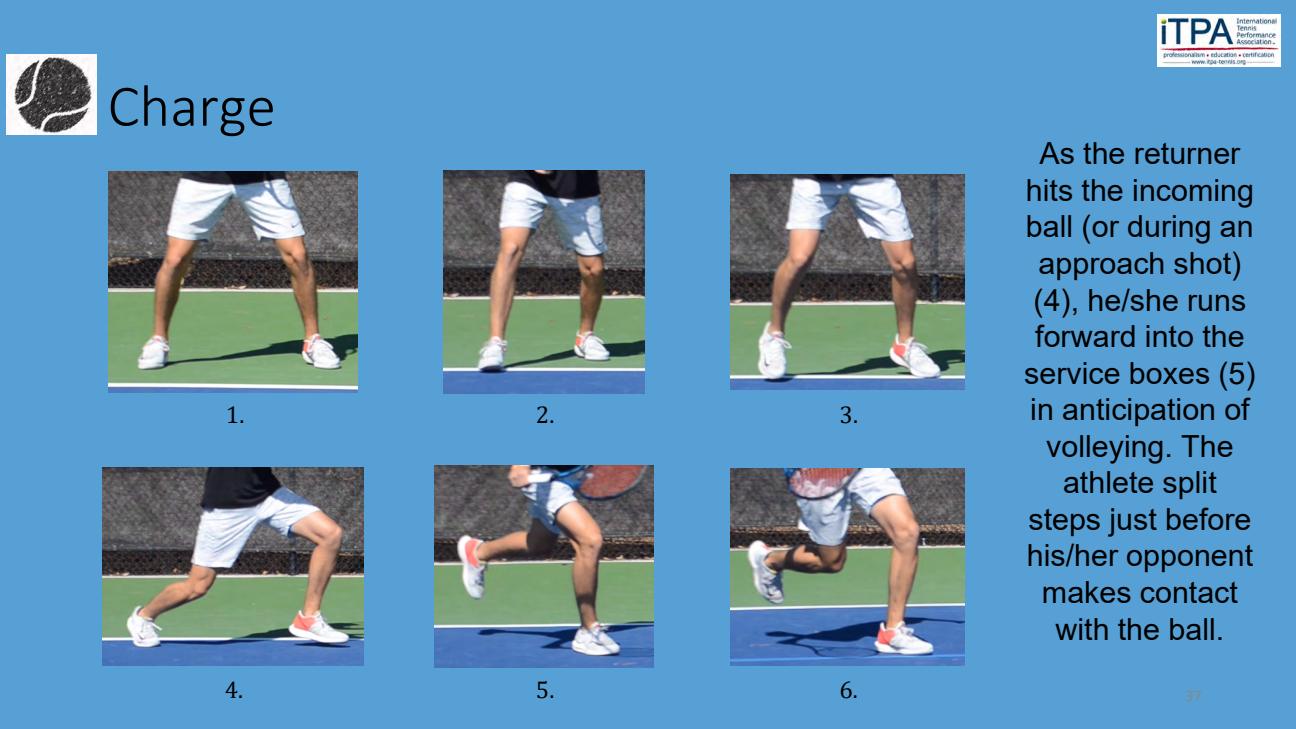
Charge
As the returner hits the incoming ball (or during an approach shot) (4), he/she runs forward into the service boxes (5) in anticipation of volleying. The athlete split steps just before his/her opponent makes contact with the ball.
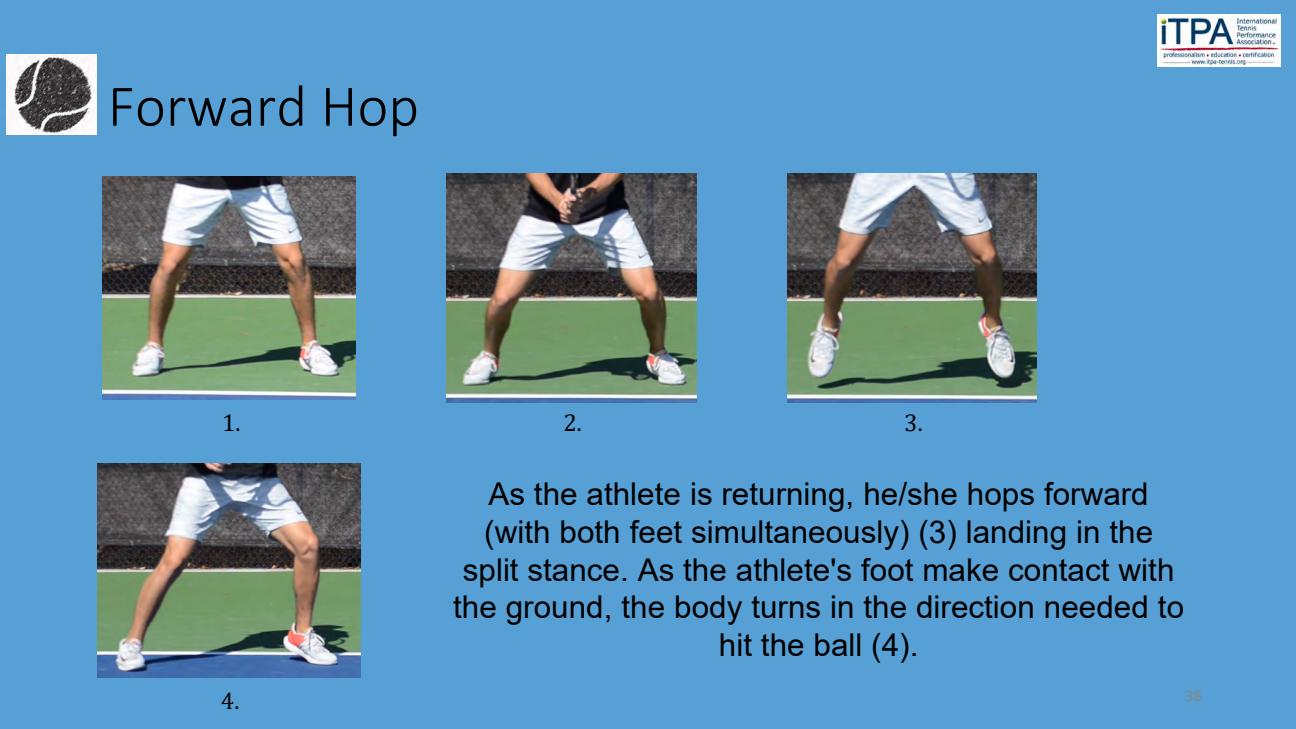
Forward Hop
As the athlete is returning, he/she hops forward (with both feet simultaneously) (3) landing in the split stance. As the athlete’s foot make contact with the ground, the body turns in the direction needed to hit the ball (4).
Serve
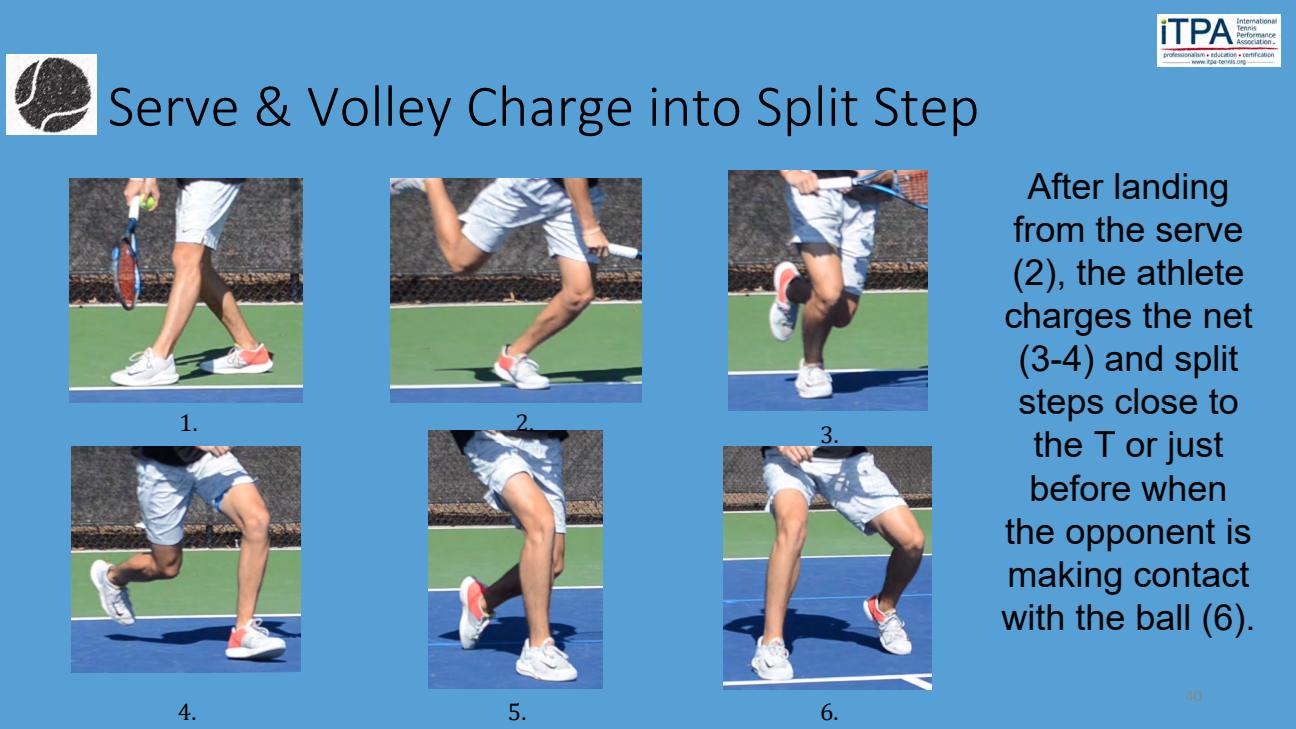
Serve & Volley Charge into Split Step
After landing from the serve (2), the athlete charges the net (3-4) and split steps close to the T or just before when the opponent is making contact with the ball (6).
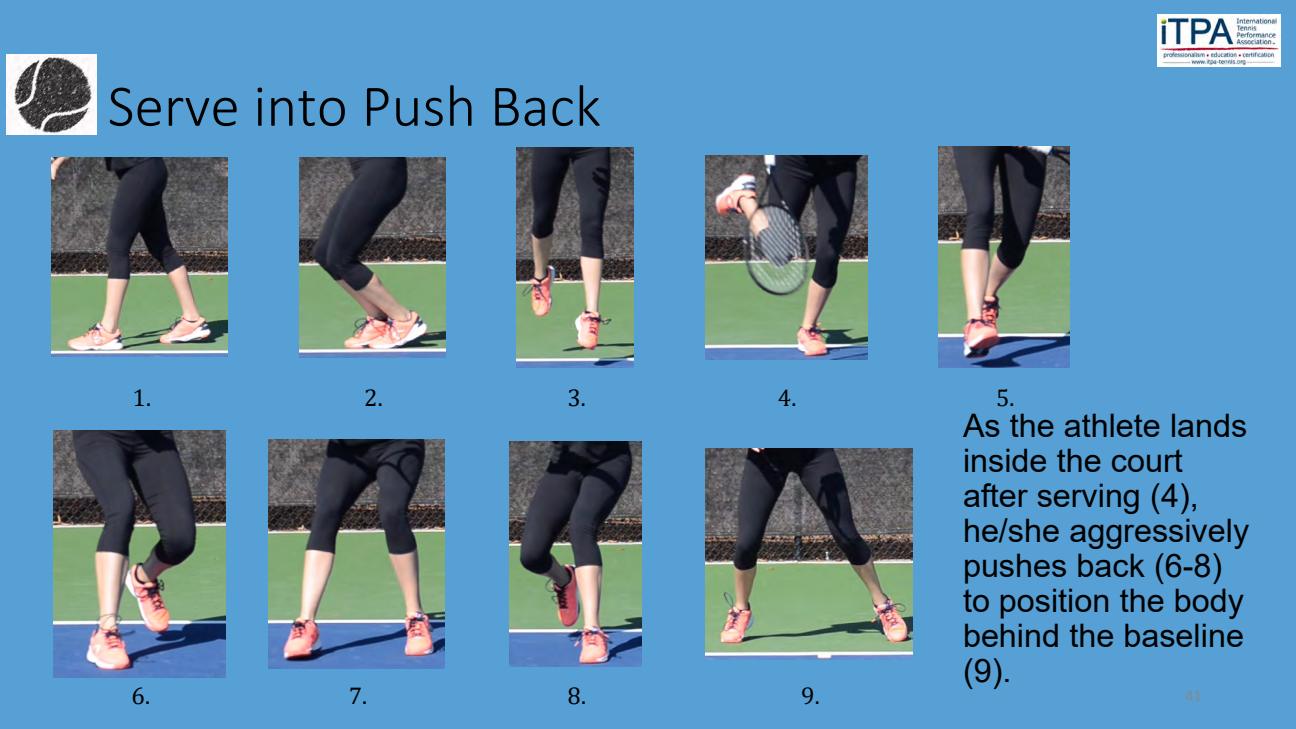
Serve into Push Back
As the athlete lands inside the court after serving (4), he/she aggressively pushes back (6-8) to position the body behind the baseline (9).
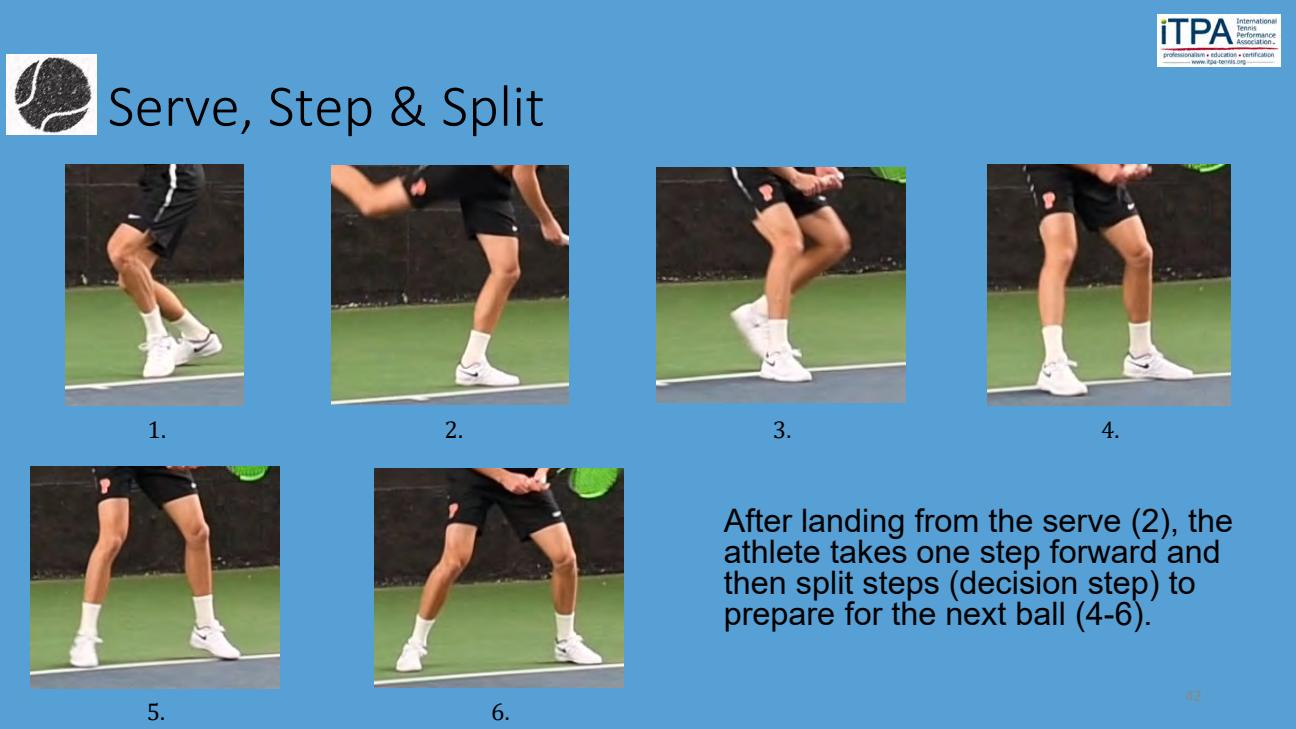
Serve, Step & Split
After landing from the serve (2), the athlete takes one step forward and then split steps (decision step) to prepare for the next ball (4-6).
Overhead
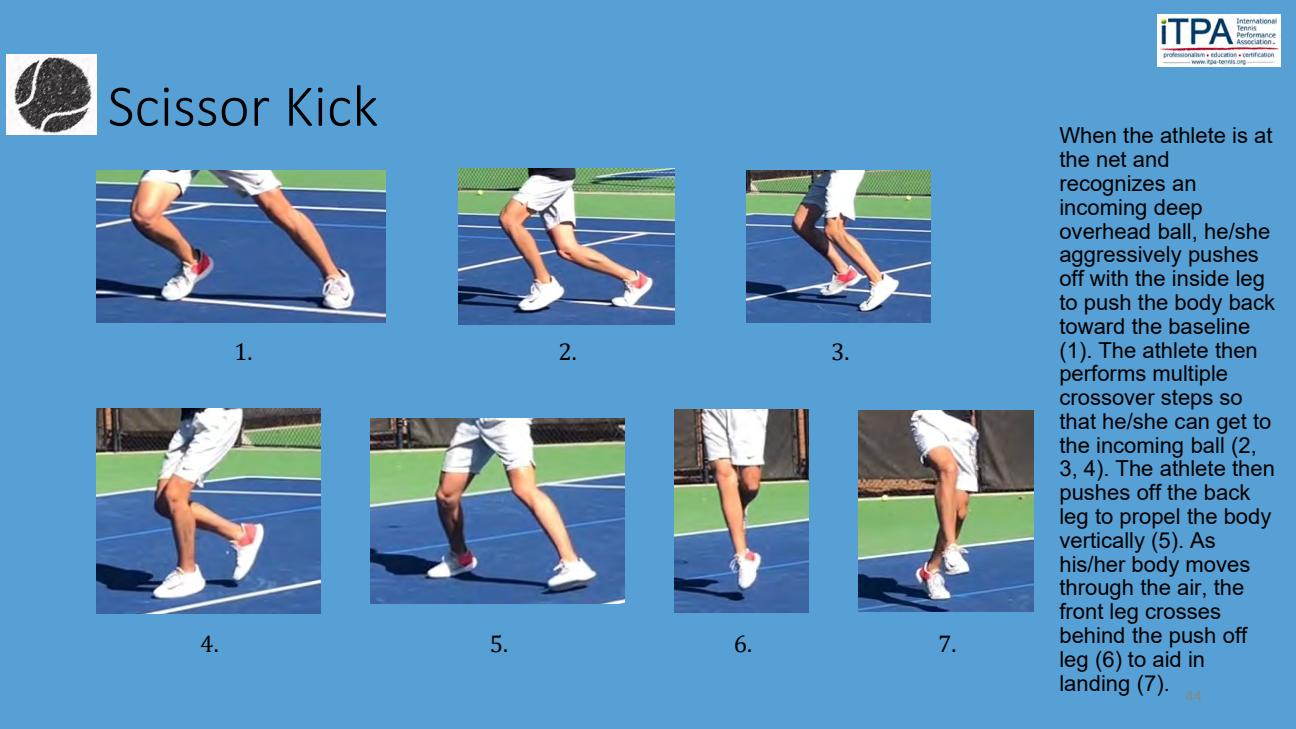
Scissor Kick
When the athlete is at the net and recognizes an incoming deep overhead ball, he/she aggressively pushes off with the inside leg to push the body back toward the baseline (1). The athlete then performs multiple crossover steps so that he/she can get to the incoming ball (2, 3, 4). The athlete then pushes off the back leg to propel the body vertically (5). As his/her body moves through the air, the front leg crosses behind the push off leg (6) to aid in landing (7).
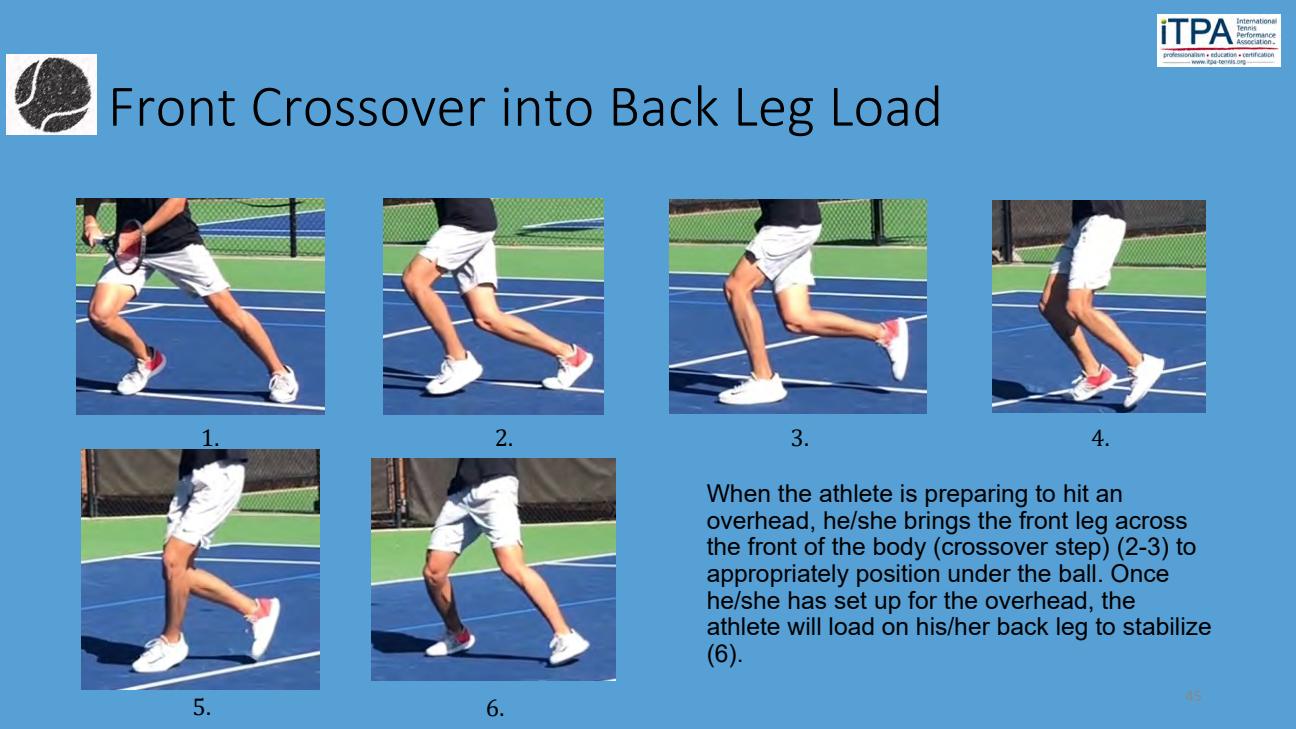
Front Crossover into Back Leg Load
When the athlete is preparing to hit an overhead, he/she brings the front leg across the front of the body (crossover step) (2-3) to appropriately position under the ball. Once he/she has set up for the overhead, the athlete will load on his/her back leg to stabilize (6).
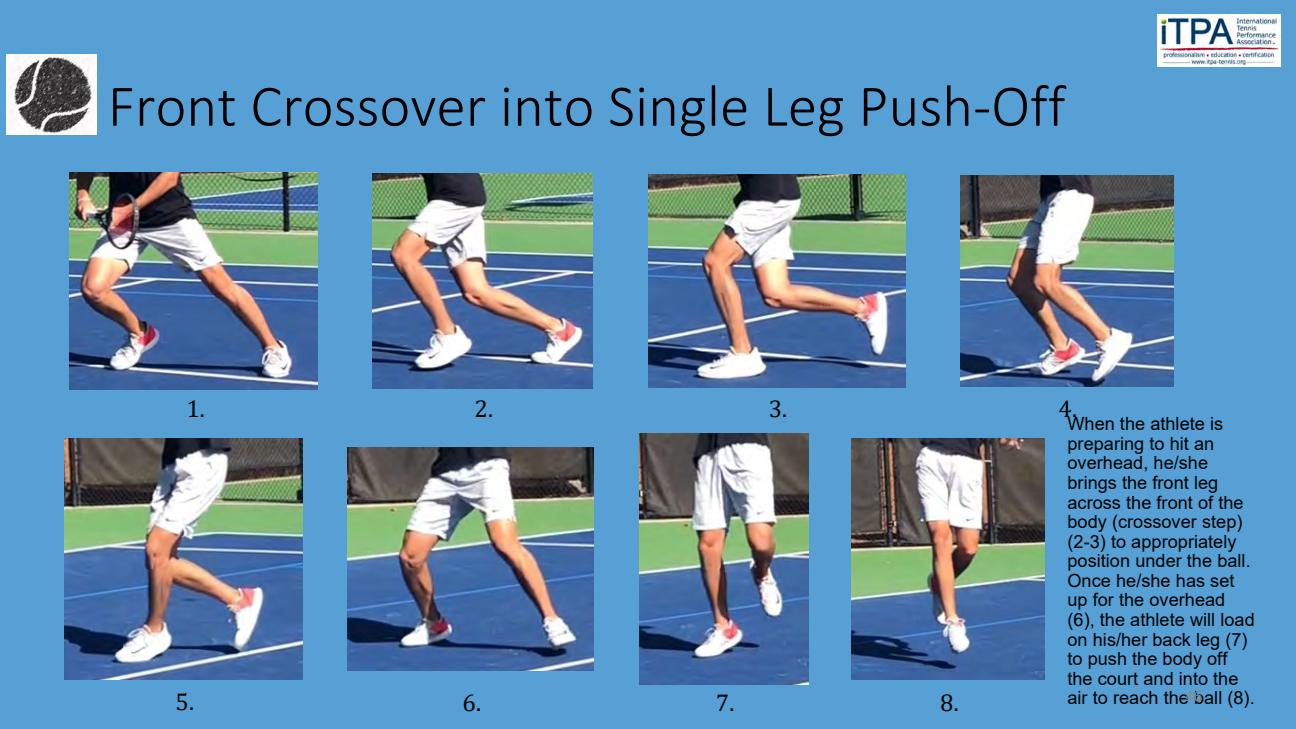
Front Crossover into Single Leg Push-Off
When the athlete is preparing to hit an overhead, he/she brings the front leg across the front of the body (crossover step) (2-3) to appropriately position under the ball. Once he/she has set up for the overhead (6), the athlete will load on his/her back leg (7) to push the body off the court and into the air to reach the ball (8).
Volleys
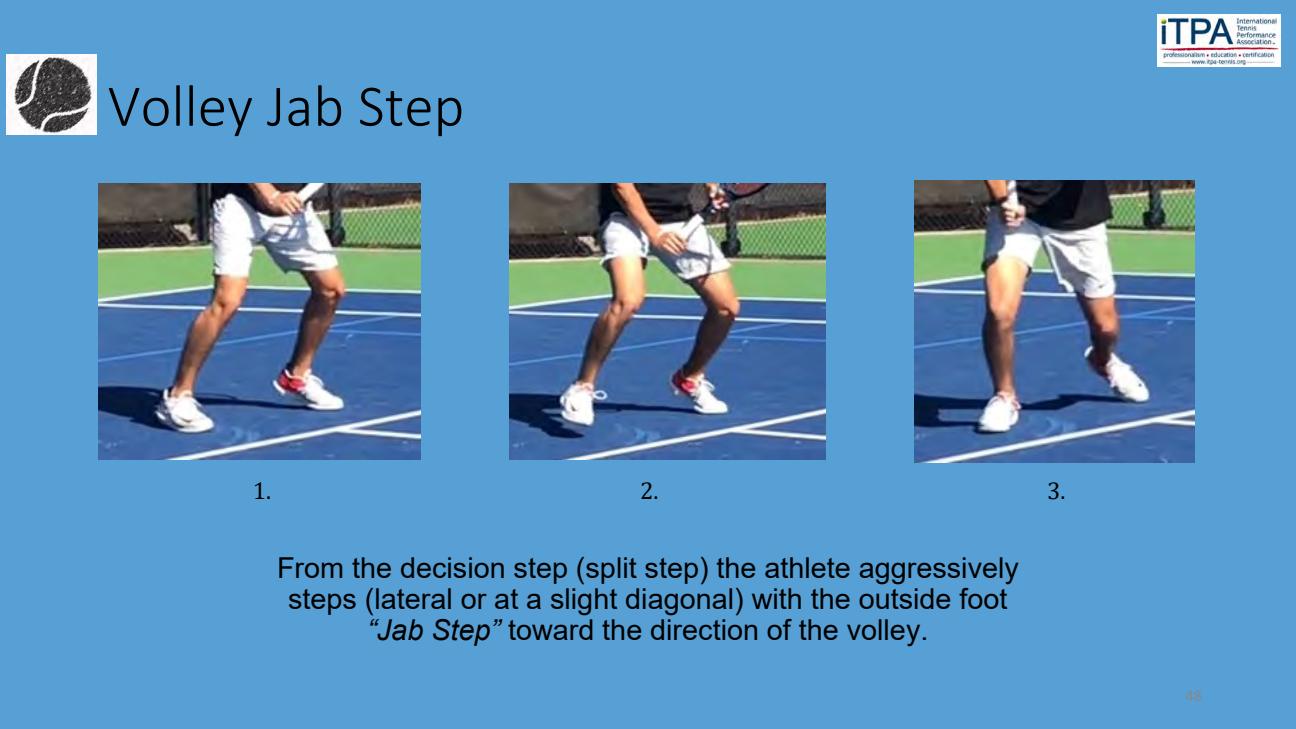
Volley Jab Step
From the decision step (split step) the athlete aggressively steps (lateral or at a slight diagonal) with the outside foot “Jab Step” toward the direction of the volley.
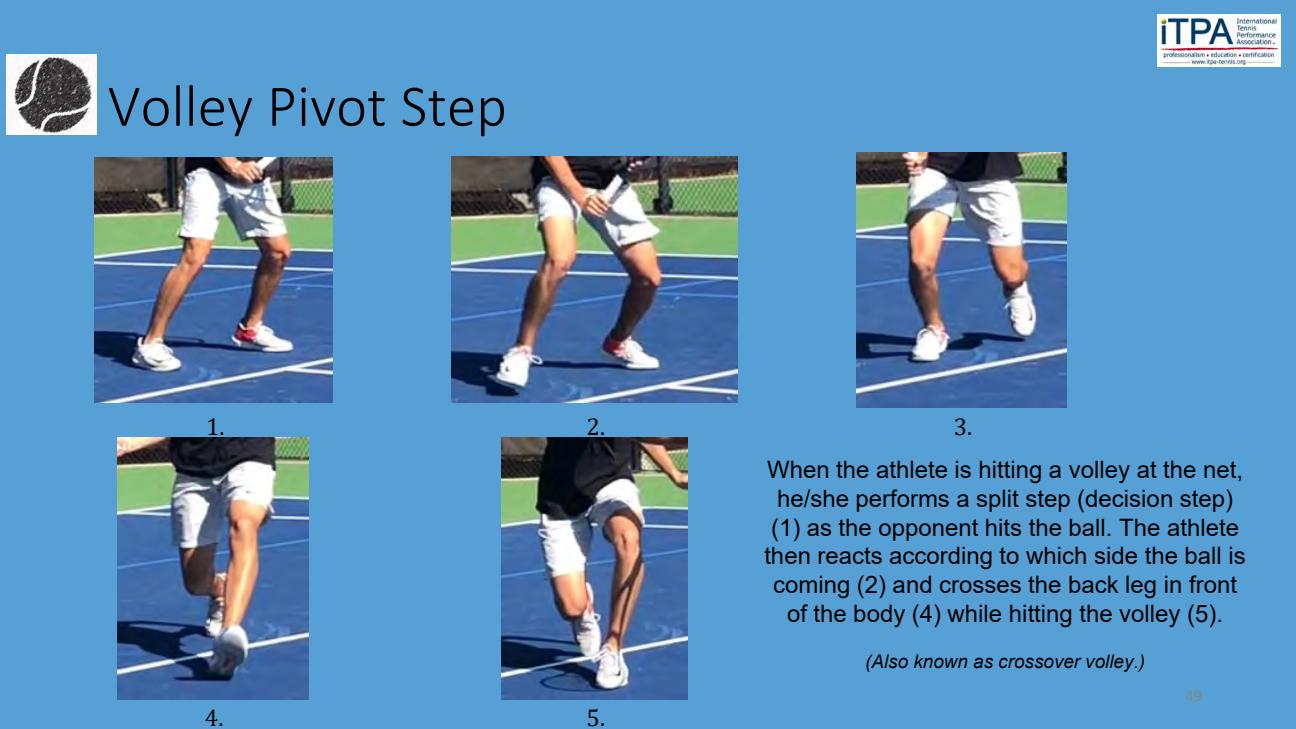
Volley Pivot Step
When the athlete is hitting a volley at the net, he/she performs a split step (decision step) (1) as the opponent hits the ball. The athlete then reacts according to which side the ball is coming (2) and crosses the back leg in front of the body (4) while hitting the volley (5). (Also known as crossover volley.)
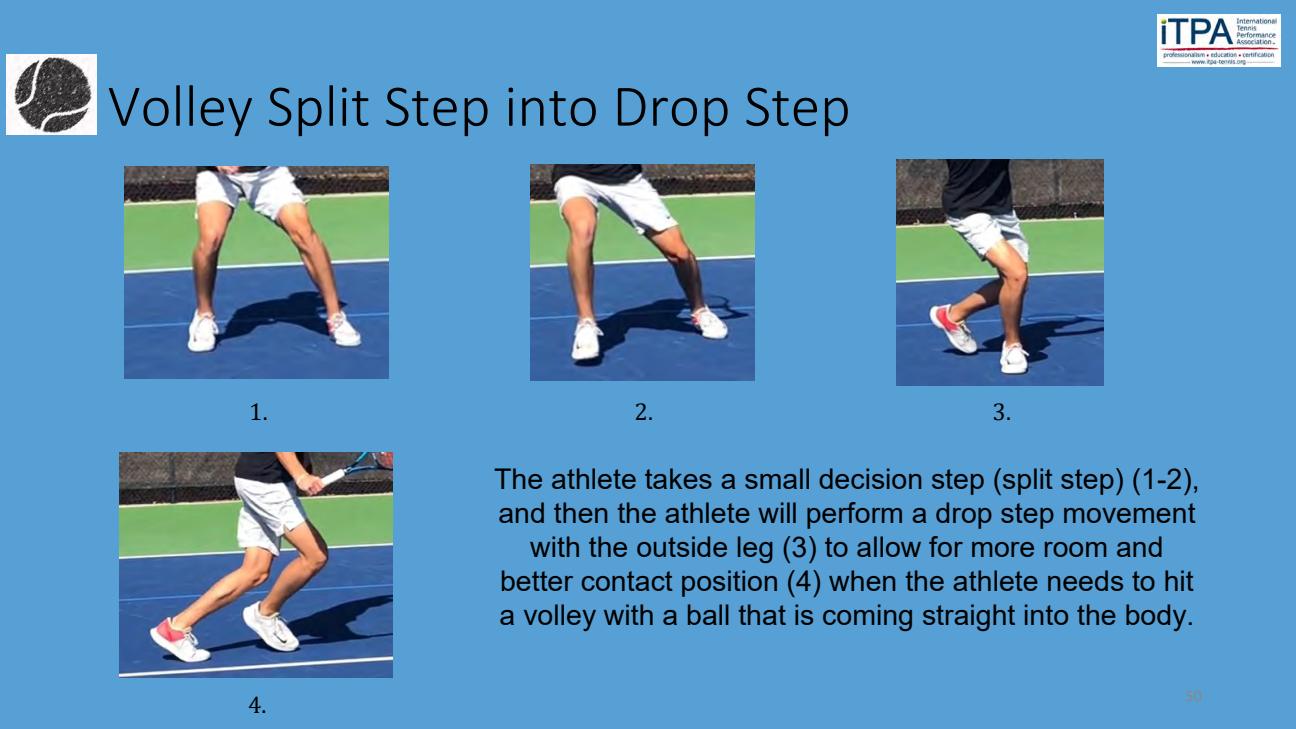
Volley Split Step into Drop Step
The athlete takes a small decision step (split step) (1-2), and then the athlete will perform a drop step movement with the outside leg (3) to allow for more room and better contact position (4) when the athlete needs to hit a volley with a ball that is coming straight into the body.
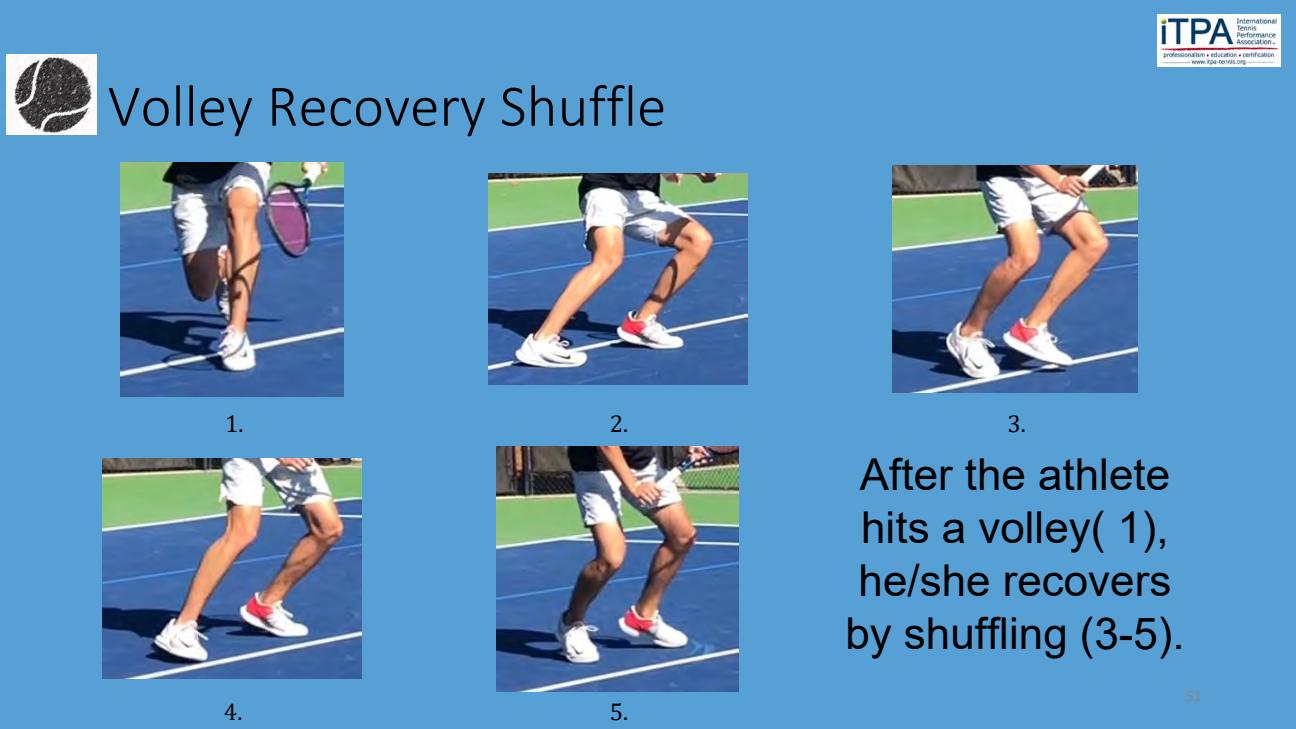
Volley Recovery Shuffle
After the athlete hits a volley (1), he/she recovers by shuffling (3-5).
About the iTPA
International Tennis Performance Association (iTPA) is the worldwide tennis fitness education and tennis certification organization for trainers, coaches and specialists who have a passion for tennis-specific performance enhancement and injury prevention. Through quality evidence-based fitness and sport science education, the iTPA is the leader in tennis-specific performance, education and certification for individuals and organizations working within the tennis industry. The iTPA offers 3 levels of certification: Tennis Performance Trainer (TPT), Certified Tennis Performance Specialist (CTPS) and Master Tennis Performance Specialist (MTPS).