Modern Tennis Forehand Biomechanics: ISR, Pronation & Contact Geometry
Core Kinetic Principle: True forehand whip is created by a proximal-to-distal energy handover: Internal Shoulder Rotation (ISR) generates 35–45% of racket head speed peaking 50 ms before impact (~1,000°/s), handing over to Forearm Pronation which peaks 30 ms after impact (~750°/s) to drive the modern windshield wiper topspin finish.
1. The Kinetic Timeline: ISR and Pronation Coordination
The following biomechanical timing chart illustrates the exact angular velocity trajectories of the upper arm and forearm from racket lag through follow-through:
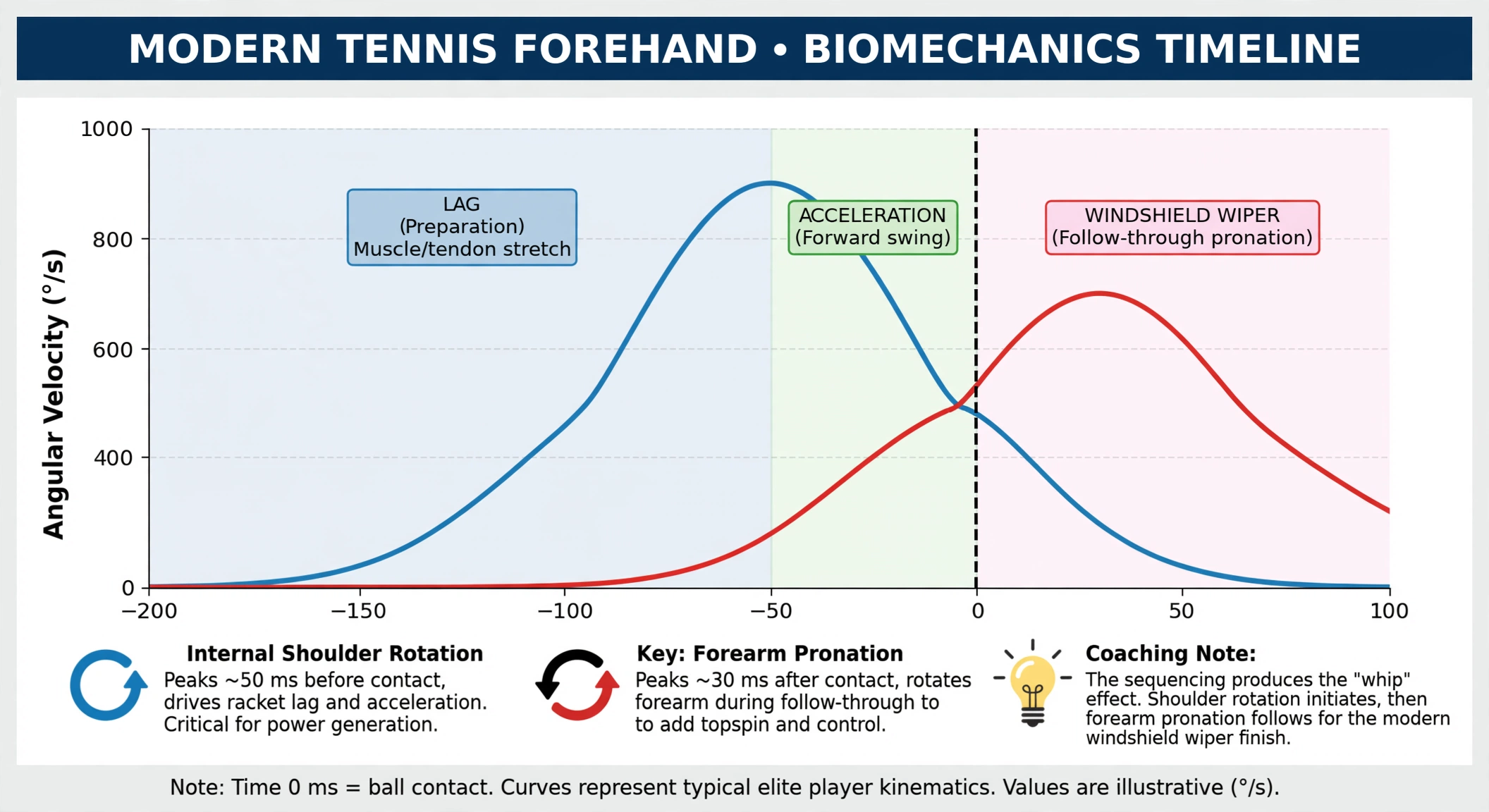
Figure 1: Biomechanics Timeline — Internal Shoulder Rotation (blue curve) peaks ~50 ms before contact at ~1,000°/s, intersecting with Forearm Pronation (red curve) at impact (t = 0 ms, ~500°/s), which then peaks during the windshield wiper finish at ~750°/s.
2. Physics of Ball Collision & String Interaction
During the minute 4 to 5 millisecond dwell window, the tennis ball flattens by up to 50% of its diameter, interacting with the strings through two distinct mechanical forces:
- Normal Force (Perpendicular Compression): The string bed deflects backward 1–2 cm, storing elastic strain energy and propelling the ball forward via the trampoline effect.
- Tangential Force (Snapback Friction): Modern polyester main strings slide laterally and violently snap back, generating explosive topspin ($2,000 - 3,500+\text{ RPM}$).
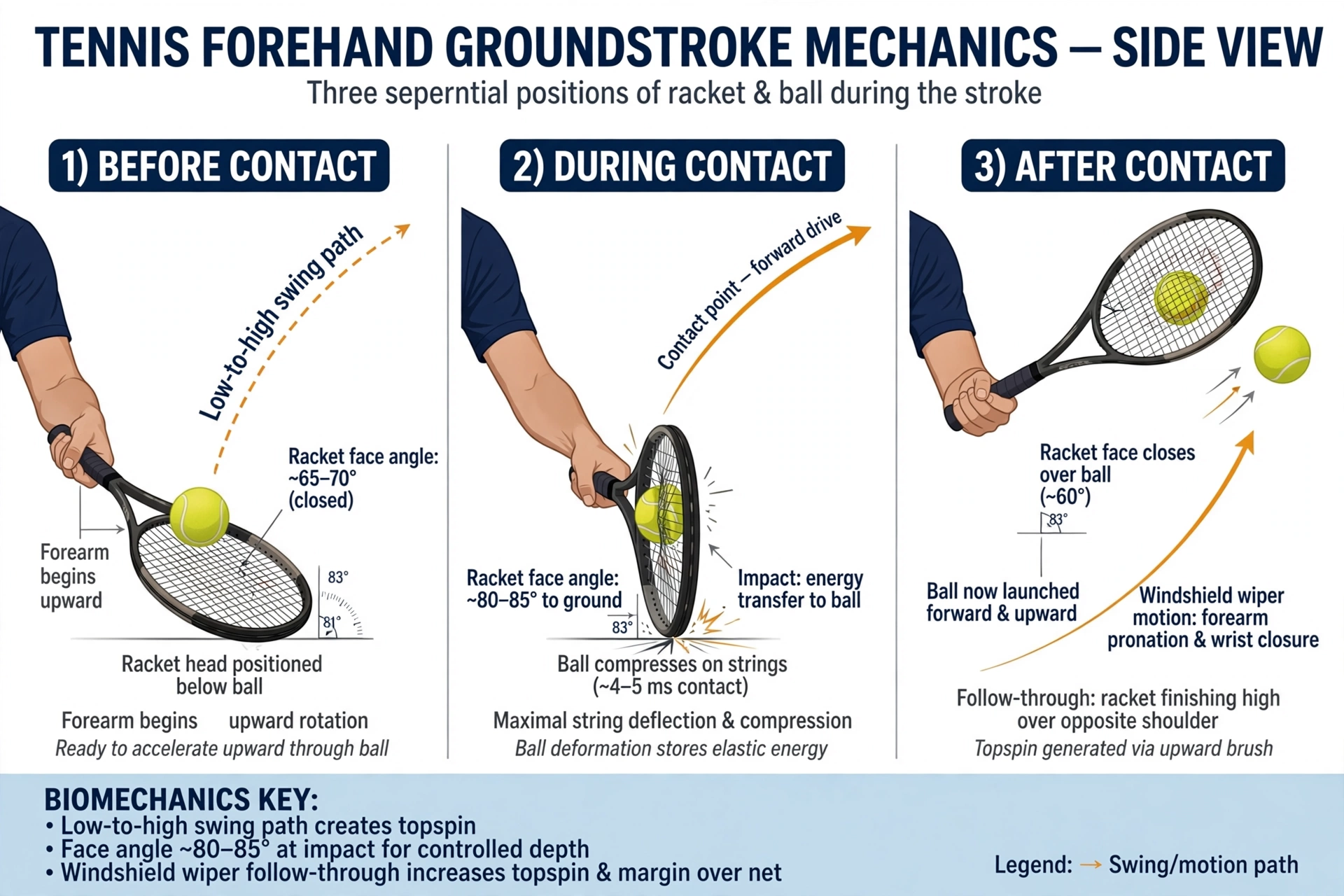
Figure 2: Sequential Stroke Mechanics (Side View) — 1) Before Contact: Racket below ball, face angle ~65–70° closed; 2) During Contact: Ball compresses 4–5 ms, face angle ~80–85° to ground; 3) After Contact: Windshield wiper pronation closes face over ball (~60°) finishing high over opposite shoulder.
3. Grip Geometry & Spatial Contact Distance
As the player shifts their grip clockwise from Eastern to Semi-Western and Western, the optimal contact point moves progressively farther out in front of the forward hip:
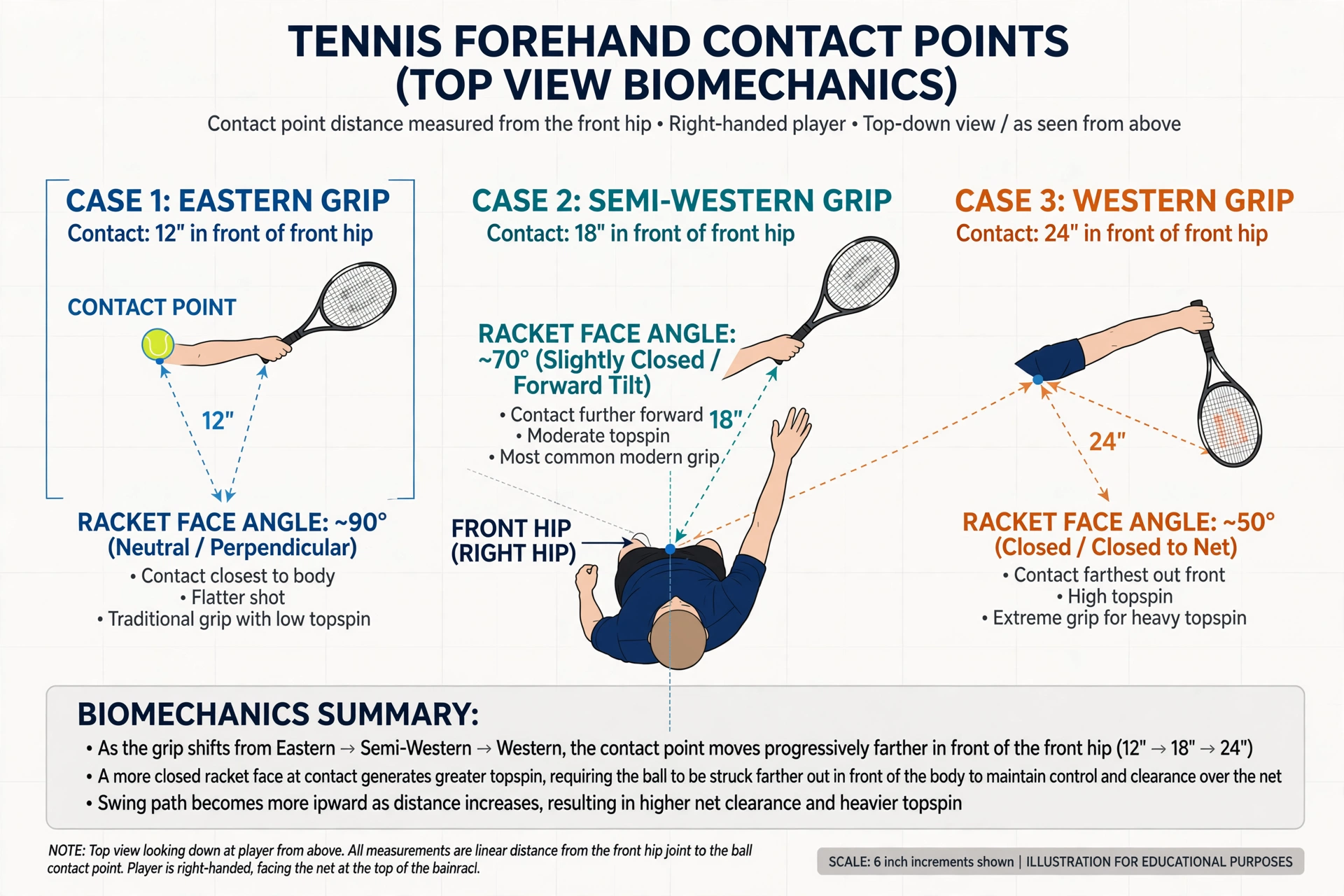
Figure 3: Top-Down Contact Geometry — Case 1: Eastern Grip (12" in front, ~90° vertical face); Case 2: Semi-Western Grip (18" in front, ~70–85° closed forward tilt); Case 3: Western Grip (24" in front, ~50–60° closed to net).
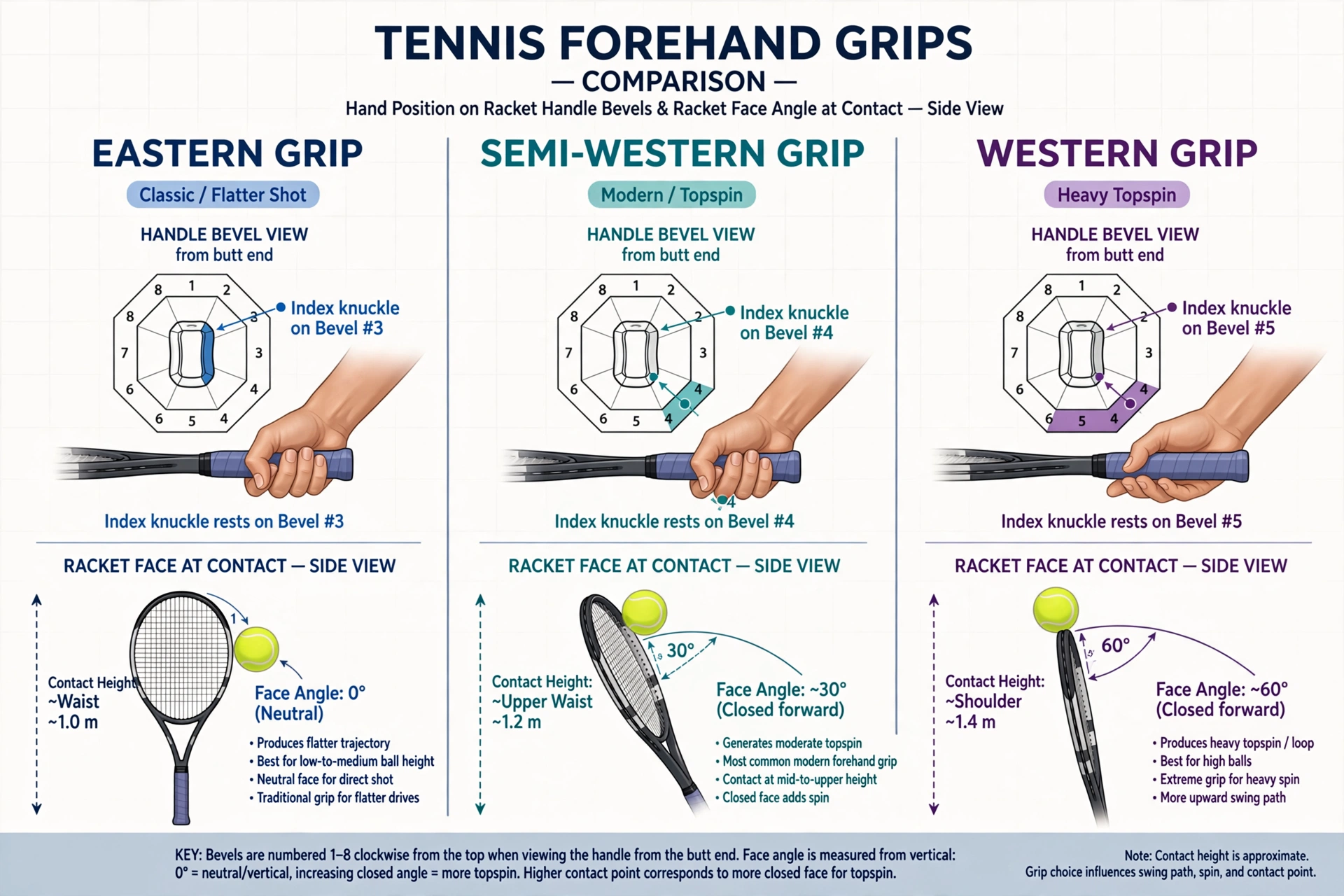
Figure 4: Handle Bevels & Side-View Contact Height — Eastern (Bevel #3, waist height ~1.0 m); Semi-Western (Bevel #4, upper waist ~1.2 m); Western (Bevel #5, chest/shoulder height ~1.4 m).
4. Grip-Specific Biomechanical Mapping Table
| Biomechanical Metric | Eastern (Bevel 3) | Semi-Western (Bevel 4 — Modern Standard) | Western (Bevel 5) |
|---|---|---|---|
| Contact Point Offset | 12 inches (30 cm) in front | 18 inches (45 cm) in front | 24 inches (60 cm) in front |
| ISR Velocity Peak | -30 ms at 800°/s | -50 ms at 1,000°/s | -60 ms at 1,150°/s |
| Pronation Initiation | -40 ms | -75 ms | -95 ms |
| Pronation Velocity Peak | +35 ms at 450°/s | +25 ms at 700°/s | +15 ms at 850°/s |
| Wrist at Impact | Moderate extension | Strong extension + slight supination | Extreme extension + supination |
| Dominant Power Mechanism | Linear ISR-dominant (1,200–1,800 RPM) | Balanced ISR / Pronation overlap (2,000–3,000 RPM) | Angular Pronation-dominant (3,000+ RPM) |
5. Video Demonstrations & Coaching Analysis
6. Common Technical Errors & Neuromuscular Drills
The Golden Angle Rule: At contact, the racket face must be slightly closed at $80^\circ - 85^\circ$. Closing the face prematurely (<75°) dumps the ball into the net; opening it (>90°) sends the ball flying over the baseline.
Drill 1: The Axillary Towel Lag Drill
Tuck a small towel under the hitting armpit. Practice slow-motion forward swings. The towel must remain secure during early body rotation and only fall out naturally when the shoulder accelerates into internal rotation, preventing early "arming" of the stroke.
Drill 2: The Palm-Check Impact Freeze Drill
Perform shadow swings and freeze dead at contact. Check that your hitting palm faces the side fence at an $80^\circ - 85^\circ$ forward angle, ensuring you do not prematurely roll your wrist over before the ball leaves the strings.
Drill 3: The 18-Inch Spatial Calibration Drill
Place an alignment stick 18 inches in front of your front hip. Practice self-dropping balls so impact occurs directly above the marker, cementing the modern Semi-Western contact spatial zone.
Conclusion
The modern forehand is a masterpiece of biomechanical sequencing. By coordinating **Internal Shoulder Rotation (ISR)** for raw linear velocity with **Forearm Pronation** for heavy topspin, and positioning the contact point at the exact grip-specific distance (**18 inches for Semi-Western**), players achieve effortless, heavy, and world-class ball striking.