Tennis Biomechanics: The 1-Inch Punch vs Linear Displacement
Core Biomechanical Thesis: Effortless power in tennis does not come from linear arm pushing across 1 meter of space. It comes from Bruce Lee's 1-Inch to 2-Inch Punch Principle: at the 4–5 millisecond ball compression window, the hand moves only 2.5–5 cm, releasing the accumulated kinetic energy channeled upward from an unyielding martial arts stance (Bộ Pháp / Tấn Pháp).
1. The Primary Artifact: Martial Arts Stance & Energy Transmission
The following handwritten technical document establishes the profound structural parallel between martial arts footwork/stances (Tấn Pháp) and modern tennis ball striking:
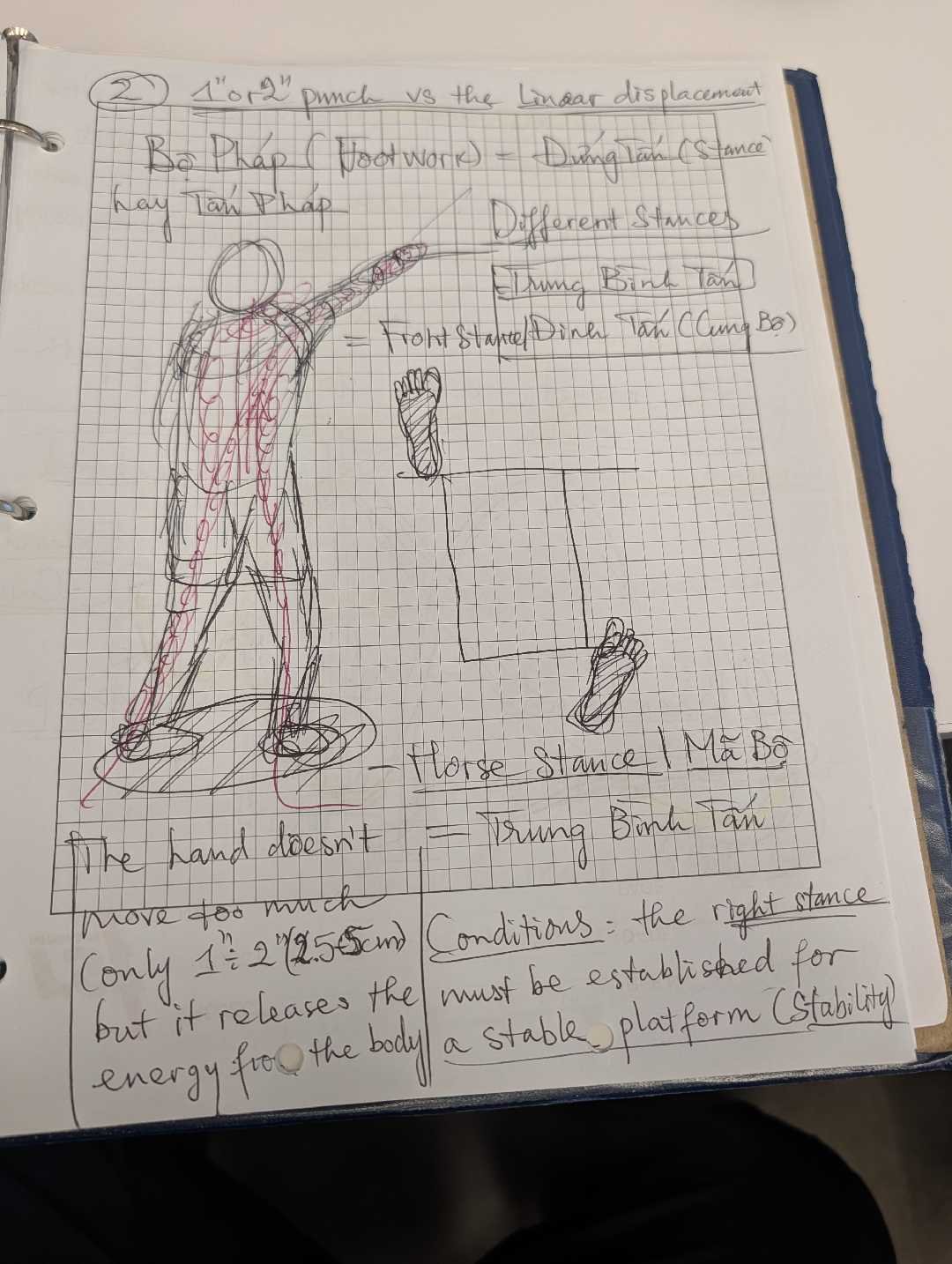
Primary Field Artifact: (2) 1" or 2" punch vs the Linear displacement, Footwork (Bộ Pháp) = Stance (Tấn Pháp), Front Stance (Đinh Tấn) & Horse Stance (Mã Bộ / Trung Bình Tấn), showing the red somatic kinetic force line from the ground to the hand.
2. The Linear Displacement Fallacy vs The 1-Inch Reality
The Linear Displacement Fallacy ("Arming the Ball")
Club players frequently operate under the illusion that ball velocity is proportional to the linear distance traveled by the hitting arm. They push the racket forward through 70–100 cm of space using their shoulder and bicep muscles. Biomechanically, this triggers:
- Antagonistic Co-contraction: The biceps, anterior deltoid, and wrist flexors simultaneously contract to direct the racket, freezing the fluid kinetic chain and drastically capping racket-head speed.
- Premature Deceleration: Because muscular tension acts as an internal brake, the racket often slows down right before or during ball collision.
- Postural Collapse: Over-reaching with the arm pulls the player's Center of Mass (CoM) outside their Base of Support (BoS), causing loss of dynamic balance and causing acute strain on the elbow joint (tennis elbow).
The 1-Inch Punch Reality (Bruce Lee Kinetic Chain)
High-speed camera recordings (10,000 frames/sec) reveal that tennis ball compression on the string bed lasts merely $4 - 5\text{ ms}$. During this minute window, the forward displacement of the hitting hand independent of body rotation is only $2.5 - 5\text{ cm}$ ($1 - 2\text{ inches}$)!
The hand is simply the terminal nozzle delivering concentrated somatic impulse accumulated from the ground up.
3. Stance Foundations: Horse Stance (Mã Bộ) & Front Stance (Đinh Tấn)
In traditional martial arts, Bộ Pháp (Footwork) is fundamentally rooted in Tấn Pháp (Stance Posture). In tennis, you cannot generate clean kinetic energy without anchoring to the court:
| Martial Stance | Tennis Stance Analogue | Load Distribution | Biomechanical Function |
|---|---|---|---|
| Horse Stance (Mã Bộ / Trung Bình Tấn) | Modern Open & Semi-Open Stance (Federer, Djokovic, Sinner, Alcaraz) | 50% Left / 50% Right; CoM sunk deeply between wide feet | Maximizes vertical Ground Reaction Force ($F_z > 2.0\text{x BW}$) and explosive rotational torque ($T_z$) around the vertical spinal axis. |
| Front Stance (Đinh Tấn / Cung Bộ) | Neutral / Step-In Stance (Approach shots, Drive volleys, 1H Backhand) | 60–70% Front Leg, 30–40% Rear Leg pushing obliquely | Acts as a linear-to-rotational kinetic brake, driving momentum forward through the baseline vector for heavy penetrating ball depth. |
4. The Kinetic Chain Vector: The Red Force Line
As drawn in the original schematic, energy flows through six distinct mechanical hubs:
- Ground Friction & Foot Root: The feet form a stable circular footprint. No premature heel lift.
- Knee Extension: Quadriceps and calf complex push against the court via Newton's 3rd Law.
- Hip Rotation ("The Transmission Gearbox"): Pelvic angular velocity reaches $400^\circ - 600^\circ/\text{s}$, pulling the torso into tension.
- Core & Oblique Coil: The abdominal wall stores elastic energy in the stretch-shortening cycle (SSC).
- Scapular Protraction & Shoulder Internal Rotation: The chest and shoulder unwind, catapulting the arm.
- Terminal Hand Release: The hand releases the impulse into the handle through a compact 2.5–5 cm contact collision.
5. Video Demonstrations & Biomechanical Breakdowns
6. Key Faults & Field Drills
Crucial Rule of Stability: Power cannot be expressed without an uncompromised base of support. You cannot fire a cannon from a canoe!
Drill 1: The Wall Horse Stance 1-Inch Punch Drill
Stand in a wide Horse Stance (Mã Bộ) with your back lightly touching a wall. Place a foam pad or tennis ball 2.5 cm away from your knuckles. Without pulling your fist back, drive through your feet and snap your hips to pop the pad. Notice how power is entirely generated by the lower body.
Drill 2: The Front Stance (Đinh Tấn) Solid-Base Strike
Step forward into a classic Front Stance, bending your front knee to $120^\circ$ and keeping your rear heel grounded. Hit incoming balls focusing exclusively on feeling the ball dwell on the string bed for 2.5–5 cm, without lunging or extending your arm excessively forward.
Conclusion
True tennis power is not linear displacement; it is **concentrated impulse**. By mastering **Bộ Pháp (Footwork)** and grounding through **Mã Bộ (Horse Stance)** and **Đinh Tấn (Front Stance)**, players transform the hitting hand into a lethal, relaxed conduit delivering maximum energy in a single 1-to-2 inch burst.