Tennis Biomechanics: Plane of Swing vs Stance vs Shot Type
The Core Biomechanical Axiom: Shot direction in modern tennis is not steered by the wrist—it is engineered from the ground up: "Open for Cross-Court (C-C), Closed for Down-The-Line (DTL)". Aligning the stance geometry at the optimal $45^\circ$ angle creates the necessary kinetic rotational corridor, while closed vertical foot-stacking enforces a linear baseline-to-net driving plane.
1. The Four-Quadrant Technical Blueprint
The following high-resolution technical diagram establishes the exact foot alignments, swing planes, and ball trajectory vectors across all four fundamental groundstroke scenarios:
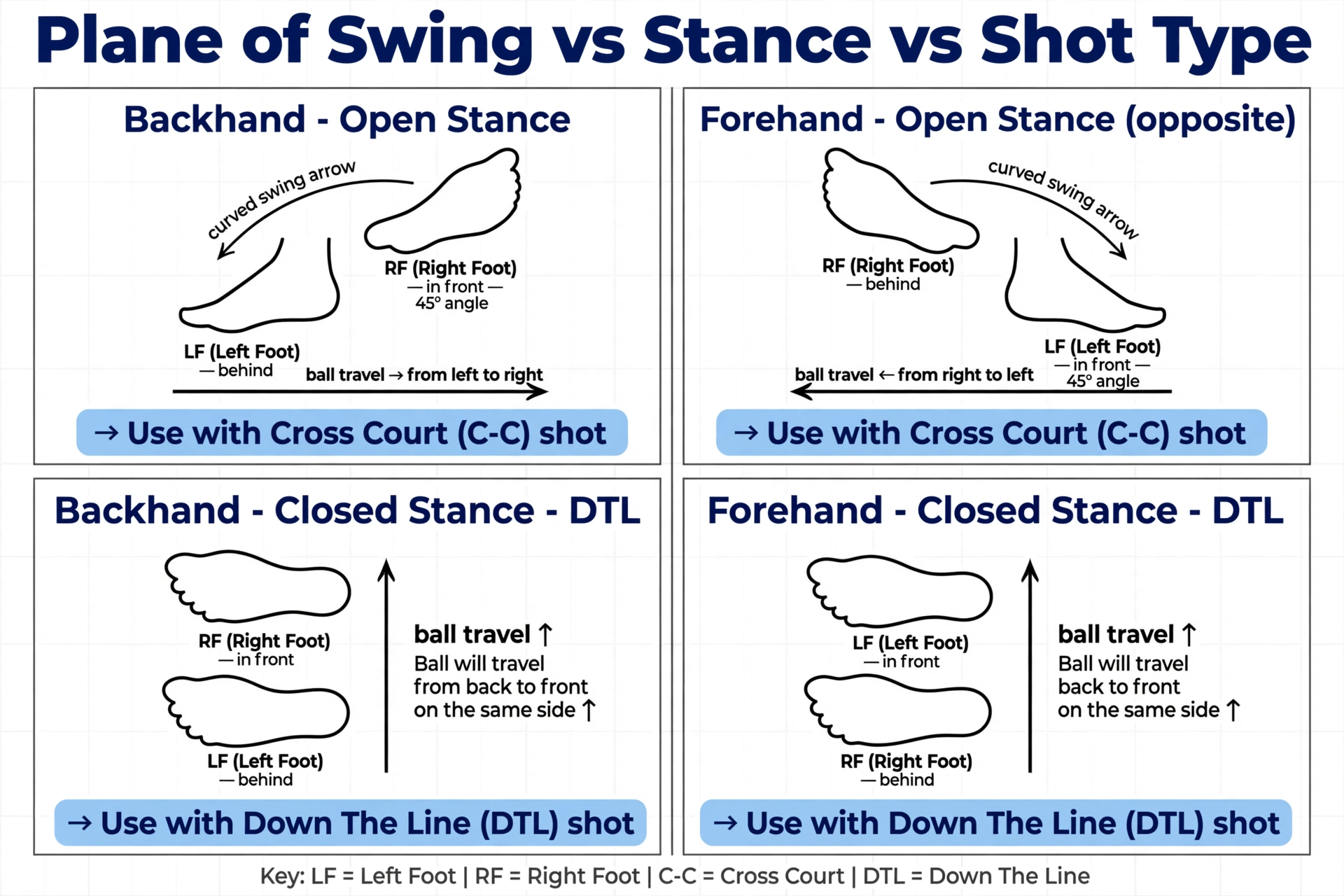
Master Technical Blueprint: Backhand Open Stance (C-C), Forehand Open Stance (C-C), Backhand Closed Stance (DTL), Forehand Closed Stance (DTL). Key: LF = Left Foot | RF = Right Foot | C-C = Cross Court | DTL = Down The Line.
2. Decoded Nomenclature & Core Biomechanical Parameters
- LF (Left Foot) & RF (Right Foot): Orientation of the lead and rear foot units.
- C-C (Cross-Court): Diagonal target trajectory. Offers the highest margin of safety in tennis: longest court diagonal ($25.14\text{ m}$) and lowest net clearance at center ($0.914\text{ m}$).
- DTL (Down-The-Line):** Straight sideline attack. Shorter distance ($23.77\text{ m}$) and higher net obstacle ($1.07\text{ m}$ at posts), demanding uncompromising directional stability.
- The $45^\circ$ Stance Flaring: The golden angle of modern open/semi-open stances, providing optimal pelvic rotation clearance while preserving lateral recovery friction.
3. Comprehensive Four-Quadrant Kinematic Analysis
| Scenario | Foot Configuration | Swing Plane Arc | Ball Trajectory & Target | Contact Point Timing |
|---|---|---|---|---|
| Backhand — Open Stance | LF behind, RF in front flared at $45^\circ$ angle | Curved rotational uncoiling arc | Left to Right across court (Cross-Court) | Early contact, well out in front of forward hip |
| Forehand — Open Stance | RF behind, LF in front flared at $45^\circ$ angle | Curved centrifugal arc across the torso | Right to Left across court (Cross-Court) | Early contact, $30\text{ cm}$ in front of lead toe |
| Backhand — Closed Stance | RF stepped across in front, LF behind (linear stack) | Linear back-to-front driving corridor | Back to front along same side (Down-The-Line) | Slightly later, adjacent to forward hip plane |
| Forehand — Closed Stance | LF stepped across in front, RF behind (linear stack) | Linear baseline-to-net driving corridor | Back to front along same side (Down-The-Line) | Slightly later, adjacent to forward hip plane |
4. Video Breakdowns & Biomechanical Analysis
5. Critical Biomechanical Nuances
5.1 Contact Point Depth: Open vs Closed
A fatal mistake among intermediate players is attempting to hit down-the-line with an early, open-stance contact point. When the body is rotating rapidly, contacting the ball too far in front naturally hooks the shot cross-court:
- Open Stance (C-C): Catch the ball at the apex of rotational uncoiling, out in front of the body.
- Closed Stance (DTL): Allow the ball to travel deeper into the hitting zone (adjacent to the lead hip) so the racket face stays square to the sideline corridor through impact.
5.2 The 45° Angle Sweet Spot
A pure $90^\circ$ open stance (toes pointing directly at the net) risks excessive lateral rotation with zero linear penetration. Conversely, a fully parallel closed stance ($0^\circ$) can jam the lead hip. The $45^\circ$ angular flaring represents the biomechanical sweet spot: maximizing rotational torque while preserving stability and recovery speed.
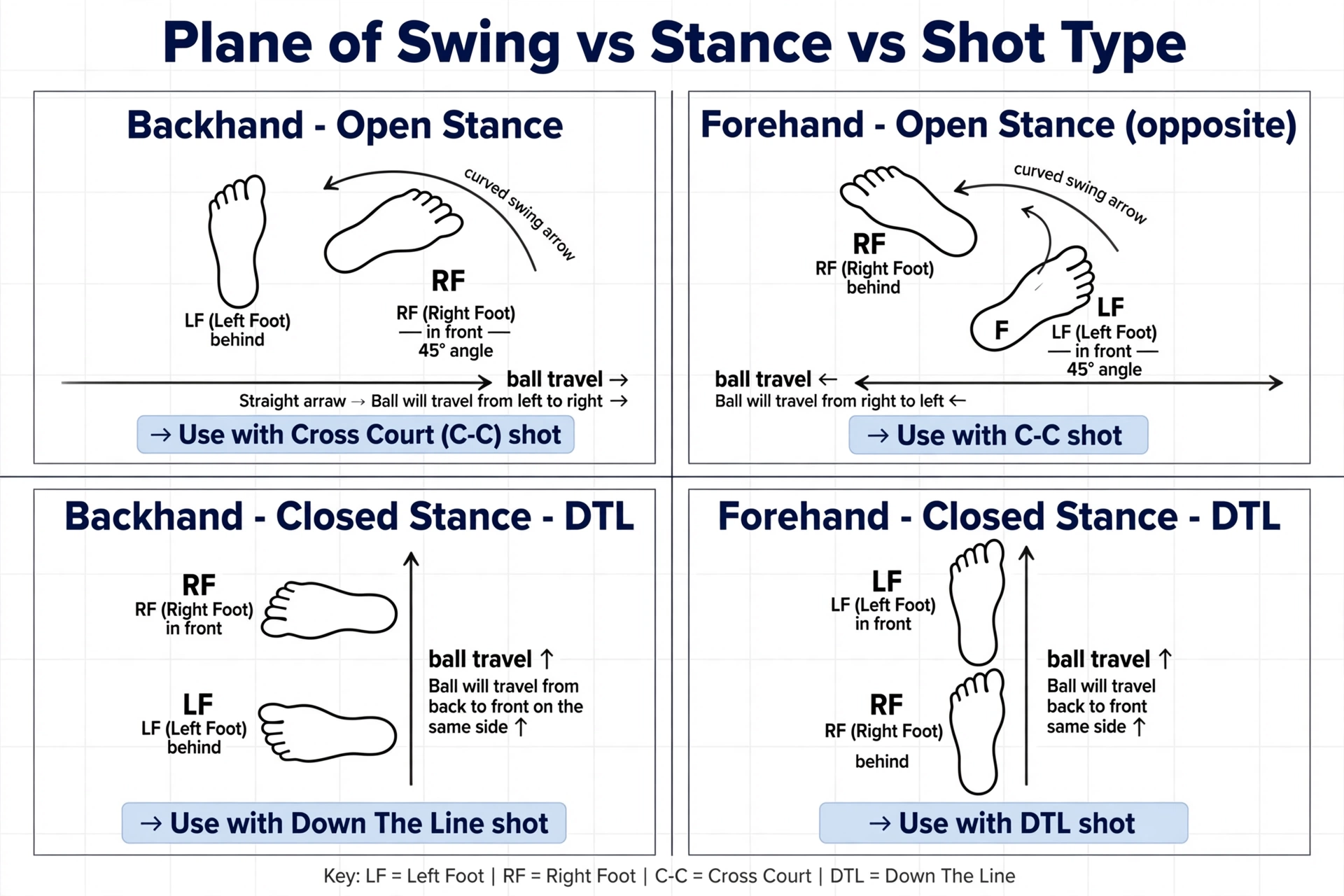
Original Field Research Sketch: Mapping foot angles (RF / LF) and swing paths for Cross-Court and Down-The-Line trajectories.
Conclusion
Target accuracy in tennis is governed by stance engineering. By internalizing the principle: **"Open for Cross-Court, Closed for Down-The-Line"** and coordinating contact point depth with stance alignment, players develop lethal shot precision, effortless power, and impenetrable tactical court coverage.