Beyond Taiji
Taiji is not the only internal art with something to say about the feet. On the same shelf sit xingyiquan, baguazhang and the Chen-style combat applications — three systems whose footwork looks nothing like taiji’s and yet rests on the same two ideas: know which foot is full, and let the waist lead. This article reads what each of the three actually teaches about stepping.
Three More Schools
The three are usually grouped with taiji as the “internal” family, but their footwork starts from very different places. Xingyi is the most direct: it advances in straight lines and its basic practice is a standing post, not a form. Bagua is defined by its footwork — the whole art is organised around walking a circle. Chen-style taiji is the oldest of the taiji lineages and keeps the explosive, stamping footwork that later styles softened.
What makes them worth reading together is that they disagree about everything except the two rules taiji also insists on. That agreement is the interesting part: three systems that look completely different on the floor converge on the same weight logic.
Xingyi: The Standing Post
Xingyi’s basic training posture (san ti shi) is a standing post with a clear front/rear weight split, held still for long periods. The point of the stillness is that it makes the weight distribution undeniable: if you are standing 50/50, the posture tells you within a minute. The Vietnamese rendering keeps the logic plain — the stance teaches the body to hold one foot full and the other empty while doing nothing else, which is the same skill taiji calls phân hư thực.
Xingyi then moves in straight lines, advancing by driving off the rear leg. There is no lateral stepping vocabulary to speak of; the art solves the problem of angles by moving forward and turning at the last moment. The transfer is narrow but sharp: the rear-leg drive is exactly the mechanic behind a forceful first step.
Bagua: Circle Walking
Bagua is the only one of the three whose footwork is its curriculum. The core practice is walking a circle, and the tradition describes movement in the six directions along that circle. The step itself — the “mud-walking step” — has the moving foot slide forward close to the supporting foot, toe first, before the weight follows. Everything is trained at an angle to the opponent rather than head-on.
The court transfer is the most literal on this whole shelf. Lateral movement along a curved path, taken with a controlled sliding step and the weight arriving late, is precisely what a player does when recovering along the baseline. Bagua is the only art here that trains that specific pattern as its main practice rather than as a drill.
Chen: Explosive Stamping
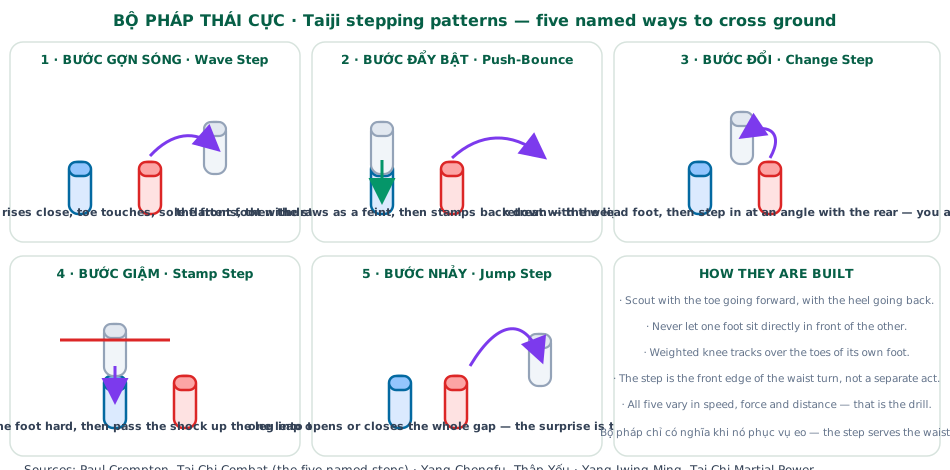
Chen-style keeps what later taiji styles smoothed out. Its combat applications (kỹ kích pháp) use stamping steps to deliver weight downward into a strike, and the step is taught as a genuine drop of the whole body, not a tap of the foot. This is the same stamp step that appears in Paul Crompton’s five named steps, and the sources treat it identically: a specialist tool for delivering weight, not a way to travel.
The caution the sources attach is worth keeping. A stamping step is loud, committed and hard to reverse. It belongs to moments where the strike is the point, and Chen-style uses it that way.
What They Share
Two rules survive across all three.
- One foot is full. Xingyi’s standing post, bagua’s circle walk and Chen’s explosive entry all require a decisive weight split at every instant. None of the three has an “equal weight” posture, and the double-weighting fault (trùng lượng) is named in all of them.
- The waist leads. All three turn the body from the waist and let the feet follow, which is the same instruction Yang Chengfu gives as “relax the waist” and “the waist is the master of the whole body.” Three systems with nothing else in common agree on this because it is mechanics, not doctrine.
On the Tennis Court
1. Take the lateral drill from bagua. Circle walking is the closest thing in any martial art to baseline recovery: a controlled slide along a curve with the weight arriving late. Players who train lateral movement usually train it as shuttle runs; bagua trains it as the art itself.
2. Take the first step from xingyi. The straight rear-leg drive is the mechanic behind an explosive first step. Xingyi trains it in isolation, which is more than most footwork drills do.
3. Keep the stamp in its box. Chen’s stamping step is for delivering weight into a committed strike. It is not a movement pattern, and players who adopt it as one trade away the elastic return they need for the next shot.
Source Books
Kỹ Thuật Thực Chiến Thái Cực, Hình Ý & Bát Quái (Combat Techniques of Taiji, Xingyi and Bagua) — xingyi’s standing post and bagua’s circle walking: combat_techniques_taiji_xingyi_bagua_vi
Mã Hồng, Trần Thức Thái Cực Quyền Kỹ Kích Pháp (Chen-style combat applications) — the explosive stamping step: chen_style_combat_applications_ma_hong_vi
Cross-checked against Paul Crompton’s Thực Chiến Thái Cực Quyền on the stamp step and Yang Chengfu’s Thập Yếu on the waist: paul_crompton_tai_chi_combat_vi · yang_chengfu_ten_essential_points_vi
All quotations translated from the Vietnamese readers of these editions. Diagrams are original work made for the TFL Footwork Research Project.
← Footwork on the Martial Side - Root, Pivot and Knee | TFL Footwork Research Project | Kamae and Hanmi - Aikido's Ready Posture →