Full and Empty
Before a taiji practitioner is allowed to take a single step, the tradition demands that they can answer one question about their own body: which foot is full, and which is empty? This article reads the weight-distribution rule — phân hư thực (虚實, full-and-empty) — as the first footwork skill, the error it forbids, the ratio it prescribes, and what it looks like on a tennis court.
The First Distinction
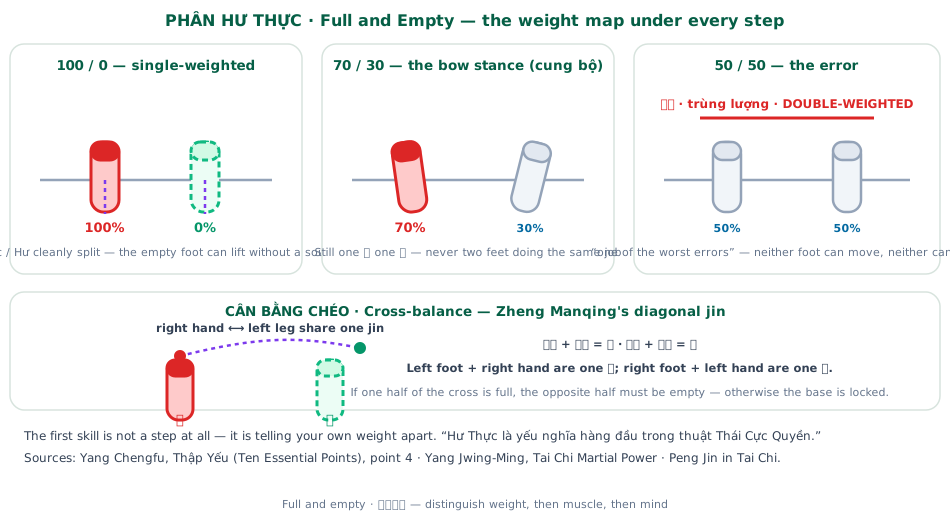
The fourth of Yang Chengfu’s Ten Essential Points is named for the distinction itself: phân hư thực, distinguish full from empty. The commentary is blunt about its importance — getting this wrong is “one of the worst errors” a student can make. “Full” means the foot that carries the body’s weight; “empty” means the foot that is free to move. At every instant, exactly one foot should be full and the other empty, and the practitioner should know which is which without looking.
Yang Jwing-Ming, in Tai Chi Martial Power, restates the same rule from the side of jing (issued force): the root must be in one leg at a time. When the root is ambiguous — weight split fifty-fifty with no decision — no force can be issued and no step can be taken cleanly. The distinction is not a posture; it is a continuous self-report the body runs while standing still.
The Double-Weighting Error
The error this rule forbids has a name: trùng lượng (雙重, double-weighting). It happens whenever weight is shared equally between two feet, or between two hands, or between a hand and the foot on the same side. The Vietnamese reader renders the diagnosis plainly: the body becomes “stuck” — it can neither deliver force nor move, because nothing is committed. Double-weighting is the single most common fault the tradition warns against, and it is the direct opposite of the crisp full/empty split the fourth point demands.
Notice the court echo. A tennis player who stands square with weight split evenly between both feet — the classic “standing on the railway line” mistake — has committed the exact double-weighting error taiji forbids. The base can neither push off nor rotate; it is stuck, exactly as the commentary says.
The Bow Stance Ratio
When taiji does commit weight, it does so to a ratio. The bow stance — the forward-weighted posture used for most strikes — is taught at roughly 70 / 30: seventy percent of the weight on the front foot, thirty on the rear. The rear foot is not empty (it still grounds thirty percent), but it is decisively lighter, which is what lets it step. Crucially, the tradition forbids the 50 / 50 split in this posture; 50 / 50 is the double-weighting error, not a neutral option. The number is a teaching device, but the point is structural: a stance must declare which foot is in charge.
Cross-Balance
A subtler rule governs the diagonal. In the Zheng Manqing / Yang Jwing-Ming lineage, the body is balanced crosswise: the right hand and the left leg share one jin, and the left hand and the right leg share another. The full foot and the active hand are on opposite sides. This is why a taiji stance never looks like a soldier at attention — the load is deliberately cross-wired so that a step and a strike can be born from the same diagonal. On the diagram, that is the “cross-balance” strip: right hand forward, left leg full, and the two connected by a single line of intent.
On the Tennis Court
Three transfers are direct.
1. Always know which foot is full. Before the split step, a player should be able to say which foot carries them. The taiji drill is the same: stand, then lift one foot an inch without shifting — if you cannot, you were double-weighted. A player who cannot lift a foot is a player who cannot move first.
2. Never land square. The 50 / 50 landing is the double-weighting error. A good recovery step lands weighted toward the direction of the next move, not balanced on both feet like a stork that forgot how to fall.
3. Use the cross-wire. The forehand drive and the right leg pushing off — or the backhand and the left leg — are the same diagonal taiji prescribes. Coaches call it “loading the leg on the hitting side”; the internal arts call it cross-balance. Same picture.
Source Books
Yang Chengfu, Thập Yếu (Ten Essential Points, point 4) — Vietnamese reader with full commentary: yang_chengfu_ten_essential_points_vi
Cross-checked against Yang Jwing-Ming, Thái Cực Quyền Vũ Lực (Tai Chi Martial Power), whose root-and-jing chapter restates the one-leg-at-a-time rule, and Bằng Kình Trong Thái Cực Quyền (Peng Jin in Tai Chi) on alignment: yang_jwing_ming_martial_power_vi · peng_jin_in_tai_chi_vi
All quotations translated from the Vietnamese readers of these editions. Diagrams are original work made for the TFL Footwork Research Project.
← The Root in the Foot - Yang Chengfu's Ten Essential Points | TFL Footwork Research Project | Named Stepping Patterns - Paul Crompton's Five Steps →