Named Stepping Patterns
Combat taiji does not teach footwork as a vague instruction to “move well.” It publishes a short, named alphabet of steps, and each name describes exactly what the feet do. This article reads that alphabet out of Paul Crompton’s Tai Chi Combat — wave, push-bounce, change, stamp, jump — and asks what a tennis player can take from a system that names its steps.
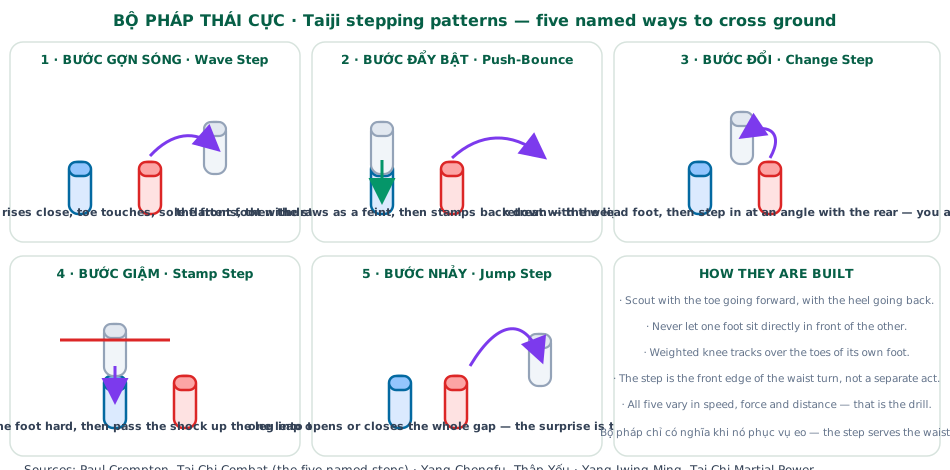
An Alphabet of Steps
The habit of naming steps is what separates a footwork system from footwork advice. Tennis has its own small alphabet — split step, first step, crossover, step-down, mogul move — and it works for exactly the same reason: a named pattern can be drilled, diagnosed and corrected. When a coach says “that was a lazy split step,” the player knows what is being corrected. Crompton’s five names do the same job inside a striking art, and the Vietnamese reader keeps them as ordinary Vietnamese words rather than transliterations: bước gợn sóng, bước đẩy bật, bước đổi, bước giậm, bước nhảy.
Each name is a mechanism, not a metaphor. The wave step moves the body on a rising-and-falling line; the push-bounce step loads and releases; the change step swaps which foot leads; the stamp step delivers weight downward; the jump step leaves the ground entirely. Nothing here is decorative.
The Wave Step
The wave step is the one taught first, because it is the ordinary walking step of the art made deliberate. Weight transfers from the rear leg to the front leg while the body stays level — the “wave” is the small rise and fall of the centre as the weight moves across, and the discipline is to keep that wave shallow. A deep wave means the body is bouncing; a flat wave means the weight has not really transferred. The instruction is to keep the head travelling at a constant height, the same cue a coach gives a player who is hopping instead of gliding into the ball.
Push-Bounce and Change
The push-bounce step is the loading step. The rear leg pushes, the body is driven forward, and the front foot arrives already loaded — the “bounce” is the elastic return the practitioner learns to feel and then to reuse rather than absorb. It is the step used to enter on an opponent, and it is what makes the difference between arriving and arriving with something.
The change step is the corrective step: it swaps which foot is forward without losing the base. In practice it is how a practitioner recovers a stance that has gone wrong, or reverses direction without a pause. This is the most directly transferable of the five, because tennis players spend most of a rally recovering and reversing, not striking.
Stamp and Jump
The stamp step delivers weight downward through a planted foot — it is the step of the Chen-style explosive applications (see the companion article on xingyi, bagua and Chen), and it is what gives a strike its drop. The jump step is the one that leaves the ground: used to close distance fast or to change level. Both are specialist steps. Neither is a general-purpose way to travel, and the sources present them that way — as tools for specific moments, not as the default.
How They Are Built
Three construction rules run underneath all five steps.
- Scout first. The moving foot goes out toe-first, heel settling after — the foot explores the ground before it accepts weight. A player who plants a flat foot first has committed before they know where the ground is.
- The knee tracks over the toes. The knee follows the direction the toes point, never collapsing inward. This is the same alignment rule that shows up in the peng-jin literature and in every modern tennis knee-injury prevention cue.
- The step is the front edge of a waist turn. The foot does not move on its own; it moves because the waist has already begun to turn. This is the practical form of the rule from Yang Chengfu’s Ten Essential Points that the waist is the master of the whole body.
On the Tennis Court
Two transfers are direct and one is a warning.
1. Name your steps. A player who can say “that was a bad change step” can fix it. The alphabet is the diagnostic tool; without names, the only feedback available is “move your feet.”
2. Load on arrival, not after. The push-bounce principle — arrive already loaded — is the difference between a recovery step that costs time and one that hands time back. Planting flat and then loading is a two-beat move in a one-beat window.
3. The stamp is a warning, not a model. Stamping is for delivering weight into a strike. A player who stomps on every shot is losing the elastic return of the push-bounce step. The sources treat stamp and jump as specialist tools, and so should a player.
Source Books
Paul Crompton, Thực Chiến Thái Cực Quyền (Tai Chi Combat) — the five named steps and their construction rules: paul_crompton_tai_chi_combat_vi
Cross-checked against Kỹ Thuật Thực Chiến Thái Cực, Hình Ý & Bát Quái (Combat Techniques of Taiji, Xingyi and Bagua) and Yang Chengfu’s Thập Yếu on the waist as master: combat_techniques_taiji_xingyi_bagua_vi · yang_chengfu_ten_essential_points_vi
All quotations translated from the Vietnamese readers of these editions. Diagrams are original work made for the TFL Footwork Research Project.
← Full and Empty - Weight Distribution as the First Footwork Skill | TFL Footwork Research Project | Footwork on the Martial Side - Root, Pivot and Knee →