The CORE System Overview
The complete Q-V-ROOT-8-45-Impulse-Jin chain — all 12 variables in one view.
The Chain
Every variable is a link. Break one, the chain fails. Master all twelve, the stroke becomes inevitable.
Quick Reference
| # | Variable | Name | The Question It Answers | Key Cue |
|---|---|---|---|---|
| 1 | Q | Quiet Eye | Where do I park my eyes? | "Park at the bounce." |
| 2 | V | Vestibular | Why does my head move? | "Chin tucked, head still." |
| 3 | ROOT | Rooting | Where does force come from? | "Screw the feet, lift the arch." |
| 4 | F | Fascia | How does force travel? | "Spiral line & Back line." |
| 5 | P | Proprioception | Can I feel the stretch? | "3/10 → 6/10 at contact." |
| 6 | T | Tensegrity | Why don't I leak energy? | "Bones float, fascia holds." |
| 7 | SSC | Stretch-Shortening | Where's the free power? | "Stretch → no pause → snap." |
| 8 | 8 | Figure-8 | How do I regulate power? | "Small 8, hard brake." |
| 9 | 45° | Swing Plane | Drive + spin together? | "Back pocket to far shoulder." |
| 10 | BRAKE | Braking | What creates impulse? | "Front leg stops, torso stops." |
| 10 | PULSE | 1-Inch Pulse | What's the release? | "One inch push, not swing." |
| 12 | JIN | Jin/Kinh | What comes out? | "Listen → Transform → Release." |
The CORE Equation
CORE is the operational subset — the six variables you actively manage on every shot.
| Variable | Role in CORE |
|---|---|
| Q | Locks the external target |
| V | Keeps the platform stable |
| ROOT | Anchors the kinetic chain |
| 8 | Guarantees no pause (SSC) |
| BRAKE | Creates the impulse |
| PULSE | Releases the energy |
F, P, T, SSC, 45°, JIN are the foundation — built in training, expressed in CORE.
The Three Zones
| Zone | Variables | Training Focus |
|---|---|---|
| Input | Q, V, ROOT | Setup, eyes, feet, head |
| Process | F, P, T, SSC, 8, 45° | Chain integrity, chain regulation |
| Output | BRAKE, PULSE, JIN | Release, impulse, expression |
Variable Deep-Dives
| Variable | Chapter | Key Insight |
|---|---|---|
| Q | Ch 8 | Eyes park 300ms before contact. |
| V | Ch 9 | Head still = VOR quiet = face stable. |
| ROOT | Ch 18 | Tripod + arch = spiral tension. |
| F | Ch 10 | Two lines: Spiral (FH) & Back (BH). |
| P | Ch 10 | 4ms dwell time = feel the face. |
| T | Ch 11 | Bones float, fascia holds. No knots. |
| SSC | Ch 12 | <200ms amortization or energy lost. |
| 8 | Ch 13 | Crossover = amortization. Small 8 = power. |
| 45° | Ch 14 | 50/50 drive/spin split. |
| BRAKE | Ch 15 | Front leg/hip stops → impulse releases. |
| PULSE | Ch 15 | 1-inch push, 30ms peak force. |
| JIN | Ch 16 | Ting (listen) → Hua (absorb) → Fa (release). |
Visual: The Master Diagram
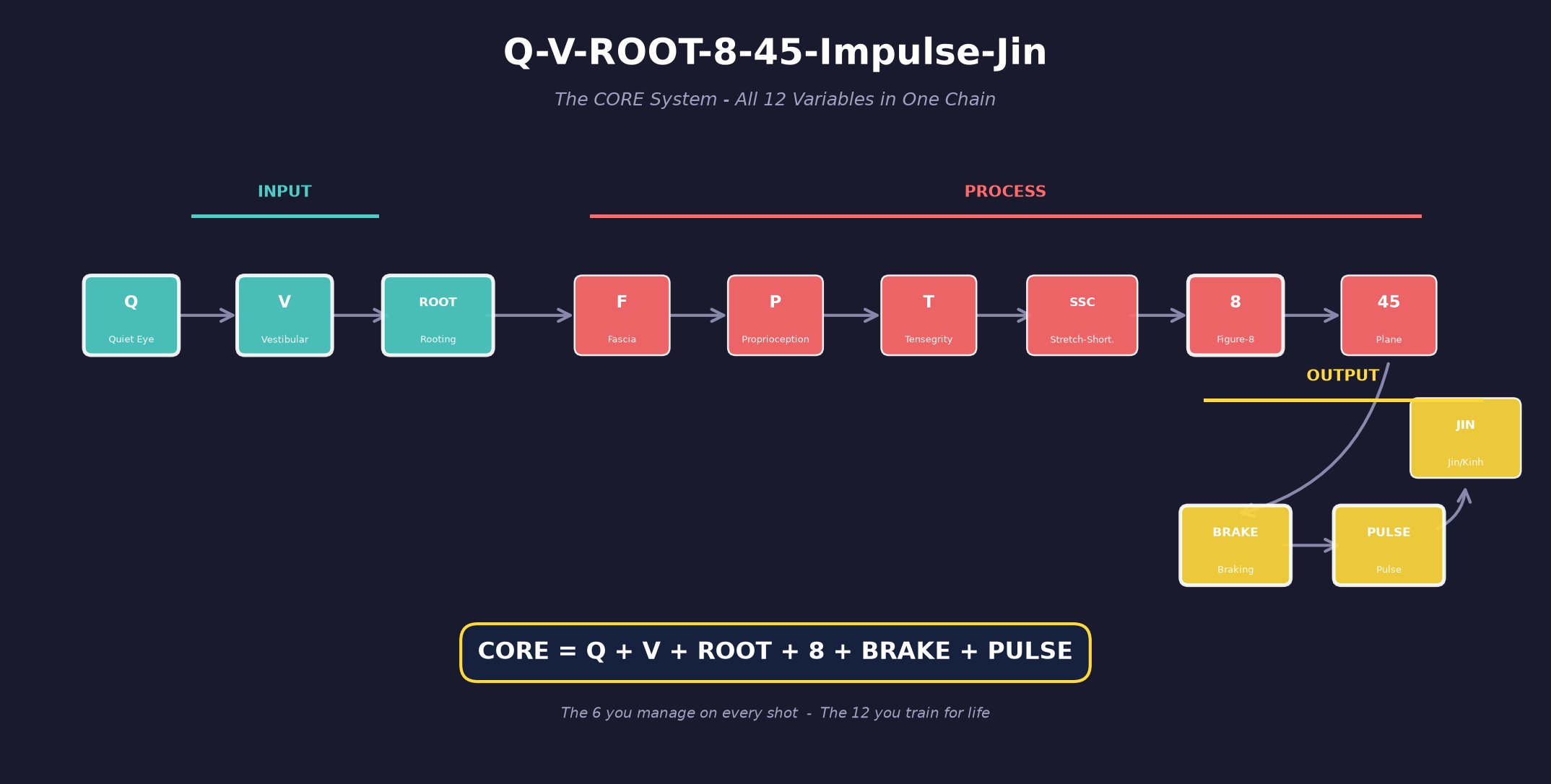
Every chapter references this map. Print it. Keep it in your bag.
Quick Diagnostic
| Symptom | Broken Link | Fix |
|---|---|---|
| Late contact, shanks | Q | Park eyes at bounce |
| Head lifts, face opens | V | Chin tucked, eyes parked |
| No power, falling back | ROOT | Screw feet, lift arch |
| Arm-only, elbow pain | F/P | Feel spiral/back line stretch |
| Muscled swing, no whip | T/SSC | Loose takeback, no pause |
| Big takeback, late | 8 | Small 8, continuous |
| Flat, no margin | 45° | Back pocket → far shoulder |
| Pushy, no penetration | BRAKE | Front leg stomp, torso stop |
| Inconsistent under pressure | JIN | Ting → Hua → Fa |
The CORE Loop (Per Shot)
1. Q: Eyes park on contact zone at opponent's contact
2. V: Head still, chin tucked through swing
3. ROOT: Back foot screws → front foot braces
4. 8: Continuous figure-8, no pause at top
5. BRAKE: Front leg/hip stops hard
6. PULSE: One-inch push through contact
7. JIN: Feel → Absorb → Release
All six in under 1 second. Automatic. Trained.
Next Steps
| Action | Link |
|---|---|
| Deep-dive each variable | Variables Index → |
| Find your broken link | Diagnostics → |
| See the visual map | Visual Library → |
| Train the chain | Drills Library → |
The chain has twelve links. Your job isn't to perfect all twelve at once. It's to find the one that's broken today — and fix it.