DD5 — Hips & Thighs
Gluteus Maximus, the 6 Deep Rotators, and Why Wider Stance Saves Your 50+ Knees
📋 DOCUMENT MAP
The hip is the largest joint in the body. The gluteus maximus is the largest muscle. The 6 deep external rotators control the femoral head in the socket. Tennis requires the hip to rotate 40–50° per stroke — the hip must be both MOBILE (to rotate) and STABLE (to protect the lumbar).
What it covers: the 3 gluteal muscles (max, med, min), the 6 deep external rotators (piriformis, obturator internus/externus, gemellus sup/inf, quadratus femoris), the femoral-acetabular joint, the wider-stance transformation, and the hip CARs (Controlled Articular Rotations) drill.
What it does NOT cover: the knee (DD6), the ankle/foot (DD7), or sciatica (DD4 — already covered).
Reading time: 30–40 minutes.
📑 TABLE OF CONTENTS
| # | English |
|---|---|
| 1 | The Hip Joint — Ball-and-Socket, Femoroacetabular |
| 2 | Gluteus Maximus — The Largest Muscle in Your Body |
| 3 | The 6 Deep External Rotators — Centering the Femoral Head |
| 4 | The Wider Stance Transformation — Quads to Glutes |
| 5 | Hip Stiffness — The Restricted Outflow Problem |
| 6 | Hip CARs — The Daily 2-Minute Mobility Drill |
| 7 | The Thigh Compartment — Quads, Hamstrings, Adductors |
Chapter 1 — The Hip Joint (Ball-and-Socket, Femoroacetabular)
The hip is a ball-and-socket joint — the head of the femur (ball) sits in the acetabulum of the pelvis (socket). Unlike the shoulder, the hip is built for STABILITY. The socket is deeper, the ligaments are tighter, the surrounding muscles are larger.
The price of stability is range of motion. The hip can flex 120°, extend 30°, abduct 45°, adduct 30°, internally rotate 45°, and externally rotate 45°. This is LESS than the shoulder (which has ~180° flexion and ~90° rotation in any direction).
Tennis needs: the modern open-stance forehand needs 40–50° hip rotation. If the hip can't rotate that much, the body finds rotation elsewhere — the lumbar spine. The lumbar disc pays.
The Hip Range of Motion Numbers
| Movement | Normal ROM | Tennis Needs | 50+ Decline | Tennis Impact |
|---|---|---|---|---|
| Flexion (knee to chest) | 120° | 90° (lunge position) | -10 to -20° | Knee can't go deep in low volleys |
| Extension (leg behind) | 30° | 20° (serve loading) | -5 to -10° | Reduced serve power |
| Abduction (leg out to side) | 45° | 30° (split-step) | -10° | Slower side shuffle |
| Adduction (leg across) | 30° | 20° (recovery) | -5° | Cross-over shuffle harder |
| External rotation (toes out) | 45° | 40° (open-stance forehand) | -10 to -15° | Forces lumbar rotation |
| Internal rotation (toes in) | 45° | 30° (closed-stance backhand) | -10 to -15° | Forces lumbar rotation |
The Femoroacetabular Impingement (FAI) Reality
FAI happens when extra bone grows along one or both surfaces of the hip joint. The ball and socket don't fit perfectly. They rub against each other during movement. Over time, the cartilage tears.
The 50+ reality: by age 50, ~30% of people have some FAI changes visible on X-ray. Most are asymptomatic. The 50+ tennis player may feel a sharp groin pinch when lunging for a low forehand. That's FAI.
The fix: avoid end-range hip flexion under load. The hip hinge (DD4) keeps you OUT of the FAI zone. The wider stance (this DD) keeps the hip in mid-range.
Source: Tennis Anatomy Ch.7 (Legs), pages 181–185. Reference for ROM: AAOS (American Academy of Orthopaedic Surgeons) standards.
Chapter 2 — Gluteus Maximus (The Largest Muscle in Your Body)
Gluteus maximus is the LARGEST muscle in the human body — up to 30 kg of potential force in a trained adult. It originates on the posterior ilium, sacrum, and coccyx. It inserts on the gluteal tuberosity of the femur AND the iliotibial tract (IT band).
The gluteus maximus has TWO parts: the SUPERFICIAL part (65% of the mass) is for powerful extension — climbing, jumping, sprinting. The DEEP part (35% of the mass) is for fine control of the hip. Most people only train the superficial. The deep part is what the 50+ player needs.
The 50+ decline: by age 50, the gluteus maximus has typically lost 10–15% of its cross-sectional area. By 70, it's 25–30%. The result: a) reduced power, b) the hip becomes "lazy" — the body finds extension from the lumbar (back pain) or the hamstrings (hamstring strain).
Gluteus Maximus — The 3 Gluteal Muscles
| Muscle | Location | Primary Action | Tennis Role | 50+ Decline |
|---|---|---|---|---|
| Gluteus maximus | Posterior hip, large | Hip extension + external rotation | Generates power in forehand, backhand, serve | 10–15% by 50, 25–30% by 70 |
| Gluteus medius | Lateral hip, upper | Hip abduction, pelvic stabilization | Keeps pelvis level during split-step and side shuffle | 10% by 50, weak lateral stability |
| Gluteus minimus | Lateral hip, deep | Hip abduction + internal rotation | Deep stabilization of the femoral head | 5–10% by 50 |
The Glute Med "Pelvis Drop" Test — A Self-Check
Stand on one leg. Have a friend watch your pelvis from behind. The free-side hip should stay level or slightly UP (because the stance-side glute med is working). If the free-side hip DROPS, your glute med is weak.
The fix: the clamshell exercise. Side-lying, knees bent 45°, feet together. Open the top knee like a clamshell. 2×15 each side, daily. After 4 weeks, retest the pelvis drop.
The 50+ tennis rule: if your glute med is weak, you will lean your torso to the side during every side shuffle. The lean compresses the L4-L5 disc laterally. Over time, scoliosis-like compensation.
Source: Anatomy_Tennis_Full_.docx, Part I (Wider stance → glutes), Part II (Deep rotators). Tennis Anatomy Ch.7 (Legs) corroborates.
Chapter 3 — The 6 Deep External Rotators (Centering the Femoral Head)
The 6 deep external rotators are the unsung heroes of hip stability. From superficial to deep: piriformis, gemellus superior, obturator internus, gemellus inferior, obturator externus, quadratus femoris. They are small. They sit deep. Their main job is NOT to produce movement. It is to CENTER the femoral head in the acetabulum.
The key insight from the user's source: "Chức năng chính là định tâm khớp, không phải tạo lực. Khi thiếu kích hoạt, chỏm xương đùi di lệch nhẹ về phía trước, kích thích thụ thể nociceptive trong bao khớp." (The main function is joint centering, not force production. When activation is lacking, the femoral head shifts slightly forward, stimulating nociceptive receptors in the joint capsule.)
The translation: the brain interprets the slight forward shift of the femoral head as PAIN. It doesn't know the cause. It just knows the hip feels "stiff." The brain then tenses the SURFACE muscles (TFL, rectus femoris) to "protect" the joint. This is the "restricted outflow" pattern — the deep stabilizers are silent, the surface muscles are overworked.
The 6 Deep External Rotators
| # | Muscle | Origin | Insertion | Action |
|---|---|---|---|---|
| 1 | Piriformis | Anterior sacrum | Greater trochanter (apex) | External rotation + abduction when flexed |
| 2 | Gemellus superior | Ischial spine | Greater trochanter (medial) | External rotation |
| 3 | Obturator internus | Inner surface of obturator membrane | Greater trochanter (medial) | External rotation |
| 4 | Gemellus inferior | Ischial tuberosity | Greater trochanter (medial) | External rotation |
| 5 | Obturator externus | Outer surface of obturator membrane | Trochanteric fossa | External rotation |
| 6 | Quadratus femoris | Ischial tuberosity | Intertrochanteric crest | External rotation + adduction |
The Restricted Outflow Pattern — How It Feels
The "stiff hip" of a 50+ player is almost NEVER a flexibility problem. It is a CONTROL problem. The deep rotators are silent. The capsule feels tight because the femoral head is in the wrong position.
The fix is NOT aggressive stretching. Aggressive stretching of a "tight hip capsule" in this state actually destabilizes the joint further. The fix is RE-ACTIVATION: controlled hip rotations (CARs) that wake up the deep rotators.
The result: after 2–3 weeks of CARs, internal rotation increases 12–18° WITHOUT static stretching. The capsule feels "more open" — not because it's been stretched, but because the femoral head is now centered. The brain re-allocates tension.
Source: Anatomy_Tennis_Full_.docx, Part II (Deep rotators, restricted outflow). Tennis Anatomy Ch.7 corroborates.
Chapter 4 — The Wider Stance Transformation (Quads to Glutes)
Opening the stance WIDER than the shoulders does 3 things simultaneously: (1) externally rotates the femur, (2) stretches the gluteus maximus + medius + TFL, (3) brings the ADDUCTORS (inner thigh) into play.
The adductors' new role: they create a CENTRIPETAL force — pulling the femoral head INTO the acetabulum. The glute medius no longer has to work alone. The wider stance DISTRIBUTES the hip centering load across 3 muscle groups. The result: a more stable, more powerful, less painful hip.
The user's source explains the moment of lifting: "Mở chân rộng hơn vai làm xương đùi xoay ngoài, kéo căng gluteus maximus, gluteus medius và tensor fasciae latae. Cùng lúc, adductor longus, brevis và magnus được kích hoạt..." (Opening the feet wider than the shoulders externally rotates the femur, stretching glute max, glute med and TFL. Simultaneously, the adductor longus, brevis, and magnus are activated.)
The Wider Stance — The 3 Muscle Groups
| Group | Action | Why It's Critical |
|---|---|---|
| Glute max + med + TFL (lateral hip) | STRETCHED by external rotation | Stretched = elastic energy stored. When you push off, the elastic recoil adds power. |
| Adductors (inner thigh) | ACTIVATED by the wider base | The adductors become hip CENTERERS, not hip addductors. This is their new role. |
| Deep external rotators (6 small muscles) | ACTIVATED to center femoral head | All 6 fire as the hip rotates externally. This is the centering pattern. |
The Moment of Lifting — A Sequence
| Phase | What Happens | Muscles |
|---|---|---|
| 1. WIDER stance | Feet shoulder-width → 1.5× shoulder-width | No contraction yet. Just position. |
| 2. Knee flex ~65° | Hip drops, knee bends | Glutes lengthen, adductors begin to fire |
| 3. Hip externally rotates | Pelvis tilts slightly forward | Glute max stretches, TFL stretches, obturator internus contracts |
| 4. Adductors activate | Inner thigh "kisses" the midline | Adductor longus + brevis + magnus contract |
| 5. Quads REDUCE tone | Quadriceps relax slightly | This is the moment of "lift" — the body shifts load from knee to hip |
| 6. Glute max becomes prime mover | Hip extension ready | The 30 kg of potential force is now loaded |
The Net Effect — What Changes
The "moment of lifting" transfers load from the quadriceps to the gluteus maximus.
Quadriceps (front of thigh): small cross-section in 50+ player, prone to tendonitis, cannot generate 30 kg of force safely.
Gluteus maximus (back of hip): largest muscle, prime mover, designed for 30 kg of force.
The result: lower pressure on the patellar tendon (knee), lower pressure on the L4-L5 disc (back), higher force production. This is the "wide stance" magic.
Source: Anatomy_Tennis_Full_.docx, Part I (Wider stance transformation).
Chapter 5 — Hip Stiffness (The Restricted Outflow Problem)
The most common "hip problem" in a 50+ tennis player is NOT arthritis, NOT a labral tear, NOT a tight IT band. It is restricted outflow. The deep rotators are silent. The capsule feels tight. The brain allocates tension to the surface muscles. The hip FEELS stiff, but the actual joint ROM is fine.
The 4 telltale signs of restricted outflow (NOT arthritis):
-
Stiffness is WORSE in the morning, IMPROVES with movement
-
Stiffness is ASYMMETRIC (one hip worse than the other)
-
No actual pain AT REST
-
Movement patterns show "lazy" hip — body finds alternative rotation
The Restricted Outflow Fix — 3 Layers
| Layer | Action | Frequency | Time to Effect |
|---|---|---|---|
| 1. Re-activation | Hip CARs (next chapter), 2 min/day | Daily | 2–3 weeks for 12–18° IR gain |
| 2. Centering | Single-leg balance with knee drives, 2×10 each side | 3×/week | 4–6 weeks for pelvic stability |
| 3. Integration | Side lunges with control, 2×8 each side | 2×/week | 6–8 weeks for tennis-specific pattern |
The 50+ Hip Truth — Don't Stretch, Activate
Friend, the worst thing you can do for a "stiff 50+ hip" is static stretching. It destabilizes the joint further. The capsule doesn't need length — the femoral head needs to be CENTERED. The fix is activation, not stretching.
The test: lie on your back. Bend one knee to chest. The other leg stays flat. If the bent knee can reach the chest with the OPPOSITE leg staying flat, your hip flexors are fine. The "stiffness" is in the CENTRATORS, not the flexors.
Source: Anatomy_Tennis_Full_.docx, Part II (Restricted outflow).
Chapter 6 — Hip CARs (The Daily 2-Minute Mobility Drill)
CARs = Controlled Articular Rotations. A CAR is a slow, deliberate rotation of a joint through its FULL range of motion, with TENSION applied at the end range to "teach" the nervous system that the new range is safe.
Why CARs work for the hip: the hip's stiffness is often a CONTROL problem. The capsule has range, but the brain doesn't trust it. CARs take the joint to the end range, hold tension there for 2–3 seconds, and return. The brain learns: this is safe. The brain releases its protective tension. Range increases.
The Hip CAR Protocol — Step by Step
| Step | Position | Movement | Tension |
|---|---|---|---|
| 1. Start | On hands and knees (quadruped) | Lift one leg, knee at 90° | 20% effort |
| 2. Rotate OUT (away from body) | Knee traces a circle outward | Slow, 5 sec | 50% effort at end range |
| 3. Hold | At maximum external rotation | Hold 2–3 seconds | 70% effort |
| 4. Rotate IN (across body) | Knee traces a circle inward | Slow, 5 sec | 50% effort at end range |
| 5. Hold | At maximum internal rotation | Hold 2–3 seconds | 70% effort |
| 6. Repeat | Same side | 3 reps each side | Daily |
The 5 Rules of Hip CARs
| # | Rule | Why |
|---|---|---|
| 1 | Go SLOW. 5 seconds per direction. | Slow = control. Fast = momentum (cheating). |
| 2 | Maximum EFFORT at end range. | Tension at end range teaches the brain the new range is safe. |
| 3 | NO pain. Discomfort = OK. Pain = STOP. | Pain means the brain is NOT ready for that range yet. |
| 4 | Same speed BOTH directions. | Symmetric loading. |
| 5 | DAILY. 2 minutes total. | Consistency beats intensity. |
The Tennis Application — 4 Times to Use Hip CARs
| When | Why |
|---|---|
| Morning | Wake up the hip centring pattern. Counter overnight stiffness. |
| Before play | Pre-activate the deep rotators. Reduce the "lunge goes wrong" risk. |
| Between sets | Re-set the hip after repeated forehand rotations. |
| After play | Reset. Prevent next-day stiffness. |
Source: Anatomy_Tennis_Full_.docx, Part II (Re-activation). Reference: standard CARs protocol from Dr. Andreo Spina's Functional Range Conditioning.
Chapter 7 — The Thigh Compartment (Quads, Hamstrings, Adductors)
The thigh has 3 compartments separated by fascia. The ANTERIOR compartment (front) holds the quadriceps. The POSTERIOR compartment (back) holds the hamstrings. The MEDIAL compartment (inner) holds the adductors. Each has a different role. Tennis needs all 3 to work in coordination.
The 3 Thigh Compartments
| Compartment | Main Muscles | Primary Action | Tennis Role | Injury Risk if Imbalanced |
|---|---|---|---|---|
| Anterior (quads) | Rectus femoris, vastus lateralis, medialis, intermedius | Knee extension + hip flexion (rectus femoris only) | Push-off, lunges, knee stability | Patellar tendonitis |
| Posterior (hamstrings) | Biceps femoris, semitendinosus, semimembranosus | Knee flexion + hip extension | Deceleration, lunges, sprinting | Hamstring strain, "tweaked" hamstring |
| Medial (adductors) | Adductor longus, brevis, magnus, gracilis, pectineus | Hip adduction + some flexion | Hip centering in wider stance, side shuffling | Groin pull, adductor strain |
The Quadriceps — The 4 Muscles
| Muscle | Origin | Insertion | Special |
|---|---|---|---|
| Rectus femoris | Anterior inferior iliac spine (AIIS) | Patella + tibial tuberosity via patellar tendon | The ONLY quad that crosses BOTH the hip and knee. Can be tight if hips are overworked. |
| Vastus lateralis | Lateral femur (linea aspera) | Patella + tibial tuberosity | The largest of the 4. Most commonly strained quad. |
| Vastus medialis | Medial femur (linea aspera) | Patella + tibial tuberosity | The VMO (vastus medialis oblique) is critical for the last 20° of knee extension. |
| Vastus intermedius | Anterior femur | Patella + tibial tuberosity | The deepest. Under rectus femoris. |
The Hamstrings — The 3 Muscles
| Muscle | Origin | Insertion | Special |
|---|---|---|---|
| Biceps femoris | Ischial tuberosity + linea aspera | Head of fibula | The lateral hamstring. Knee flexion + external rotation. |
| Semitendinosus | Ischial tuberosity | Medial tibia (pes anserinus) | The "half-tendon." Knee flexion + internal rotation + hip extension. |
| Semimembranosus | Ischial tuberosity | Posteromedial tibia | The "half-membrane." Deepest hamstring. Main knee flexion power. |
The Adductors — The 5 Muscles
| Muscle | Origin | Insertion | Tennis Role |
|---|---|---|---|
| Adductor longus | Pubis | Middle linea aspera | The most commonly strained adductor (groin pull). |
| Adductor brevis | Pubis | Upper linea aspera | Deep to longus. |
| Adductor magnus | Ischiopubic ramus + ischial tuberosity | Linea aspera + adductor tubercle | The largest adductor. Hip centering in wider stance. |
| Gracilis | Pubis | Medial tibia (pes anserinus) | Hip adduction + knee flexion. Longest adductor. |
| Pectineus | Pubis | Pectineal line of femur | Hip flexion + adduction. |
The Tennis Thigh Truth — All 3 Compartments Must Coordinate
A forehand in wider stance requires: quads (push off), glute max (hip extension), adductors (centering), hamstrings (deceleration). If one is weak or tight, the others compensate. Compensation = injury.
The fix: balance training. Don't just do quad exercises (squats, leg press). Do hip-dominant exercises (hip hinge, single-leg deadlift). Do adductor work (side lunge, Copenhagen plank). Do hamstring eccentric work (Nordic curl, Romanian deadlift).
Source: Tennis Anatomy Ch.7 (Legs), pages 181–195.
📋 DD5 CARD — Printable
"Hip stiffness" in 50+ players is a CONTROL problem, not a flexibility problem. The 6 deep external rotators center the femoral head. When they go silent, the capsule feels tight. The fix is ACTIVATION (Hip CARs), not stretching.
- Gluteus maximus = largest muscle, ~30 kg potential
- 6 deep external rotators center the femoral head
- Hip needs 40–50° rotation for open-stance forehand
- Glute max declines 10–15% by 50, 25–30% by 70
- Wider stance transfers load: quads → gluteus max
- Hip CARs gain 12–18° internal rotation in 2–3 weeks
Aggressively stretching a "stiff hip" with the Pigeon pose for 5 minutes. The deep rotators are silent; aggressive stretching destabilizes the joint further. Use Hip CARs to RE-ACTIVATE, not stretch.
- Hip CARs: 3 reps each side, 2 min total, daily (5 sec out, hold 2 sec, 5 sec in, hold 2 sec)
- Wider stance transformation: practice 90/90 hip CARs + side lunges 2×/week
- Clamshell: 2×15 each side, daily for glute med
"Activate, don't stretch."
🖼️ ILLUSTRATIONS
26 images available in Anatomy_Lab/images/DD5_hips_thighs/ (13 from Anatomy_Tennis_Full_.docx + 13 from Tennis Anatomy PDF Ch.7).
Figure 9–13 — Forearm/Thumb Integration (Reference to DD3)
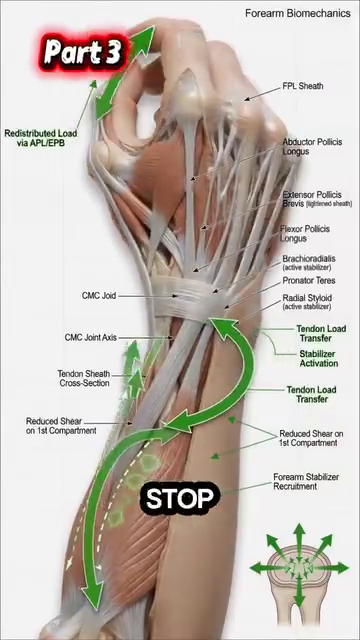 through
 img13.png
Figures 14–26 — Tennis Anatomy Ch.7 (Legs)
| Figure | Description | Image |
|---|---|---|
| 14 | Muscles of the front of the leg | DD5_hips_thighs_01.png (Tennis Anatomy Fig.7.1) |
| 15 | Muscles of the back of the leg | DD5_hips_thighs_02.png (Fig.7.2) |
| 16 | Lower leg: back and front | DD5_hips_thighs_03.png (Fig.7.3) |
| 17 | Squat — start position | DD5_hips_thighs_04.png (Fig.7.4) |
| 18 | Squat — bottom position | DD5_hips_thighs_05.png (Fig.7.5) |
| 19 | Squat — knees over second toe alignment | DD5_hips_thighs_06.png (Fig.7.6) |
| 20 | Front squat variation | DD5_hips_thighs_07.png (Fig.7.7) |
| 21 | Romanian deadlift — start | DD5_hips_thighs_08.png (Fig.7.8) |
| 22 | Romanian deadlift — bottom | DD5_hips_thighs_09.png (Fig.7.9) |
| 23 | Hamstring buck — setup | DD5_hips_thighs_10.png (Fig.7.10) |
| 24 | Hamstring buck — extension | DD5_hips_thighs_11.png (Fig.7.11) |
| 25 | Gluteal muscles detail | DD5_hips_thighs_12.png |
| 26 | Hip external rotators anatomical drawing | DD5_hips_thighs_13.png |
All image filenames verified to exist in Anatomy_Lab/images/DD5_hips_thighs/.
🔗 CROSS-REFERENCES
| Topic in DD5 | See Also |
|---|---|
| Hip rotation for forehand | DD1 Player in Motion — the 6 critical angles at contact |
| Hip hinge (chest up, hips back) | DD4 Trunk & Spine — the spine-protecting hinge |
| Piriformis and sciatic nerve | DD4 Trunk & Spine — the piriformis trap, double crush |
| Glute activation for serve | DD2 Shoulders — kinetic chain starts from glute max |
| Knee loads in wider stance | DD6 Knees — patellar tendon, ACL shear, valgus |
| Thigh compartment balance | DD1 Player in Motion — big muscles first, small muscles last |
| Hip stiffness in 50+ | DD8 Control System — proprioception decline, motor recruitment |
📚 SOURCES
| Source | Type | What It Contributed |
|---|---|---|
Human anatomy/Anatomy_Tennis_Full_.docx |
User's Vietnamese notes (13 images) | Wider stance transformation, adductor activation, deep rotators, restricted outflow pattern, capsule reopening after CARs |
Tennis Knowledge/7.Tennis Books in pdf/Tennis Anatomy ( PDFDrive ).pdf Ch.7 (Legs) |
Reference textbook | Hip anatomy, gluteal muscles, quadriceps 4 muscles, hamstrings 3 muscles, adductors 5 muscles, squat and Romanian deadlift exercises |
| Functional Range Conditioning (FRC) literature | Reference for Hip CARs protocol | Controlled Articular Rotations concept, tension at end range, daily 2-min drill |
End of DD5 — Hips & Thighs
Next: DD6 — Knees (Patella, Meniscus, ACL, the 50–80° Loading Rule)